Age
NOT TOO OLD AT 48
PRIVATE EDWARD MAXWELL DOCKRILL
Edward Dockrill's brother, Harold, chose his inscription. Although Edward was a married man and the father of three children it appears that he and his wife were estranged.
Dockrill volunteered on 3 September 1914. He was 44, a painter living with Harold and his wife. A few days earlier the embargo on news from the front had been lifted and the public learnt for the first time that the British army was in retreat having suffered huge casualties. As a result, the numbers of men volunteering to join the army went up hugely and the third of September 1914 saw 333,204 men enlist, the highest daily total of the whole war. The upper age limit for recruits at that time was 38. However, Edward Dockrill obviously felt that at 44 he was not too old to go. He must have feared that he would be considered too old though because he told the recruiting officer that he was 34.
Dockrill served with the 8th Battalion The Loyal North Lancashire Regiment and went to France on 22 September 1915. He was wounded in action on 21 May 1916 when the regiment fought a desperate action at Broadmarsh Crater on Vimy Ridge. Dockrill died in a Casualty Clearing Station eight days later from 'gsw' wounds, which meant either gun shot or shrapnel wounds, that had penetrated his right lung and spine.
GEORGE, A TARNAGULLA LAD
CELEBRATED HIS 16TH BIRTHDAY
AT ANZAC IN 1915
PRIVATE GEORGE DUNCAN RADNELL MM
TO WHOM IT MAY CONCERN
This is to certify that I the undersigned, father of George Duncan Radnell of Tarnagulla whose age is eighteen years and five months, hereby grant my consent to his enlistment as a unit of the Expeditionary Forces now being trained at Broadmeadows, Victoria.
Wm J Randall
Dated at Tarnagulla this 19th day of Jan. 1915
At the beginning of March 1915, Radnell embarked from Australia with the 14th Australian Infantry for Egypt. A month later, on 14 April, the battalion set sail from Alexandria and on 26 April went ashore at 'Kaba Tepe', Anzac Cove. On 21 August Randell went sick with enteritis - dysentery - and was hospitalized in England, only returning to his unit at the end of November, just in time for the evacuation from the peninsula.
The battalion transferred to France and on 28 August 1916 Radnell was wounded in the left arm, 'shell wound'. Hospitalized again in England, he returned to the front at the beginning of January 1917. Wounded and hospitalized in England again in September, he returned to France in January 1918.
In September 1917, Radnell was awarded a Military Medal:
"During the operations near Zonnebeke on 26 September 1917, Pte Radnell displayed great courage and initiative by getting together a party of 7 men and rushing an enemy post in which were 10 Germans, killing four and taking the remainder prisoners."
On 31 May Radnell was wounded for a third time, this time in the shoulder, face and legs. He died in a Casualty Clearing Station the next day.
Now look at his inscription: "George, a Tarnagulla lad, celebrated his 16th birthday at Anzac in 1915". George was not 18 and five months when he enlisted, as his father must have known only too well. He was 15. But he wanted to be with his elder brother and cousins who had all gone to fight. His brother, Charles Victor Radnell, was killed on 27 February 1917, and one of his cousins, Joseph Charles Radnell, on 4 August 1916.
PAST THE MILITARY AGE
HE RESPONDED
TO THE MOTHER COUNTRY'S CALL
REGIMENTAL SERJEANT MAJOR STEWART GODFREY
Stewart Godfrey was a former soldier who had fought in the South African War. Born in Brixton, London, he enlisted in Canada on 24 August 1914, giving his civilian occupation as 'clerk'. He was 44. He served with Princess Patricia's Canadian Light Infantry (Eastern Ontario Regiment), which departed for England on 22 September 1914, landed on 25 October and after four months intensive training went to France in February 1915. His rank on departure from Canada was Company Quartermaster Sergeant. This means that he was not "past the military age" as his brother put on his inscription.
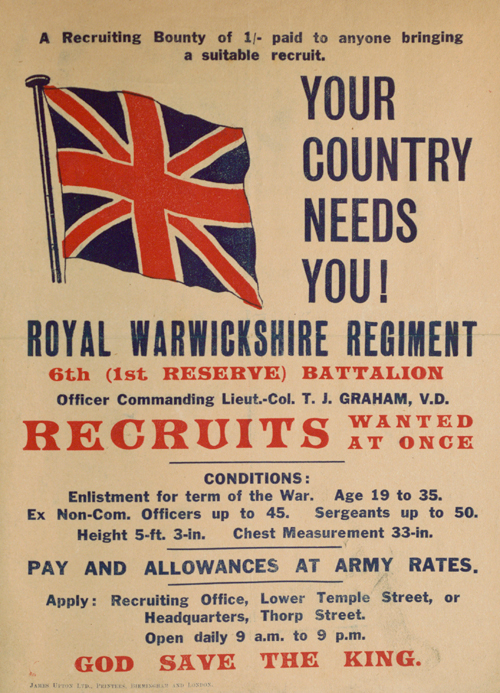
The original call up was for men between the ages of 19 and 35 but this recruiting poster shows that for former non-commissioned officers the upper age limit was 45, and for sergeants 50.
The regiment was involved in the fighting at St Julien in April 1915, when the Germans used gas for the first time, and at Festubert and Ginchy. It spent the winter of 1915 in the trenches near Ploegsteert and took part in the battle of St Eloi Craters between 27 March and 16 April 1916. Godfrey survived all this and then was killed on 18 April when, as reported in the War Diary, the Battalion Headquarters at Half Way House was 'shelled with 4.2" R.S.M. [Godfrey S. 1589] killed by direct hit on dugout'.
Although Godfrey had been born in Britain, it was not necessary for a Canadian to have been born there to feel the pull of the mother country. Many Canadian citizens simply looked on themselves as those north Americans who had remained loyal to the British crown - they were British, and more than 600,000 of them were prepared to volunteer to fight for their country.
AGED 17 YEARS
R.I.P.
PRIVATE HUGH AUBREY COCKERTON
"Sep.10 [To Mrs Sorley]
I am writing on behalf of a gallant youngster in my company, and I believe known to you. His age is I suspect not more than 17 now, and he has been out some while, and though he is an excellent sturdy youngster his nerves are obviously not strong enough for the racket of this existence, which is now-a-days more violent than usual. The point therefore is that his parents or guardian can write and claim him back, by producing a birth certificate, only he himself is apparently entirely in the dark as to who his guardian is - he has of course no parents. So I wonder if you could make representations in the right quarter and collect a copy of his birth certificate and get the thing done: he isn't a fellow I want to lose, but I feel it partakes rather of cruelty to animals to keep him out here just at present."
[Letter from Captain Arthur Innes Adam, Cambridgeshire Regiment, who was killed six days later (16.9.16), see previous epitaph]
The 'gallant youngster', Private Hugh Aubrey Cockerton, died of gas poisoning on 2 October before anything could be done to send him home. His father had died in 1907 and although his mother was still alive, she died four months later in February 1917.
A Miss Cockerton chose his inscription, perhaps one of his several sisters, making sure that from now on there should be no mistake about his age. An elder brother, John Richard William Cockerton, was killed in action on 9 November 1914 and is commemorated on the Le Touret Memorial.
KILLED IN ACTION
IN HIS TWENTIETH YEAR
LIEUTENANT EDWARD WYNDHAM TENNANT
A simple inscription, which speaks volumes about the soldier's parents. Edward Wyndham Tennant celebrated his nineteenth birthday on 1 July 1916, barely two months before he was killed. He had been at the front since August 1915, in other words, since he was just eighteen. Army policy decreed that no soldier should be allowed to serve overseas until he was nineteen, unless he had his parents' permission. Lady Glenconner, in her memoir of her son, says that, "On account of his efficiency as an officer he had the honour of being especially selected to go out to France, although Brigade Orders had just been issued that no one should leave England before nineteen years of age". Edward's parents would have had to have their permission too, just as John Kipling and Yvo Charteris's parents had done, with similar tragic consequences.
Edward Tennant left Winchester in the summer of 1914, a year early, with the intention of spending some time in Germany studying the language prior to a career in the Diplomatic Service. This meant he was free to join up the moment war broke out, when he was only just seventeen. Many of the first volunteers were similarly youthful and many of their parents felt angry with the Government because it had delayed introducing conscription until January 1916. This delay meant that it was their young sons who were bearing the brunt of the fighting rather than older men. From the inscription they chose, it looks as though the Glenconners felt this way too.
As socially prominent people, Lord and Lady Glenconner received many, many letters of condolence. All of them contained quotable extracts, any of which could have formed a headstone inscription, but they wanted to make their point. However, they did quote from a letter on their son's memorials in Salisbury Cathedral and in the churches near their family homes in Wilsford and Traquair. The letter came from a private soldier in his platoon - "When danger was greatest his smile was loveliest". The full extract reads:
"When things were at their worst he would pass up and down the trench cheering the men, and it was a treat to see his face always smiling. When danger was greatest his smile was loveliest. All was ready to go anywhere with him, although he was so young".
Edward's final letter to his mother was published by Laurence Weaver in his collection, 'War Letters of Fallen Englishmen'. Brief extracts illustrate his mind:
"tomorrow we go over the top ... I am full of hope and trust, and pray that I may be worthy of my fighting ancestors ... I feel rather like saying 'If it be possible let this cup pass from me,' but the triumphant finish 'nevertheless not what I will but what Thou willest,' steels my heart and sends me into this battle with a heart of triple bronze ... Brutus' farewell to Cassius sounds in my heart: 'If not farewell; and if we meet again, we shall smile',"
Edward was killed by a sniper two days later.
ALSO
CAVALRY MACHINE GUNNER
IN FRANCE IN 1915
AGED 15 YEARS
SECOND LIEUTENANT GEORGE BENJAMIN JOHNSTONE STODDART
George Benjamin Johnstone Stoddart was 18 and nine months when he died on 4 March 1918. Born on 21 July 1899 he was therefore just 15 when he enlisted on 1 September 1914, and still 15 when he went to France as a cavalry machine gunner with 6th Dragoon Guards on 23 May 1915, thus qualifying for a 1915 Star. His medal card indicates that he was discharged on 15 January 1915. However, it doesn't look as though he was discharged because he was discovered to be underage but because he received a commission in the Royal Field Artillery.
The 25 January 1918 edition of 'Flight' lists Stoddart's name as among those being confirmed in the rank of Flying Officer, and then three months later among those who have been killed. In the information his mother gave to the War Graves Commission, she says he was killed in action. The announcement of his death in The Times on 16 April says "accidentally killed whilst flying abroad".
Strangely, little has been written about George Stoddart who sounds to have been quite a character. Born George Benjamin Johnstone, the name Stoddart was added after his mother remarried in 1909. Johnstone's father died in 1903 in the London County Asylum. His widow, Rosa, went to work in the Bethlem Royal Hospital Lunatic Asylum. Here she met and married the psychiatrist Dr William Henry Butters Stoddart. In 1911, George, his mother and his two sisters were all living with their step-father at the asylum.
O SO YOUNG & YET SO BRAVE
PRIVATE JAMES RATHBAND
Private James Rathband was 16 when he was killed in action at Ginchy on 9 September 1916.The son of Mr and Mrs J Rathband of Dublin, his inscription was signed for by Miss A Rathband, 12E Abbey Cottages, Upper Abbey Street, Dublin. A street of very modest cottages now pulled down.
Where did the inscription come from? Did Miss A Rathband read it somewhere? Put the words into Google and they come up in at least three nineteenth-century romantic novels to describe young heroes whose deeds belied their years - just as James Rathband's must have done.

AGE 17 YRS. 1 MON. 10 DYS.
IN THY KEEPING
OUR FATHER
GUNNER HAROLD MAITLAND GORING
On Harold Maitland Goring's attestation papers his date of birth is clearly given as 9 September 1898, but he was lying, Harold Goring was born on 9 September 1900. This must be why his mother was so specific on his headstone inscription stating his age as exactly 17 years, one month and 10 days. This made him 16 when he enlisted in January 1917, and still 16 went he went overseas on 23 March 1917.
He served with the 4th Division Ammunition Column of the Canadian Field Artillery and was killed outright by a German bomb dropped on the parade ground just as the men had been dismissed.
DEAR HAPPY BOY
SECOND LIEUTENANT JAMES DOUGLAS HODDING
This "dear happy boy", a second lieutenant in the Royal Fusilers, was born in March 1899, gazetted on 28 May 1915 and therefore was only 17 when he died of wounds at the Casualty Clearing Station in Heilly on 10 July 1916. He was too young to be on active service and too young to be at the front. It appears that he was wounded when, behind the lines, a shell set off a grenade dump. He died at the Casualty Clearing Station in Heilly the next day.
Hodding was born in Portsea, Hampshire. His father and grandfather served in the Indian Army. A pupil at Wimbledon College at the time of the 1911 census, the family subsequently emigrated to Duncan, Vancouver Island, British Colombia.
27 YEARS
BELOVED SON OF
C. AND E. GREEN
BURRA, SOUTH AUSTRALIA
LANCE CORPORAL HAROLD TEMPERLEY GREEN
"Green was badly wounded - shot through the head and fell beside me. After being bandaged he was carried to the Dressing Station and on their return the bearers told me he was dead."
Private J. Davy to the Australian Red Cross Wounded and Missing Enquiry Bureau 14.10.1918
"I saw above named on a stretcher just after he had been wounded (about 9 pm) at Merris. I spoke to him, S/B Wright (No 452) of same Battalion) bandaged him up. The face (mouth portion) had been blown in."
L/Cpl J McFarlane to the Australian Red Cross Wounded and Missing Enquiry Bureau 21.10.1918
"I saw Pte. (sic) J Green fatally wounded by shell while holding the lines in front of Merris on the 30th July 1918 ... The ground was held."
L/Cpl W Bartch 14.10.1918
"3333 Pte. (sic) Green H.T. 10th Bn. died of wounds at our Dressing Station Borre at 5.45.a.m. on 30/7/18. Wound received was S.W.skull compound fracture. He was unconcious on admission and died soon after. Burial took place at Military Cemetery Borre same day."/ Signed by Major, Acting CO 1st Australian Field Ambulance, [signature unreadable]
Harold Green's elder brother Edward Owen Green "died of accidental injuries" near Tripoli in Syria, according to his father when he filled in the circular for the Roll of Honour of Australia. Edward Green is buried in Bierut War Cemetery in the Lebanese Republic. His inscription, which was signed for by his father rather than by his mother as Harold's was, reads:
Beloved son of
C. and E. Green
Of World's End
South Australia.
HE LOVED DUTY
AND HE FEARED NOT DEATH
CAPTAIN BRYAN DOLPHIN PAULL
Bryan Paull left school, Charterhouse, in 1914 and enlisted immediately. He was gazetted Lieutenant in February 1915 and promoted Captain two months later. He was just 18 and one month, surely one of the youngest Captains of the war. He was 19 and 9 months when he was killed leading an attack on the German trenches in September 1916. His promotion indicates that he was a natural leader; his inscription, confirmed by his mother, that he was a brave and serious minded boy.
GREAT GRAND NEPHEW
TO MICHAEL DWYER
THE FAMOUS WICKLOW CHIEFTAIN
PRIVATE GERALD PATRICK HEAVEY
One hundred and twelve years after Michael Dwyer arrived in Australia having been deported from Ireland by the British as a nationalist rebel, his seventeen-year-old, Australian, great-grand nephew, Gerald Heavey, was killed in France fighting for the British. A hundred and twelve years is time enough to forget old scores but his parents made a point of recording the connection on their son's headstone. Yet all the evidence points to their son being keen to fight. Australia did not have conscription so he was a volunteer. However, at the age of 17 he was too young to have joined up, too young to be serving in France let alone too young to die.
HE WOULD INSIST
ON SERVING HIS COUNTRY
DRIVER WILFRED THOMAS WELLING
The point of this inscription, composed by Wilfred Welling's parents, was that Welling was only 16 when he died, far too young to have even joined up let alone to have been serving oversea. You were meant to be 18 before you could enlist and 19 before you could go abroad - unless you had your parents' signed permission. But you can see what his parents said, "He would insist on serving his country".
How could this be allowed? Richard Emden's Boy Soldiers of the Great War shows that there are no simple answers. If you were big enough and strong enough to look 18 the Army took your word for it. That is until the National Registration Act was passed in July 1915. This made it compulsary for all men between the ages of 15 and 65 to complete a form on National Registration Day, 15 August 1915, giving their name, age, nationality, marital status and employment details. After this date you had to produce your registration card when you went to enlist making it more difficult - but not impossible - for under-age boys to get through. For all the disgust we might feel today at the army accepting under-age boys, for all the stories of recruiting sergeants encouraging boys to lie about their age, it was the case that some boys really wanted to be part of the action and their parents couldn't or wouldn't stop them.
Wilfred Wellings served with the 40th Division Ammunition Column Royal Field Artillery. According to the information given by his parents to the War Graves Commission, he died of concussion. He was buried in one of the cemeteries in St Omer, a large hospital centre behind the lines.
OUR RON
AGED 18½ YEARS
HE FOUGHT THE GOOD FIGHT
PRIVATE RONALD CARPENTER BAND
"Our Ron", one can still sense his parent's heartbreak, their son, just eighteen and a half years old, dead. Official government policy was that you had to be 18 to sign up and 19 to serve abroad, unless you had your parent's written permission - or the written permission of one parent, although you could of course have simply lied about your age. The fact that Mr and Mrs Band give their son's exact age, and that they complete the inscripton with a reference to the hymn 'Fight the Good Fight', all incline me to think that they had given their permission.
DIED ON HIS 20TH BIRTHDAY
FAULTLESS BEFORE THEE
WITH EXCEEDING JOY
SECOND LIEUTENANT PHILIP HAMILTON SULIVAN
The quotation comes from Jude 1.24, "Now unto Him that is able to keep you from falling, and to present you faultless before the presence of His glory with exceeding joy"