Book
MAY NO WANTON HAND
EVER DISTURB HIS REMAINS
PRIVATE EVAN FREDERICK JONES
There is more to this inscription than meets the eye. What sounds like a simple injunction to never disturb Jones' body is in fact a famous inscription - if you know your American literature. It comes from the grave of Natty Bumppo, the hero of James Fenimore Cooper's five American frontier novels known collectively as The Leatherstocking Tales.
Natty Bumppo, a white boy raised by Indians, is a 'good' white man, a frontiersman who helps people in trouble. At the end of 'The Prairie' (1827), Bumppo dies in the fulness of time and the Indians pay him this tribute:
"A valiant, a just, and a wise warrior has gone on the path, which will lead him to the blessed grounds of his people."
Bumppo was buried "beneath the shade of some noble oaks" and his grave "has been carefully watched to the present hour by the Pawnees of the Loop, and is often shown to the traveller and the trader as a spot where a just whiteman sleeps."
Later, a "stone was placed at its head, with the simple inscription, which the trapper had himself requested [...] "May no wanton hand ever disturb his remains!" This is the last line of the novel.
By choosing this inscription, Evan Jones' father, William Jones, associated his son with "a valiant, a just, and a wise warrior". Jones served with the first Battalion the King's Shropshire Light Infantry and was killed in action on 8 October 1918 when the battalion attacked at 5.10 am under a creeping barrage on the opening day of the Battle of Cambrai. The battalion war diary reported a 'great numbers of prisoners soon began to come back, which meant attack was going well'. The attack did go well but nevertheless the battalion suffered over 100 casualties killed and wounded.
Ten days before Evan Jones died his brother, Albert Rees Jones serving with the 2nd/4th King's Own Yorkshire Light Infantry, was killed in action at the Canal du Nord. However, William Jones had no opportunity to choose an inscription for his younger son because Albert's body was never found. He is commemorated on the Vis-en-Artois memorial to the missing.
William Jones was a farmer at Pantau Farm, Llanddew, Breconshire. Evan and Albert were two of his nine children all of whom worked with him on the farm. His wife, Mary died in 1912, his daughter Sarah in 1915 and two of his sons in 1918.
"HE HATH TURNED
THE SHADOW OF DEATH
INTO THE MOURNING"
LIEUTENANT GEOFFREY ROBERT FOLEY
Geoffrey Foley was an engineer's apprentice when he enlisted in September 1914. By the following August he was in France with his regiment, the Somerset Light Infantry. A former public school boy, it wasn't long before he was selected for a commission, which was gazetted in December 1915.
On 13 March 1916, he was severely wounded when he was shot in the thigh by a sniper. On recovery he returned to the front but in October was hospitalised at Etaples with shell shock. Returning again to the front he was leading his men in an attack at Roeux Wood on 3 May when in was severely wounded again in the left leg, this time by a machine gun. Taken to a Casualty Clearing Station, his leg had to be amputated. At first he appeared to be recovering but his conditioned worsened and he died.
Foley's father chose his inscription from John Bunyan's Pilgrim's Progress. Christian has braved the Valley of the Shadow of Death, negotiating a narrow path in pitch darkness with a dangerous quagmire on one side and a deep ditch on the other. He has been surrounded by flame and smoke and hideous noises, seeing and hearing frightful sights and sounds - a continual howling and yelling as of a people in unutterable misery - until he reaches the other side and the day breaks, at which point Christian says: "He hath turned the shadow of death into the morning".
Christian's Valley of the Shadow of Death sounds very like the Western Front; Robert Foley had been there too.
"'TISN'T LIFE THAT MATTERS
'TIS THE COURAGE
YOU BRING TO IT"
WALPOLE
SECOND LIEUTENANT JOHN FRANCIS ASHLEY HALL
"'Tisn't life that matters! 'Tis the courage you bring to it" ... this from old Frosted Moses in the warm corner by the door." ... "A little boy, Peter Westcott, heard what old Frosted Moses had said, and turned it over in his mind."
FORTITUDE Hugh Walpole 1913
John Francis Ashley Hall's father chose his inscription, taking it from the opening words of Hugh Walpole's 1913 novel, Fortitude. The main character is Peter Westcott whose life is tested by one personal catastrophe after another, in the face of which he shows great personal fortitude.
Hall originally served with the East Yorkshire Regiment, being commissioned from the Royal Military College, Sandhurst in August 1916. However, at some point he transferred to the Royal Air Force where he served with 21 Squadron, a strategic reconnaissance and bombing squadron.
I don't know how Hall met his death on 14 August 1918 but he's buried beside a fellow member of 21 Squadron, Second Lieutenant Hugh William Savage, who also died on 14 August. This suggests to me that they were the observer and pilot of one of 21 Squadron's RE-8s. Savage's record says that he was killed in action rather than being accidentally killed. I would imagine that this was Hall's fate too.
"BUT HE LIVES. SOMEHOW
HE LIVES. AND WE WHO
KNEW HIM, DO NOT FORGET"
CAPTAIN HERBERT BEN DREWETT
These words come from The Beloved Captain by Donald Hankey, the gentleman soldier and author who wrote for The Spectator under the pseudonym A Student in Arms. The beloved captain was a real man, Ronald Montague Hardy, under whom Hankey had at one time served. An old Etonian, Hardy was a quiet, thoughtful, caring man whom his men adored:
"There was not one of us but would gladly have died for him. We longed for the chance to show him that. We weren't heroes. We never dreamed about the V.C. But to save the captain we would have earned it ten times over, and never cared a button whether we got it or not. We never got the chance, worse luck."
The captain was killed when a shell landed in the trench on the exact spot where he was trying to dig out some of his men who had been buried by a previous shell. The story concludes:
"But he lives. Somehow he lives. And we who knew him do not forget. We feel his eyes on us. We work for that wonderful smile of his. There are not many of the old lot left now; but I think that those who went West have seen him. When they got to the other side I think they were met ... Anyway, in that faith let me die, if death should come my way; and so, I think, shall I die content."
Captain Ronald Hardy was killed at Hooge on 23 July 1915. The Beloved Captain was published in The Spectator on 15 January 1916. Donald Hankey was killed in action on 12 October 1916.
Captain Herbert Drewett was 33 when he joined the Inns of Court OTC in November 1915, and 34 when he received his commission in the 4th Battalion East Yorkshire Regiment in November 1916. According to the battalion war diary, he was killed in action on 31 October 1917 not on the 30th as in the CWGC records, in an attack on Turenne Crossing on the outskirts of Houthulst Forest.
His only brother, Charles, was killed in action on the 29 June 1916 and is commemorated on the Thiepval Memorial.
KEEP MY MEMORY GREEN
PRIVATE JAMES OLIVER
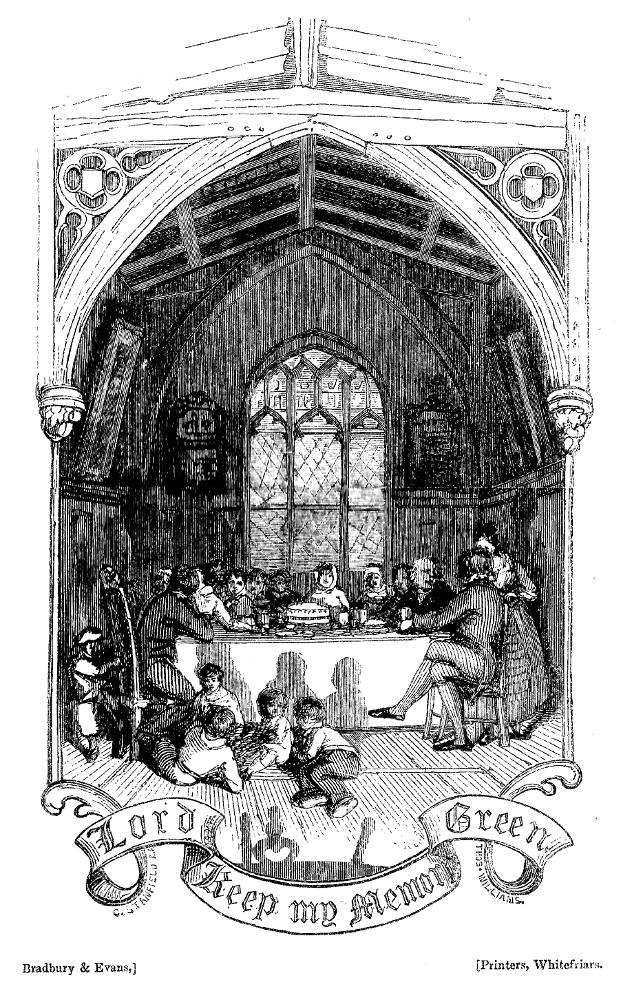
'Lord keep my memory green' is the last line of Charles Dickens' book The Haunted Man and the Ghost's Bargain, 1848. It was accompanied by an illustration by C.Stansfield RA showing a grand Gothic room with adults sitting round a festive table and young children playing on the floor.
The ghost's bargain is that he can help Professor Redlaw, the haunted man of the title, "to forget the sorrow, wrong and trouble you have known ... to cancel their remembrance ... forever". But, this gift of forgetfulness will be given to everyone he comes into contact with too. Redlaw accepts the bargain but finds that he becomes inexplicably more angry, unkind and bitter. Eventually it is pointed out to him that, "It is important to remember past sorrows and wrongs so that you can then forgive those responsible and, in so doing, unburden your soul ...". In accepting this, Redlaw realises that memory is a vital ingredient for love and understanding to flourish.
There is a terrible poignancy to James Oliver's inscription. It was chosen by his mother, Mrs Sophia Oliver of Trail, British Columbia. Two of her sons, James and William, were killed in the war and her husband, Sidney, was killed on the same day and in the same battle as William - 24 April 1915 at St Julien. William and Sidney have no known grave and are commemorated on the Menin Gate in Ypres, so James is the only one for whom she could choose an inscription.
Sidney Oliver was a forty-nine-year-old miner from Trail, British Colombia. Born in England, in Hartington, Derbyshire, he emigrated to Canada as a young man where he married. He enlisted on 18 September 1914, ticking the box to say that he had had previous military experience and claiming that he had been born in 1870 and was therefore 44. In fact he was nearer 49 as he was 50 when he was killed the following year.
'Keep my memory green'. Not don't forget me, nor even don't let me forget them, but let me remember everything and let me see it clearly.
NO CROSS, NO CROWN
IN MEMORY OF THE BRAVE
LANCE CORPORAL HARRY UBERT EDMANS
"No Cross, No Crown" is the title of a book by the early Quaker, William Penn (1644-1718). The purpose of Penn's book was "to show the nature and discipline of the holy cross of Christ; and that the denial of self ... is alone the way to the ... Kingdom of God." For nineteen-year-old Harry Edmans, and for all 'the brave', death in battle would have been seen as the ultimate in self-denial.
His inscription was confirmed by his sister, Marian Edmans, although his parents, James Ubert, a house painter, and Sabrina Edmans were both still alive.
DJENAN
BRIGADIER GENERAL FREDERICK JAMES HEYWORTH
"Brigadier-General FJ Heyworth, Commanding 3rd Guards Brigade, killed by a sniper at long range. Otherwise a quiet day."
Guards Division War Diary 9 May 1916
At 7 am on 9 May, General Heyworth went up to the front line to inspect a new mine crater blown by the Germans during the night. He was killed outright.
His inscription is a complete puzzle. Djenan seems to be an Arabic name for both a person and a place. It was chosen by his wife, Violet, the widow of James Hatfield-Harter, who he had married in 1913. Frederick Heyworth served in the Sudan in the 1880s, at the start of his military career, perhaps the name became associated with him then.
Written in December 1914
1 June 2018
I am very grateful to John Snowdon, @snowspain, for pointing out to me that Djenan was a character in French author Pierre Loti's popular 1906 novel, 'Les Desenchantees', the disenchanted or disillusioned. The word means 'well-beloved'.