Brother Also Killed
Read the article: Brother Also Killed
TWICE MENTIONED IN DESPATCHES
HIS TWO BROTHERS ALSO FELL
IN DEATH
"THEY WERE NOT DIVIDED"
CAPTAIN RUPERT AYRTON HAWDON
Mr and Mrs William Hawdon had five children, four sons and one daughter. Three of the sons died in the war, two in action and one of influenza five days after it ended.
The inscription belongs to Rupert who was the third son. He served with the Royal Garrison Artillery receiving his commission in September 1914 and joining his unit the following September. Rupert served throughout the war and was killed near Le Quesnoy seven days before the end by German rifle fire whilst reconnoitering for new positions for his guns. He was 24.
The eldest brother, the Revd Noel Elliot Hawdon, a chaplain in the Army Chaplains Department, died twelve days later of influenza. He was 33. Their youngest brother, Cecil, had been killed with three of his men on 27 June 1916. Delayed trying to cut the German wire prior to a trench raid, they were killed when the British artillery opened up. Cecil was 20
The remaining brother, Hugh, served throughout the war with the Durham Light Infantry.
Cecil's inscription, like Rupert's, was signed for by his father:
His two brothers also fell
In death they are not divided
The last line comes from 2 Samuel 1:23
"Saul and Jonathan were lovely and pleasant in their lives, and in their death they were not divided."
William Hawdon also chose Noel's inscription:
He kept the faith
Deo dante dedi
All four sons were educated at Charterhouse where 'Deo dante dedi', God having given I give, is the Charterhouse motto. The first line is a quotation from 2 Timothy: 4/6
"The time of my departure is at hand. I have fought a good fight, I have finished my course, I have kept the faith."
Much of the information here has been taken from The Middlesborough Roll of Honour of the Great War. The Hawdon family lived at Upsall Grange, Nunthorpe Yorkshire. William Hawdon, an engineer, was the managing director of an iron works in Middlesborough.
ONE CALLED FROM SALONIKA
AND HIS CALL
RANG WITH HIS BROTHER
LIEUTENANT ARNOLD LOCKHART FLETCHER
Arnold Fletcher died on 28 April 1917. Wounded by a shell on 18 April during the defence of Wancourt, he died twelve days later in hospital in Rouen with his father, who had come from Ireland, beside him. Two days earlier his younger brother, Donald, had been killed in Salonika. He was demonstrating how to throw hand grenades when one exploded prematurely and killed him.
Although Arnold was eight years older than Donald, the brothers had always been close. They both joined the army in May 1915, Donald had only recently left school but Arnold was already a respected geologist. They both initially served with the 4th Leinster Regiment but early in 1916 Donald transferred to the 6th Battalion. He went with it to Salonika in June 1916. Arnold meanwhile transferred to the 193rd Machine Gun Company and went it to France in December 1916. The brothers died within ten days of each other and both have the same inscription which their father, George Fletcher, chose, suggesting that the brother's closeness encouraged Arnold to follow Donald into death.
Arnold and Donald were the second and fourth children of George and Henrietta Fletcher. Their eldest child, Constance, became famous in later life as the cookery writer, Constance Spry.
[There is a lot of detail about the Fletcher fsmily on this Century Ireland site.
AT REST
WITH HIS THREE BROTHERS
WHO ALSO DIED
FOR THEIR COUNTRY
SERJEANT ROBERT HENRY PIPE
William and Emma Pipe had four children: Percy, William, Robert and Edmund. All four were killed in the First World War - all within a year of each other.
William John, the second brother, was the first one to die; a Private in the Honourable Artillery Company he was killed in action on the 3 May 1917 just under two months after his arrival in France. He was 28. Private Pipe's body was never found and he's commemorated on the Arras Memorial.
Edwin George, the youngest brother, served as a Lance Corporal in the 2nd/4th Battalion Ox & Bucks Light Infantry and was killed in action on 10 October 1917. He was 21. Lance Corporal Pipe's body was never found and he is commemorated on the Tyne Cot Memorial.
The eldest brother, Percy Dalby, a Private in the 2nd/4th Ox & Bucks Light Infantry, died on the opening day of the German Spring Offensive, 21 March 1918. He was 32. Private Pipe's body was never found and he's commemorated on the Pozieres Memorial.
Eight days after his eldest brother's death, Serjeant Robert Henry Pipe, 2nd/4th Battalion Ox & Bucks Light Infantry, died of wounds in a base hospital at Etretat. He was 26. He is buried in the churchyard there. His father chose his inscription.
ONE OF THREE DEAR SONS
WHO GAVE THEIR LIVES
FOR KING AND COUNTRY
PRIVATE WILFRED JOHN MARTIN
William and Amy Martin had seven children, five sons and two daughters. Herbert William was the oldest. A warehouseman in London where the family lived, he volunteered in September 1914 and went to France with the 23rd Battalion London Regiment on 14 March 1915. He was killed in action just over two months later in the Battle of Festubert. He was 28. His body was never identified and he's consequently commemorated on the Le Touret Memorial.
Alan Stewart, at the age of 15 working as a junior clerk, volunteered in November 1914. He served with the Royal Engineers and was present in Gallipoli from the landing at Suvla Bay on 25 April 1915 to the evacuation in December. He served in France with the 29th Divisional Signal Company and was wounded at Merris on 12 April 1918. He died in hospital at Wimereux a month later, the day after his younger brother, Wilfred John, serving with the 2nd Battalion South Staffordshire Regiment had been killed in action near Arras.
Wilfred, who had volunteered in February 1915 when he was only 16, served in Dublin during the 1916 rising. He went to France on 31 March 1918 and was dead within six weeks. He was 19.
Both Wilfred and Alan have the same inscription, signed for by their father. The single adjective giving it a simple, affecting poignancy.
RECTE FACIENDO SECURUS
LIEUTENANT ROBERT INGLIS MC
Recte faciendo securus - by acting justly you need fear nothing - is the Inglis family motto.
Robert and Isabella Inglis of Lovestone, Girvan, Ayrshire had ten children: four daughters and five sons. I think you might be able to tell where this is going. The eldest son, Alexander, was killed in South Africa in 1901, the youngest son, David, was killed in France on 19 December 1914, Charles, the third son, on 25 September 1915, and Robert, the second eldest, died of wounds on 5 October 1918. William was the only one of the five sons to survive.
Prior to the war, Robert Inglis had been joint factor with his father of the Bargany Estate in Ayrshire and a sergeant in the Scottish Horse Yeomanry. In September 1914, he was commissioned second lieutenant and after a period of service in England embarked on 1 January 1916 to join the Egyptian Expeditionary Force on the Suez Canal. In October 1916 the Scottish Yeomanry became the 13th Battalion Royal Highlanders (Black Watch) and in June 1918 the battalion was moved to France. Inglis was wounded on 3 October 1918 when 'C' Company co-operated with the Royal Dublin Fusiliers in an attack on Le Catelet and Gouy. The battalion war diary mentions that "there was considerable sniping causing several casualties". Inglis died the next day.
Recte faciendo securus - by acting justly you need fear nothing. The reference of course is to salvation rather than to having nothing to fear in this earthly life.
THIS EARTH HAS BORNE
NO SIMPLER, NOBLER MAN
LIEUTENANT COLONEL EDWARD HILLS NICHOLSON DSO AND BAR
This inscription comes from the epitaph Tennyson wrote for his friend General Gordon, killed in the Sudan in January 1885:
Warrior of God, man's friend, and tyrant's foe
Now somewhere dead far in the waste Soudan,
Thou livest in all hearts, for all men know
This earth has never born a nobler man.
It is difficult to overestimate Gordon's fame; he was one of the Victorian era's biggest military heroes, his achievements summarised on his memorial in St Paul's Cathedral:
To
Major General Charles George Gordon, C.B.
Who at all times and everywhere, gave his strength to the weak, his substance to the poor, his sympathy to the suffering, his heart to God.
Born at Woolwich 28 January 1833
Slain at Khartoum 26 January 1885
He saved an Empire by his warlike genius, he ruled vast provinces with justice, wisdom, and power.
And lastly obedient to his sovereign's command, he died in the heroic attempt to save men, women and children from imminent and deadly peril.
Tennyson's epitaph for his friend does not feature either on his memorial in St Paul's or on his memorial in Westminster Abbey but in the Gordon Boys' National Memorial Home, Woking, one of a series of boys' homes established throughout the country in his memory .
Edward Hills Nicholson was educated at Winchester College, and is remembered on their commemorative website. On leaving school he joined the regular army and fought in South Africa. After a period of service in India, he was posted to the Western Front in June 1915, and then to Salonika that November where he remained until he returned to the Western Front in July 1918. He was killed in the taking of Richmond Copse, a German stronghold, on the morning of 4 October.
Edward Nicholson was one of seven children; his parents had four sons and three daughters. Bruce Nicholson was killed on 3 May 1917 and Victor two months later on 9 August. Biographies of all three brothers appear on page 132 of the fifth volume of the Marquis du Ruvigny's Roll of Honour. The fourth brother, Walter, died suddenly in 1943 whilst serving with the RAF Volunteer Reserve.
In April 1912, Nicholson married Ethel Frances in Bombay Cathedral. She chose his inscription.
BROTHER OF
EMMANUEL GOLDSTEIN
KILLED IN ACTION
25TH SEPT. 1918
RIFLEMAN BENJAMIN GOLDSTEIN
There's a story here quite beyond the one of two brothers being killed within twenty days of each other.
Benjamin and Emmanuel Goldstein were the sons of Morris and Milly Goldstein. Morris was born in Chachinow, Plotzk a town now in central Poland but at the time of his birth in Russia. The town had a huge, vibrant Jewish community estimated at one time to have made up 40% of the population. However, by the end of the Second World War, after decades of varying degrees of anti-semitism culminating in the Plotzk Ghetto, there were thought to be no more than thirty Jewish residents in the city. Milly, Amelia Bernberg, was born in Kuldiga, a town in western Latvia, which had had a similarly thriving Jewish community. Many of them were German, which is how Milly identified her nationality in the 1911 British census. In 1941, the Jews of Kildigas were imprisoned in the synagogue before being taken out into the forest in small groups and shot.
Morris Goldstein, who was a tailor, came to Britain in about 1894 when he was 36, and became a naturalised British subject in December 1902. There is no evidence that Milly ever became a British subject. All their six children were born in Britain, of whom five survived to adulthood.
The three eldest boys all served in the British army, the second and third sons both being killed in 1918 within weeks of the end of the war.
The boys' father, Morris Goldstein, chose Benjamin's inscription, whereas their eldest brother chose Emmanuel's: "Brother of Ben Goldstein died of wounds Sept. 6th 1918". However, the eldest brother, Samuel Reuben Goldstein, was now calling himself Stanley Robert Golding. And later on I can see that the youngest brother, Louis, had changed his surname to Golding too.
It seems a shame that a family who came to Britain to escape prejudice, two of whose four sons died fighting for Britain, should have felt the need to change their name from Goldstein to the less Jewish sounding Golding - but this was the story of the twentieth-century.
ALSO IN MEMORY
OF 23202 L/CPL R GARDNER
AND 30264 PTE A.V. GARDNER
KILLED IN ACTION
PRIVATE JAMES GARDNER
I said in yesterday's inscription that 'Also' was a very ominous way to begin an inscription because it always meant that another brother had been killed. Today's remembers two brothers killed in addition to the one on whose headstone they are remembered.
I don't know how James Gardner died but his two brothers were both killed in action: his elder brother, Alfred, serving with the 2nd/4th Battalion East Lancashire Regiment, at Passchendaele on 10 October 1917, and his younger brother, Reginald, of the 8th Battalion King's Own Royal Lancaster Regiment, in the Battle of Arras on 9 April 1917. Neither brother has a grave. Alfred is commemorated on the Tyne Cot Memorial and Reginald on the Arras Memorial. I like the way the parents have included the brothers in the order in which they died rather than in order of seniority; Alfred was 30 and Reginald 20.
James, the middle of the three Gardner brothers, died a month after Alfred. He was a member of the 49th Battalion Training Reserve. So many men were called up following the introduction of conscription in January 1916 that the army couldn't cope with them. The reserve battalions of the various regiments couldn't incorporate them all either so a Training Reserve was created, which was not attached to any of the regiments. Men were trained up and then placed wherever they were needed, rather than as before waiting to be placed in the regiment they had joined. James died whilst with the Training Reserve, whether from illness or accident I haven't been able to find out. All I do know is that John and Annie Gardner lost all three of their sons between April and November 1917. They had five surviving daughters.
ALSO 8903 L/C ROBERT NEY
2ND CAMERON HIGHRS
KILLED HILL 60
23RD APRIL 1915
PRIVATE JOHN NEY
"Also ..."; it's a horribly ominous way to begin an inscription because it always means that another brother has been killed - and it usually means that the other brother has no known grave, which is why the parents commemorate him on the headstone of the one whose grave they do know.
Robert and John Ney were the two oldest sons of Robert and Mary Ney who lived in Overgate, a densely populated area of Dundee where Robert Ney senior was a street lamplighter. Both sons look as though they enlisted on the outbreak of war, although Robert's medal card gives 19 February 1914 as his date of entry into the war, which looks as though it's a mistake. John's says 10 January 1915.
Robert Ney, who served with the 2nd Battalion Cameron highlanders, was killed in action on 23 April 1915. The 2nd Battalion diary records that at "About 1.30 am the Battalion relieved the 1st Devon Regt in trenches 38 to 45" at Hill 60 just south of Ypres. All was fairly quiet until 10 am when, "enemy commenced firing minenwerfer & howitzer on right & centre of line. Many casualties, much damage ...". Among the 'many casualties' the diary lists 44 men killed, including Private R Ney. He was 24.
Eighteen days later his younger brother, John Ney, died of wounds in hospital in Boulogne. There isn't any documentary evidence as to when he was wounded but I would suggest it was on 9 May 1915 when the 1st Battalion Cameron Highlanders took part in the attack on Aubers Ridge. The fact that John Ney died of wounds two days later is circumstantial but persuasive. He was 19.
Mr and Mrs Robert Ney senior had four sons and five daughters. It looks as though their son Allan, born in 1907, chose his brother John's inscription. He would have been eight when his brothers were killed.
AGE 17.
DIED FOR
KING AND COUNTRY
WITH HIS BROTHER
PRIVATE ROLAND THOMAS WHITEHORN
There are several puzzling things here. Firstly, despite what his father put on his headstone, I don't think Roland Whitehorn was 17 when he died. In fact I'm sure he wasn't as his birth is recorded in the second quarter of 1898. This would mean he was 19 when he died in October 1917.
I came across a story on a family history site, which said that Whitehorn's wife brought their six-week-old daughter to visit him in hospital in France before he died. I thought this unlikely if he was only 17 when he died, even though you could legally be married at 16. The records show that he married Elizabeth Collins in the second quarter of 1916, at which time he would have been 18. It's not unlikely that his wife was allowed to visit him. It wouldn't have been possible if he had been in a Casualty Clearing Station closer to the front but Roland Whitehorn was in one of the base hospitals near Boulogne and the authorities did allow next-of-kin to visit. Perhaps the 'Age 17' on his headstone refers to how old Roland Whitehorn was when he enlisted.
His brother, Albert John Whitehorn, was also very young when went to war. His medal card shows that he qualified for the 1915 Star having entered France on 19 March 1915. He'd been born in the fourth quarter of 1896 so that means he was 18. Albert Whitehorn died of wounds two months later on 11 May. But there's something strange here too: Albert served under an alias, he called himself Albert Whitehall. Was this because at 18 he would have needed parental permission to serve abroad and he didn't believe his parents would grant it?
Albert Whitehorn's inscription in Boulogne Eastern Cemetery is identical to his brother's except for the age:
Age 18. Died for
His King and Country
With his brother
KILLED IN ACTION
JESU MERCY
THE REVEREND BENJAMIN CORRIE RUCK KEENE
The epitaph 'Killed in action' is a statement of fact, and can be a matter of some pride, as well, of course, of regret. It was not an unusual inscription for a soldier but it was for a chaplain.
Chaplains did not take part in attacks but this didn't mean they were never seen in the front line. Initially the Army Chaplains Department had forbidden them from going any further forward than the advanced dressing stations. But many went up into the trenches knowing that the soldiers appreciated their presence, and knowing that they could make themselves useful: helping with the wounded, staying with the dying, talking to the men. One of the most famous of all war-time chaplains, the Revd Geoffrey Studdart Kennedy, had this advice to give:
"Live with the men, go everywhere they go. Make up your mind you will share all their risks, and more, if you can do any good. The line is the key to the whole business. Work in the very front and they will listen to you; but if you stay behind, you're wasting your time. Men will forgive you anything but lack of courage and devotion."
When asked what spiritual work could be done Studdart Kennedy replied:
"There is very little; it is all muddled and mixed. Take a box of fags in your haversack, and a great deal of love in your heart and go up to them; laugh with them, joke with them. You can pray with them sometimes; but pray for them always."
According to The Times' announcement of his death, Ruck Keene was killed "by a shell in the regimental aid post". Further forward than the advanced dressing stations, regimental aid posts were usually just metres from the front line trenches.
The son of the vicar of St Michael and All Angels, Copford, Essex, Ruck Keene had been a curate at St James the Great in Bethnal Green prior to beginning his service with the Army Chaplains Department in January 1917. The use of the phrase 'Jesu mercy', a shorthand prayer for the deceased to be spared the pains of hell, would suggest that both father and son had been High Church Anglicans.
Ruck Keene's eldest brother, Ralph, a lieutenant in the Royal Welsh Fusiliers, was killed in January 1916. His inscription too gives an accurate description of the circumstances of his death:
Killed in a bombing accident
On active service
Jesu mercy
A WILLING SACRIFICE
FOR THE WORLD'S PEACE
SECOND LIEUTENANT WILLIAM KEITH SEABROOK
This inscription - "A willing sacrifice for the world's peace" - is a phenomenally magnanimous comment from the mother who had three sons killed on two consecutive days in September 1917: George Ross Seabrook and Theo Leslie Seabrook on 20 September and William Keith Seabrook on the 21st. But to whom does the word sacrifice refer? I think it has to be her son, William Keith Seabrook - and by implication her other sons - since they were the ones who volunteered to go and fight, who offered themselves willingly. There was no conscription in Australia so they were definitely volunteers.
An Australian Red Cross and Wounded Enquiry Bureau search was instituted within weeks of the brothers' deaths but it was never easy to find out exactly what happened to any one person in the heat of a battle, let alone three. Some reports say that all three brothers were killed by a single shell but others give more convincing accounts, like Private Cooper:
"T.L. Seabrook was killed by the same shell that wounded me, in fact I fell across him when I was hit. He was killed instantaneously. We were in a trench just this side of Polygon Wood, it was about 9 am."
Private Arnold gives slightly more gruesome details:
"Hit by shell head and stomach and legs. Died very soon after. He was badly hit. I saw him hit. Don't know whether he was buried. He was a friend of mine."
And Private Marshall gives a sequence to the deaths since it was whilst he was talking to George Seabrook that George:
"pointed out his brother Theo Leslie Seabrook's body lying on the ground. He had been killed by a shell. Informant states that another brother, Second Lieutenant William Keith Seabrook had been killed still earlier in the day, and that the Lieutenant had been his officer."
Neither George Ross nor Theo Leslie have graves and both are commemorated on the Menin Gate. William Keith, who had been wounded but not killed on the 20th, was taken to No. 10 Casualty Clearing Station in Lijssenthoek where he died the next day. All three brothers had been involved in the opening day of the Battle of Menin Road, the Australian Infantry Divisions' first action in the Third Ypres campaign.
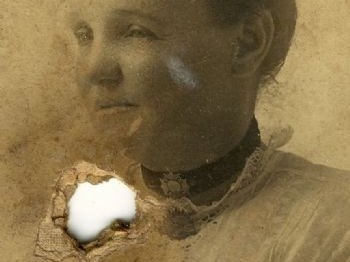
Look up images of the Seabrook brothers on the Internet and you will find one of all three of them in uniform, presumably on the eve of their departure from Australia since they all left Australia on board HMAT Ascanius on 25 October 1916. And there is another photograph too, this one was found on William Keith's body, it is a photograph of his gentle-looking mother which has a bullet hole through the bottom left-hand corner
ALSO IN MEMORY OF
CAPT. C. H. ANDERSON
1ST H.L.I.
MISSING 19.12.14
AT GIVENCHY
SECOND LIEUTENANT ALEXANDER RONALD ANDERSON
Alexander Anderson's inscription commemorates his younger brother, Charles Hamilton Anderson, was was killed on 19 December 1914. Charles' body was never found, consequently has no grave and no inscription, which is why his mother felt impelled to commemorate him on his brother's headstone.
What Alexander Anderson's inscription does not say is that all three of his brothers died in the war: Charles at Givenchy in 1914, Edward on 16 March 1918 in a flying accident in Britain, and the oldest brother, William Herbert, two weeks later leading a counter-attack at Bois Favieres during the German Spring Offensive - an action for which he was awarded the Victoria Cross.
An account of the war service of all four brothers can be found on the site Scotland's War. And there is a handsome bronze memorial to all four brothers in Glasgow Cathedral, the city where their father was a stockbroker.
AFTER TWO WEARY YEARS
GOD TOOK HIM
TO HIS TWIN BROTHER
MY HAWTON
CORPORAL MATTHEW HAWTON MITCHELL
Corporal Mitchell's twin brother, Frederick, died of wounds on 1 July 1916. Hawton followed him two years later. The Australian Red Cross Wounded and Missing Enquiry Bureau found witnesses who could tell his mother what had happened:
"I knew casualty. He was a well built man, 5 ft. 5 ins. dark complexion, about 19 years of age. Casualty was in advance at Peronne Road. He was leading his machine gun team in attack when an H.E. shell exploded a piece entering his leg. I was 20 yds. away at the time. He was carried to hospital."
Pte. A.G. Thornton
16.5.19
The Registrar of No. 1 South African General Hospital finishes the story:
"This man was admitted to this hospital from No. 53 Casualty Clearing Station on the 24th August, 1918. He was suffering from a severe wound on the thigh with fracture of the femur. He had two attacks of secondary heamorrhage, the second of which rendered amputation of the limb necessary. The operation took place on the 1st September 1918. He recovered slightly on returning to his ward but collapsed later and died at 6.30 pm on the 1st September, 1918."
GOODBYE AND GOD BLESS YOU
DEAR ERN AND SID
TILL WE ALL MEET AGAIN
PRIVATE ERNEST PALK
"Palk was a Signaller in C Coy. 9th Battn., tall, stoutly built, fresh complexion, rather large head, wore glasses, a proper cockney, not long joined up. They were in a dug out in a trench on telephone duty. I was close by in a small dug-out. I went to do my shift on phone and found the phone dugout had been blown up by a shell. Palk's body was lying on top of the wreckage, hit all over. I got a shovel and started digging to see if anyone else was underneath, and found Marsden's body also badly smashed."
Witness L/Cpl G.A. Simpson 7057
Red Cross Wounded and Missing Enquiry Bureau Report
Born in Fulham, London, in the 1901 census Ernest Palk was 8 and his mother was dead. His brother Sidney was 5. In the 1911 census Ernest looks to have been a waiter at a London Club in Pall Mall. At some point he emigrated to Australia, joined up in 1917 and embarked for Europe in June 1917.
His inscription was chosen for him by his sister Rose. She makes reference to her other brother "Sid". Despite the fact that Palk is an unusual name it has not been easy to identify Sid but I think he has to be Lance Corporal S Palk, 1st Battalion Grenadier Guards, killed in action on 31 July 1917 and buried at New Irish Farm Cemetery, Belgium. My reasoning is that there are only two S. Palk's in the War Graves Commission's records and the other one, buried at Lijssenthoek, was called Stanley. However, the records make no mention of any family and he has no inscription.
BROTHER TO A.H. HODGES
13TH BTN. KILLED AT GALLIPOLI
PRIVATE CHARLES FREDERICK HODGES
It was nine months before Charles Hodges' parents discovered his fate, nine months in which the
Australian Red Cross Wounded and Missing Enquiry Bureau had tried to find witnesses who had seen what had happened to him. Eventually they tracked down Corporal L O'Neill who told them definitively:
"On 14th November at 5 am we were attacking; we failed in our objective and retired to our front line which we held. I saw Hodges after we had got back to our lines about 9 am go outside our trench; there were wounded men inside the trench and he had to go outside to get passed them. A sniper hit him in the head and he died about two minutes after. I was right alongside of him."
Mr and Mrs Hodges therefore did eventually find out what had happened to this son, but they never found out about his elder brother, Albert Henry. He went missing in Gallipoli on 22 August 1915 in the unsuccessful Australian assault on Hill 60. His body was never found and curiously there is no record of his parents instituting a Red Cross search for him. Albert Hodges is commemorated on the Lone Pine memorial in Gallipoli and on his brother's grave in France.