Canada
A YOUNG CANADIAN SOLDIER-POET
WHO FOLLOWED THE GLEAM
SECOND LIEUTENANT HORACE EDGAR KINGSMILL BRAY
'Follow the gleam', this is a phrase that has passed out of usage; once upon a time everyone would have known what it meant. It comes from Tennyson's poem 'Merlin and the Gleam' where the gleam is a glimmer of the holy grail, that intangible quality that man should attempt to follow in his life:
Not of the sunlight,
Not of the moonlight,
Not of the starlight!
O young Mariner,
Down to the haven,
Call your companions,
Launch your vessel,
And crowd your canvas,
And, ere it vanishes
Over the margin,
After it, follow it,
Follow the Gleam.
This will have been the source of the inscription but it could have been a second-hand source. In 1920 Sallie Hume Douglas and Helen Hill composed a song for a YWCA - Young Women's Christian Association - competition. The song won and became a YMCA anthem, which is still sung today. Based on Tennyson's poem the song encourages young people to follow the gleam:
To knights in the days of old,
Keeping watch on the mountain height,
Came a vision of Holy Grail
And a voice through the waiting night.
“Follow, follow, follow the Gleam,
Banners unfurled o’er all the world;
Follow, follow, follow the Gleam
Of the chalice that is the Grail.
“And we who would serve the King,
And loyally Him obey,
In the consecrate silence know,
That the challenge still holds today:
“Follow, follow, follow the Gleam,
Standards of worth o’er all the earth,
Follow, follow, follow the Gleam,
Of the Light that shall bring the dawn.
Horace Edgar Kingsmill Bray enlisted in the Canadian Mounted Rifles in January 1915. He served in France and Belgium and then, having been wounded, transferred to the Royal Air Force. He finished his flying training and was just about to be sent to France when he had a head-on collision in the air and was killed.
His father, the Revd Horace E Bray chose his inscription. His mother had died when his sister was born. Bray's patriotic poetry was included in several Canadian anthologies.
This YouTube film, They Are Not Here, feature Bray's life and death.
VICTORY
BUT THE PRICE WAS DEAR
PRIVATE RICHARD VIDAL
Richard Vidal, a farmer from Manitoba, was one of his parents nine children. He enlisted on 14 February 1916 and served with the Canadian Cyclists Corps. Trained as an elite to carry out intelligence work, members of the corps underwent an intensive course that included musketry, bombing, bayonet fighting and the use of Lewis guns, as well as signalling and range-finding. Despite this, cyclists tended to be used for traffic control or as trench guides, ambulance drivers or even for burying the dead. However, during the last one hundred days, as the war became a war of movement, the cyclists came into their own and were finally able to do the intelligence work for which they had been trained. They could be sent in advance of the infantry to keep in touch with the retreating enemy, they were used for reconnaissance and scouting and some of them took part in direct combat.
All this was far more dangerous than their earlier work had been and they became known as the suicide battalions. Richard Vidal was killed near Wancourt just outside Arras on 2 September 1918 during the Second Battle of Arras.
His mother chose his inscription, acknowledging that the price of victory had meant the loss of her son.
FORGIVE O LORD
A MOTHER'S WISH
THAT DEATH
HAD SPARED HER SON
SERGEANT THOMAS ARMSTRONG
"On the evening of 30/31st January 1916, a party of bombers in conjunction with a number of scouts made a raid on the enemy front line trench. During the raid, Sergeant Armstrong was killed instantly by rifle and machine gun fire."
Canadian Casualty Report
Thomas Armstrong was born in Ayrshire in 1890. In 1914 he was working as a carpenter in Canada when he joined the Canadian Infantry on 24 October 1914. The battalion sailed from Montreal on 29 May 1915, by which time Armstrong had already been promoted corporal. Disembarking in France on 18 September 1815, he was promoted sergeant on 4 January 1916 and killed three weeks later.
Armstrong appears to have been the youngest of his parents' seven children. His eldest sister, Janet, was twenty-three years older than him. His mother signed for his inscription, confessing to a feeling that must have been very common among all parents although seldom voiced.
FOR THE YEARS
UNTOUCHED BY SORROW
WE THANK THEE LORD
GUNNER THOMAS EDWARD MILTON CLAYTON CLAYTON
Some parents are astonishingly magnanimous, as Mrs Julia Clayton has been here. She thanks God that for twenty years her family of two sons and two daughters has been untouched by sorrow. All this changed when her son, Milton Clayton, serving with the 23rd Howitzer Battery, 5th Brigade Canadian Field Artillery, was killed on 14 June 1918. The war cemetery register records that he 'died of accidental injuries'. The military record states:
"The gun on which Gunner Clayton was engaged was firing at the time and he was assisting in the supply of ammunition. Several rounds were fired when a premature occurred directly in front of the muzzle of the gun, several pieces flying back into the gun pit, one striking him in the chest. He was placed on a stretcher, dying while on the way to the dressing station, presumably from hemorrhage."
THE SHELL THAT STILLED
HIS TRUE BRAVE HEART
BROKE MINE
CORPORAL JAMES EDWARD NOBLE
25th Battalion Canadian Infantry War Diary
Neuville Vitasse
At 2.00 am on 13 6 1918 [the diary says 1917 but this is a mistake] the Royal Engineers put over a gas projection on the lines opposite our front, which was accompanied by heavy artillery fire. In reply to this, the enemy put down a barrage on our front and support lines, which lasted until 2.45 am. [...] Casualties - killed in action, Lieut. E.C.C. Bing and 8 Other Ranks; wounded Capt. W.A. Livingstone and 21 Other Ranks.
This was the enemy barrage that stilled Corporal Noble's heart and broke his mother's.
James Edward Noble attested in Shubenacadie, Nova Scotia on 31 March 1916. He was nineteen and one month. He served with the 25th Battalion Canadian Infantry, the Nova Scotia Rifles.
Noble's parents, William and Agnes, had ten children, two of whom died in infancy. James was killed in 1918 and his younger brother, George Ross Noble, died of tuberculosis in a sanatorium in Nova Scotia on 30 March 1921. He was 22. George had been a soldier. He'd served in France for a year with the 193rd Battalion, which it was believed had brought on his condition. He's buried under a War Graves Commission headstone with an inscription chosen by his wife, Ruby: 'Sadly missed and lovingly remembered'.
SEE THAT MY GRAVE IS GREEN
PRIVATE WILFRED LEWIS SIMMONS
'See That My Grave is Kept Green' is a sentimental American song that was written by Gus Williams in 1876. A blues version by Blind Lemon Jackson, based on Williams' original song but with the final word of the line changed to 'clean' not 'green', is world famous among jazz aficionados. So much so that the words 'See that my grave is kept clean' appear on Jackson's headstone. However, Jackson's version dates from 1927 so it's Williams' song that Wilfred Simmons' father was quoting from in his son's inscription.
In the song, the singer asks that when he's dead his wife - I'm presuming - will keep his grave green:
When from the world and it's hopes I go,
Leaving for ever the scene
Though others are dear, ah, will you then
See that my grave's kept green.
By asking for his grave to be kept green, the singer is not just asking his wife not to forget him, "will you keep me, love, in remembrance", but also that his wife will dwell on the happy times:
Tell me you'll think of the happy past
Think of the joys we have seen.
This one little promise keep for me
See that my grave's kept green.
Wilfred Simmons was a student at the Hamilton Normal School when he enlisted in March 1916. He left Canada for England in October 1916, and in January 1917 went to France. He was attached to the Canadian Forestry Corps, in effect a military lumberjack unit, cutting down forests in England, Scotland and France to meet the army's insatiable demand for timber. Simmons served in the MT section.
In August 1918 he became ill with appendicitis. He was admitted to hospital on the 24 August and operated on. His condition seemed to improve but later he became very ill very suddenly and died of what his records say was 'recurrent appendicitis'.
Oh the days will come to you darling
When no more on earth I'll be.
Oh the days will come to you darling
When no more on earth I'll be seen.
One sweet little wish darling grant me
See that my grave's kept green,
See that my grave's kept green.
NOT SINCE HER BIRTH
HAS OUR EARTH SEEN
SUCH WORTH LOOSED UPON HER
LANCE SERGEANT ALEXANDER LORIMER RIDDELL
I'm not sure what was going on here but it can have never occurred to Alexander Riddell that ninety-nine years after his death somebody would be looking at his attestation form and wondering what he'd been playing at.
Alexander Lorimer Riddell, army service number 706968, son of George and Margaret Riddell of Rosehearty, Fraserburgh, Aberdeenshire, was born in Scotland in 1885. In 1906, aged 21, he went to Canada and settled in Nanamo, British Columbia where he worked as a building contractor. He enlisted in the Canadian Infantry in February 1916, sailed from Halifax in July and joined his unit in the field in February 1917. He was wounded at Vimy Ridge in April 1917 and returned to Rosehearty in December where he married Jean Arthur. After two weeks leave he returned to the front and died of wounds received in action on 3 October 1918.
That, in brief, is the life of Alexander Lorimer Ridddell. It all comes from information provided by Riddell's family for his entry in the Marquis du Ruvigny's Roll of Honour. So why, on his attestation form, does he claim that he was born in New South Wales, Australia on 16 August 1877, which would have made him 44 when he was only 33. And why does he say that his next of kin is his step-father, Donald Riddell of Lincoln, Nebraska, when he didn't have a step-father. I don't have an answer.
His wife chose his inscription. It comes from Rudyard Kipling's poem The Children and is a savage indictment of the society that led its innocent children into war. Yes Kipling was probably moved to write it by his grief for the death of his own son, John, who was killed in action at Loos on 26 September 1915, but there is much more to the poem than the self-pity that one unsympathetic critic has accused Kipling of. Riddell's inscription comes from verse 3:
They bought us anew with their blood, forbearing to blame us,
Those hours which we had not made good when the judgment o'ercame us.
They believed us and perished for it. Our statecraft, our learning
Delivered them bound to the Pit and alive to the burning
Whither they mirthfully hastened as jostling for honour -
Not since her birth has our Earth seen such worth loosed upon her,
Never before has our earth seen 'such worth', such wonderful, valuable people thrown away, wasted in this manner. There is nothing at all heroic or triumphalist about this poem, no attempt at all to make death in war glamorous:
Nor was their agony brief, or once only imposed on them.
The wounded, the war-spent, the sick received no exemption:
Being cured they returned and endured and achieved our redemption,
Hopeless themselves of relief, till Death, marvelling, closed on them.
But, as Kipling acknowledges, we can rail against what has happened all we like, we can regret it, we can try to make amends, but in the end what's the point because nothing can bring our children back. "Who shall return us our children?" he asks, and the answer, of course, is no one.
BABY OF FAMILY
BORN GREEN BAY, WISC. U.S.A.
MOTHER STILL ANXIOUS
FOR HIS RETURN
PRIVATE ALBERT KICK
Albert Kick was a Oneida First Nation Canadian, born on the Green Bay reservation in Wisconsin U.S.A. whose family moved to the reservation in Muncey, Ontario. He was 29 when he was killed, the baby of the family.
'Mother still anxious for his return' - I had in my mind's eye the image of a grieving mother unable to accept that her son was dead and still hoping that he was going to come home. However, I have a feeling that this is not what the words mean. It was Albert's mother herself, Katherine Kick, who chose the inscription and I think her concern was to do with her son's spirit, perhaps even his body.
The Oneida, as with all First Nation people, have very specific customs, practices and rituals associated with the dead, all designed to facilitate the successful passage of their spirit back into the spirit world from which it came. This should start with the return of the deceased person's body to the place where they had lived. Was Mrs Kick agitating for the return of her son's body or was it his spirit she hoped would return? Either way, Albert Kick's inscription reflects a Oneida concern for the afterlife of the dead man.
Kick and his brother, Ernest, briefly attended Carlisle Indian Industrial School, Pennsylvania and when I say briefly I mean from 13 August to 20 October 1904 when they 'ran from school'. The school have digitised their records and you can read letters from both the brothers, written several years after they 'ran away', in which they seem to talk appreciatively about the time they spent at the school so I wonder whether they went back again.
Carlisle Indian Industrial School was the flagship Indian boarding school founded on the principle that Native Americans were the equal of European Americans and that if their children were immersed in Euro-American culture, i.e. at one of these schools, it would given them skills that would help them advance in life. The school ran from 1879 to 1918.
Albert Kick attested on 28 January 1916. He served with B Company, 4th Battalion Canadian Infantry, the same company as his brother Ernest, and was killed in action in the taking of Sancourt during the battle for the Canal du Nord. He is buried in the same grave as an unidentified soldier.
OH CANADA
HE STOOD ON GUARD FOR THEE
PRIVATE REGINALD GEORGE BOX
Private Box's inscription comes from a patriotic Canadian song that has become Canada's national anthem and is the source of the Canadian Army's motto - Vigilamus pro te: we stand on guard for thee. It was neither of these things when Private Box's father, William Box, chose it.
Originally written in 1880, in French, the words were translated into English several times before Robert Stanley Weir's version, which he wrote in 1908, was settled on. In 1939 it became de facto Canada's national anthem but was only officially adopted in 1980. Weir himself made various amendments to his original version and changes continue to be suggested and made. This is a version that Reginald Box would have recognised:
O Canada!
Our home and native land.
True patriot love in all thy sons command
With glowing hearts we see thee rise,
The True North strong and free!
We stand on guard, O Canada,
We stand on guard for thee.
O Canada, Glorious and free.
O Canada, we stand on guard for thee.
O Canada, we stand on guard for thee!
It's an interesting choice of inscription for someone who was born in England and didn't go to Canada until after 1911 when the census showed him, aged 16, as a 'farm pupil' on a farm in Dymock, Gloucestershire. Box's father, William Box, a jeweller and silversmith in Gloucester, England chose it. Both his sons had gone to Canada and both of them served in the Canadian Expeditionary Force but his eldest son, Charles Henry Box, returned to England before the end of the war having been wounded. It may have been him who influenced his father's choice
Reginald Box served with the 16th Battalion Canadian Infantry and was killed on 1 October 1918 in the capture of the village of Sancourt during the battle for the Canal du Nord.
In 1921 Charles Henry Box and his wife had a son who they names Reginald in memory of Charles' brother.
A SON OF VENEZUELA
WHO FOUGHT AND DIED
FOR GOD'S JUSTICE ON EARTH
PRIVATE MANUEL BERMUDEZ
Manuel Bermudez attested in Montreal on 16 March 1916, giving his address as the Victoria Hotel, Montreal. Was he living and working in Montreal or did he come from Venezuela specially to enlist? He gave his occupation as 'Correspondence Spanish'. Was he perhaps a correspondent on a Spanish newspaper? I can't tell.
Venezuela was strictly neutral during the First World War, although its president, Juan Vincente Gomez, was widely suspected of being pro German. Bermudez's inscription does not sound as though it comes from a strictly neutral Venezuelan citizen ... far from it. A Mr JF Bermudez of Caracas, Venezuela chose it and was very specific that Manuel Bermudez had fought and died: 'For God's justice on earth'. JF Bermudez was not Manuel's father whose name was Manuel Bermudez Lecuna. However, it's possible that the family had pro-British sentiments since at one time the father had been the Venezuelan Consul in the British territories of Grenada and St Vincent.
Manuel Bermudez served with the 14th Battalion Canadian Infantry. He was killed in action during the battle of the Canal du Nord on day the Canadian Corps captured the village of Sancourt where Bermudez is buried in a joint grave with an unknown soldier.
TO YOU FROM FAILING HANDS
WE THROW THE TORCH
BE YOURS TO HOLD IT HIGH
SERGEANT HENRY LEGGO HAMMOND
For all that this is now one of the most famous poems of the war, and certainly the most famous Canadian poem of the war, it is not often quoted in inscriptions. John McCrae wrote In Flanders Fields in May 1915, prompted by the death of a young friend killed at Ypres the previous day. McCrae, a doctor, served in France throughout the war, eventually dying of cerebral-meningitis following pneumonia in January 1918.
The inscription comes from verse 3, the last verse:
Take up our quarrel with the foe:
To you from failing hands we throw
The torch; be yours to hold it high.
If ye break faith with us who die
We shall not sleep, though poppies grow
In Flanders fields.
In this instance 'the torch' is 'our quarrel with the foe', McCrae was exhorting his readers not to give up the struggle with Germany until the war was won. More usually, however, 'the torch' is used as a metaphor for 'the torch of life', the vitai lampada'. This refers to the duties and responsibilities to one's fellow human beings that should be passed on from one generation to another. This was the meaning Sir Henry Newbolt had in mind when he wrote his poem, Vitae Lampada.
The War Graves Commission has recorded Sergeant Hammond's name as Henry Leggo Harry Hammond but I feel sure that 'Harry' was a nickname since Hammond's father was also called Henry. Hammond, a bank clerk enlisted in Montreal on 4 October 1915. He arrived in France on 23 April 1916 and served with No. 4 Company Princess Patricia's Canadian Light Infantry. He was killed on 30 September 1918. The battalion war diary recorded the events of the day:
"The plan was that the P.P.C.L.I., having crossed the Railway, should swing to the East and South-East and make good the Railway Cutting, the village of Tilloy as far forward as the main Tilloy-Blecourt Road ...
At 6-00 a.m. the attack was made with Nos. 1, 2 and 4 Coys front line and No. 3 Coy in support. Rapid progress was made as far as the road running from 8.21.b.60.80. to 8.27.a.40.60. From this point the advance was still continued on the right by No. 4 Coy, who reached their objective at the juncture of the main Tilloy-Blecourt Road and Embankment. Nos. 1 and 2 Coys on the Left and No.3 Coy in Support were suffering very heavy casualties from Machine Gun fire from the village and from the high ground to the North ... By this time most of the Officers and N.C.O.s had been knocked out and the Coys were badly disorganized ..."
Hammond was a senior N.C.O. in No. 4 Company.
His parents were initially told that he was missing presumed wounded in action. A month later they received the news that he had been killed. He's buried in Mill Race Cemetery, Tilloy-lez-Cambrai. The name coming from a switch line on the Cambrai-Douai railway, which ran to a large German supply dump on the site of the cemetery. Corps burial officers began constructing the cemetery in late October 1918, which is when Hammond's body must have been discovered and his parents informed.

MORE BRAVE FOR THIS
THAT HE HATH MUCH TO LOVE
LIEUTENANT JAMES MCDONALD MC
James McDonald was a married man, a fact which provides a clue to his inscription. It comes from Wordsworth's poem 'Character of the Happy Warrior'. The poem asks the question - "Who is the happy warrior? Who is he that every man in arms would wish to be?" - before enumerating all the noble and honourable qualities that make a man a good soldier, describing him as someone who can withstand the 'storm and turbulence' of warfare but:
Is yet a Soul whose master-bias leans
To homefelt pleasures and to gentle scenes;
Sweet images! which, whereso-er he be,
Are at his heart; and such fidelity
It is his darling passion to approve;
More brave for this, that he hath much to love: -
And 'much to love' meant he had much to lose, which explains why in Wordsworth's eyes he was 'more brave' than those who were not family men.
More than one inscription quotes from Wordsworth's poem, and the term 'happy warrior' had passed into general usage as a description for an all-round good sort. Presumably none of the people who quoted from Wordsworth's Happy Warrior were familiar with Herbert Read's poem of the same title:
His wild heart beats with painful sobs
His strain'd hands clench an ice-cold rifle
His aching jaws grip a hot parch'd tongue
His wide eyes search unconsciously.
He cannot shriek.
Bloody saliva
Dribbles down his shapeless jacket.
I saw him stab
And stab again
A well-killed Boche.
This is the happy warrior,
This is he ...
McDonald had been born in Scotland in 1878 but by the time he enlisted in September 1915 he was a grocer in Vancouver, British Columbia. He served with the 72nd Battalion Canadian Infantry and arrived in France in August 1916. Severely wounded in his right foot and right temple, he was out of action for the early months of 1917. In July 1918 he went home on leave to Dumbarton in Scotland, returning to the front on 17 August. He was killed just over a month later.
FOR YOUR TOMORROW
WE GAVE OUR TODAY
LIEUTENANT CHARLES ARNOLD GRANT
When you go home, tell them of us and say
"For your to-morrows these gave their to-day"
The most famous use of this inscription is on the Kohima Memorial which marks the point at which the Japanese advance into India was halted in April 1944. The words were composed by a Cambridge Classic's don, J Maxwell Edmonds, and included in a 1919 HMSO publication titled, 'Suggested Inscriptions for War Memorials'. However, the words on the Kohima Memorial are slightly different, which is how they are usually found:
When you go home
Tell them of us and say
For your tomorrow
We gave our today.
A Miss M Grant chose Charles Grant's inscription. His parents were both dead and it's not possible to tell whether this was an aunt or a sister.
Grant was a barrister, a partner in the firm of Parker, Grant, Freeman and Abbott, when he enlisted in December 1915. Badly wounded on the Somme in September 1916, he didn't return to the front until early in 1917. He was wounded again in June 1917, but less seriously less time. He was wounded again on 28 August 1918 in the Canadian action at Jigsaw Wood. (The diary entry for the action has been transcribed and can be read here).
It wasn't until 4 September that Mrs James Grant received a telegram informing her that her step-son had been wounded. This was quickly followed a few hours later by one saying that he was dangerously ill and within hours another one to say that he had died on 2 September.
ENGLAND EXPECTS EVERY MAN
TO DO HIS DUTY
PRIVATE ALBERT EDWARD HARROP
I think a lot of people will recognise this inscription; it's the message Admiral Lord Nelson ordered to be sent from his flagship HMS Victory on the morning of 21 October 1805 just before the British fleet engaged with the French at Trafalgar. Nelson knew this was to be a momentous battle, Britain's freedom of the seas depended on it; he wanted to say something that would stiffen his sailors' hearts. He can't have realised just how successful a message it would be - and he never did realise it as he died that day.
Apparently Nelson selected the word 'confides', in other words, England is confident that every man will do his duty. However, the signals officer said that he would have to spell out the word 'confides' whereas there was already a signal for 'expects' so could he use that instead, it would be much faster. Nelson agreed and the saying, 'England expects that every man will do his duty' has sunk deep into the nation's cultural memory.
So what is it doing on the grave of an American serving in the Canadian army? The answer isn't difficult to find. Albert Harrop was an Englishman, born in Birmingham in 1898 to English parents. In 1891 the family were living in Birmingham, Aston, where father James was a chandelier caster. But they must have moved to the United States before the 1901 census where there is no sign of them. Certainly by the time Albert joined up on 15 December 1917 they were living in Rhode Island. By this time the United States had entered the war. It's interesting that Albert Harrop should have enlisted in the Canadian army, was this a sign of the family's continuing feeling of loyalty to the old country where recruiting posters were exhorting young men to join the army by using the phrase - 'England expects every man to do his duty'.
Harrop served with the 13th Battalion Canadian Infantry and was killed at Upton Wood eight months later, just after the Canadians had captured Hendecourt-les-Cagnicourt.
INDIAN-TRIBE 6 NATIONS
DIED FOR HONOUR OF EMPIRE
EVER REMEMBERED
BY WIFE AND CHILDREN
SAPPER LEWIS WILSON
The place of indigenous peoples in the armies of the British Empire is a very interesting one. Dominion Governments were reluctant to arm and train them fearing the consequences for the stability of their post-war rule. New Zealand never prevented Maoris from joining the army but originally it only envisaged them in noncombatant roles. Australia was very reluctant to enlist Aborigines at all, some did manage to join up but there was never a policy of recruiting them. The Canadian Government too was initially reluctant to enlist any of the indigenous people, this despite the fact that many of them were very keen to do so. Timothy C. Winegard's book, 'Indigenous Peoples of the British Dominions and the First World War, explains why many native North Americans were so keen to take part in the war. Money, employment and adventure all played their part, as they did with all recruits of whatever nationality, but in addition many North American Indians were keen to revive the warrior tradition of their ancestors, which they felt had stagnated after their years of living on the reserves, receiving Western schooling and religious education.
However, whilst many North American Indians were willing to put their warrior heritage at the service of the British Crown, it was the British Crown they wanted to serve rather than the Dominion Government. And the Dominion Government was equally reluctant to have them serve it, despite the fact that many Indians were already serving in militia units. But this changed in October 1915 when the British Government made a direct appeal for the recruitment of indigenous people.
All this fits Lewis Wilson precisely. His inscription asserts his race, which the physical description on his attestation form confirms: complexion - dark, eyes - brown. hair - black. He enlisted in May 1916 having already served three years with a militia unit, the Haldimand Rifles. And his wife states specifically that he 'Died for the honour of the British Empire'.
But, however much Wilson might have wanted to be a 'warrior', he served in the Canadian Engineers. On 30 August 1918 the 3rd Battalion Canadian Engineers were engaged in work on a tramway that ran from somewhere between Beaurains and Neuville Vitasse to Wancourt. That night an 'E.A. bomb' fell on their billets killing two other ranks and wounding seven. Wilson died the next day in a Casualty Clearing Station in Aubigny-en-Artois.
"CURST GREED OF GOLD
WHAT CRIMES THY TYRANT POWER
HAS CAUSED"
VIRGIL
PRIVATE VICTOR LIONEL SUMMERS
Virgil didn't say this precisely; he used the word 'attest' rather than 'caused', not that it makes much difference. Virgil's point was that many crimes attest to, are evidence of, the power not of gold itself but of the greed for gold. The sentiment is similar to the biblical words from Timothy 6:10: "For the love of money is the root of all evil".
If that was Virgil's point, what was the point of W de V Summers, Victor's cousin, who chose the inscription? It sounds very much as though W de V was one of the many people who held the socialist view that the war was the result of imperialist tensions caused by world capitalism: "What was responsible for these wars was the whole world system of capitalism with its competitive struggle for profits and its collection of competing armed states".
It's strange that W de V Summers, the de V representing the family name de Vere, who lived in Berkeley, California should have been his cousin's next of kin but then Victor Lionel's parentage is something of a mystery. Aged four in 1891 he was living with his grandparents, and aged 14 in 1901 he was a pupil at St Saviour's College, Ardingly in Sussex. When he enlisted in Watrous, Saskatchewan on 28 October 1916 he named his grandmother, Elizabeth Summers, as his next of kin. She died in 1923 and perhaps this was before the War Graves Commission sent out the request for inscriptions.
Victor Summers served with the 28th Battalion Canadian Infantry and was killed on 9 August 1918 when the battalion was ordered up from the reserve to go to the assistance of the 31st Battalion in their attack on the village of Rosieres on the second day of the Amiens offensive..
"THESE BE THE GLORIOUS ENDS
WHERETO WE PASS"
KIPLING
PRIVATE MICHAEL ALFRED STANTON
This inscription does not mean what it looks as though it means. It has nothing to do with death and glory, quite the opposite in fact. What Kipling is saying is - we all must die, much of what we do on earth is pointless, death can come from anywhere, any time, the dead are soon forgotten and we are all replaceable.
These be the glorious ends whereto we pass -
Let Him who Is, go call on Him who Was;
And He shall see the mallie* steals the slab
For currie-grinder, and for goats the grass.
A breath of wind, a Border bullet's flight,
A draught of water, or a horse's fright -
The droning of the fat Sheristadar**
Ceases, the punkah stops, and falls the night
For you or Me. Do those who live decline
The step that offers, or their work resign?
Trust me, Today's Most Indispensables,
Five hundred men can take your place or mine.
* the cemetery gardener
** the court clerk
The Last Department, 1899 (verses 7-9)
Rudyard Kipling
This is a very different sentiment from Kipling's 'If' in which he claimed that:
If you can fill the unforgiving minute
With sixty seconds' worth of distance run,
Yours is the Earth and everything that's in it,
And - what is more - you'll be a Man, my son!
Michael Stanton's father chose his inscription. Did he know how Kipling meant it? I think he did, and that he meant us to know too otherwise he wouldn't have shown so clearly that it was a quotation, nor identified the author as he did. This is a very disillusioned father who does not think his son's death was worthwhile.
Nineteen-year-old Michael served with the 3rd Company Canadian Machine Gun Corps and was killed in action in the attack on Vimy Ridge.
War Diary 3rd Company Canadian Machine Gun Corps
Trenches Roslincourt Sector
April 9 1917
At 3 am, in accordance with attached Operation Orders and with Brigade Operation Orders our 12 mobile guns Commanded by Major E. H. Houghton proceeded through Douai and Bentata tunnels to the Assembly trench. ... At zero hour, 5.30 am. Artillery opened up Barrage on Enemy front line and at zero plus 3 minutes our Infantry advanced. All our 12 mobile guns going forward with the second wave. The infantry reached and captured the Black line at about zero plus 36 minutes ...
[At the end of the day] Total casualties 4 killed, 13 wounded, 4 missing.
ALAS! WHAT LINKS
OF LOVE THAT MORN
HAS WAR'S RUDE HAND
ASUNDER TORN
PRIVATE JAMES WINNING CHAPMAN
Alas! what links of love that morn
Has War's rude hand asunder torn!
For ne'er was field so sternly fought,
And ne'er was conquest dearer bought.
Here piled in common slaughter sleep
Those whom affection long shall weep:
Here rests the sire, that ne'er shall strain
His orphans to his heart again;
The son, whom, on his native shore,
The parent's voice shall bless no more;
The bridegroom, who has hardly press'd
His blushing consort to his breast;
The husband, whom through many a year
Long love and mutual faith endear.
Thou canst not name one tender tie,
But here dissolved its relics lie!
Stanza XX The Field of Waterloo
Sir Walter Scott 1815
As with the field of Waterloo on 18 June 1815 so with Vimy Ridge, on 9 April 1917; the bodies of fathers, sons, husbands and new bridegrooms lay scattered everywhere, the cause of heartbreak in homes across the world. The War Graves Commission site records that 6,851 men died in France on 9 April 1917, the first day of the Second Battle of Arras, of which Vimy Ridge was a part. British and Prussian casualties (allies in 1815) on 18 June 1815 were in the region of 42,000. I haven't been able to discover how many of these were dead.
Private Chapman was an undertaker from Paris, Ontario. Born in Glasgow, he and his family emigrated to Canada before the 1911 census. He served with the 8th Company Canadian Machine Gun Corps and was killed in action on 9 April 1917, his body found in a shall hole four days after the battle with three other members of his gun crew. The nature and extent of the injuries indicated that they had all been hit by a shell.
KILLED IN ACTION
VIMY RIDGE
PRIVATE FRANK LEWIS PORTMORE
War Diary 54th Battalion Canadian Infantry
Vimy Ridge 9 April 1917
Weather, snow & rainstorms. 5.30 am. Bn. attacked, - 350 all ranks in four waves behind 102nd Bn. Frontage LA SALLE to OLD BOOT SAP. Distance about 500 yards. Objective BEER and BLUE trenches. ... Strenuous opposition encountered on our extreme left flank from enemy strong post at OLD BOOT SAP & slight opposition from strong point near BROADMARSH CRATER. All objectives were reached and communication with 42nd Bn. stabilised. ... Our casualties approximately 4 officers & 20 O.R. killed, 5 officers & 100 O.R. wounded - 100 O.R. missing ... "
This was just one episode, for one battalion on one day of the four-day battle for Vimy Ridge, part of the five-week 2nd Battle of Arras. At the end of the four days the Canadians had lost 3,598 killed and 7,004 wounded - but they had captured Vimy Ridge, the high ground that dominated the plain of Douai and had been an Allied objective since the earliest days of the war.
Frank Lewis Portmore, originally one of the 100 missing other ranks, was killed by shell fire in the attack on the ridge. His mother chose his inscription.

I SHALL SEE MY PILOT
FACE TO FACE
WHEN I HAVE CROST THE BAR
LIEUTENANT RICHARD HUBERT LEWIS UGLOW
War Diary 3rd Canadian Divisional Signal Company
15 June 1917
Working party of 50 for buried cable work. All other work progressing favourably. Lt Uglow seriously wounded by sniper while looking over new points for extension of buried cable system.
16 June 1917
Only small working party for cable burying. Work commenced on installing new Signal office at Adv Div HQrs. Other work of air line construction and tunnel work progressing. Lt.Uglow died of wounds at No. 7 Casualty Clearing Station.
17 June 1917
Lt Uglow buried at Noeux Le Mins. All other work in hand being carried on satisfactorily.
Uglow's mother, Charlotte, chose his inscription. It comes from Tennyson's much-loved poem, Crossing the Bar, except that Tennyson wrote "I hope to see my Pilot face to face when I have crost the bar", whereas Uglow's mother wrote , "I shall see my Pilot face to face when I have crost the bar".
PAST THE MILITARY AGE
HE RESPONDED
TO THE MOTHER COUNTRY'S CALL
REGIMENTAL SERJEANT MAJOR STEWART GODFREY
Stewart Godfrey was a former soldier who had fought in the South African War. Born in Brixton, London, he enlisted in Canada on 24 August 1914, giving his civilian occupation as 'clerk'. He was 44. He served with Princess Patricia's Canadian Light Infantry (Eastern Ontario Regiment), which departed for England on 22 September 1914, landed on 25 October and after four months intensive training went to France in February 1915. His rank on departure from Canada was Company Quartermaster Sergeant. This means that he was not "past the military age" as his brother put on his inscription.
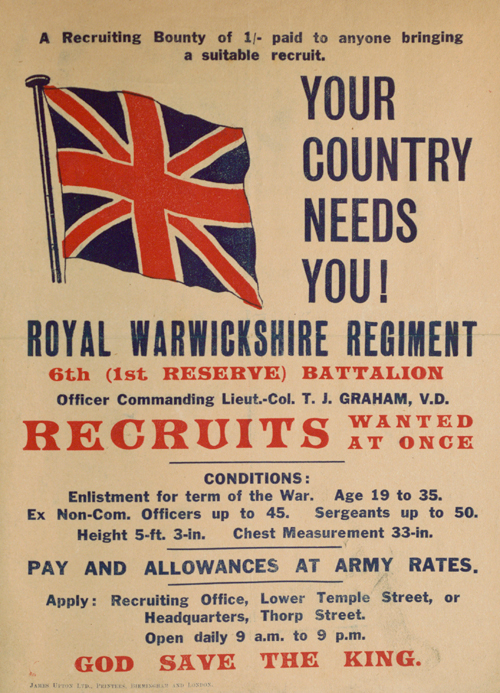
The original call up was for men between the ages of 19 and 35 but this recruiting poster shows that for former non-commissioned officers the upper age limit was 45, and for sergeants 50.
The regiment was involved in the fighting at St Julien in April 1915, when the Germans used gas for the first time, and at Festubert and Ginchy. It spent the winter of 1915 in the trenches near Ploegsteert and took part in the battle of St Eloi Craters between 27 March and 16 April 1916. Godfrey survived all this and then was killed on 18 April when, as reported in the War Diary, the Battalion Headquarters at Half Way House was 'shelled with 4.2" R.S.M. [Godfrey S. 1589] killed by direct hit on dugout'.
Although Godfrey had been born in Britain, it was not necessary for a Canadian to have been born there to feel the pull of the mother country. Many Canadian citizens simply looked on themselves as those north Americans who had remained loyal to the British crown - they were British, and more than 600,000 of them were prepared to volunteer to fight for their country.
I RAISED MY BOY
TO BE A SOLDIER
MOTHER
PRIVATE MOSTYN SCOTT SANDS
I am grateful to Eric McGeer for drawing my attention to this inscription and its meaning in his article Approaches to Canadian Epitaphs of the Great War. It sounds like a simple statement of fact - I raised my boy to be a soldier - but actually it's a proud reposte to a popular American anti-war song I didn't raise my boy to be a soldier. I shall quote the whole song here because, published early in 1915, it became a significant factor in keeping America out of the war for so long.
Ten million soldiers to the war have gone,
Who may never return again.
Ten million mother's hearts must break
For the ones who died in vain.
Heads bowed in sorrow
In her lonely years,
I heard a mother murmur thru' her tears:
Chorus
I didn't raise my boy to be a soldier,
I brought him up to be my pride and joy.
Who dares to place a musket on his shoulder,
To shoot some other mother's darling boy?
Let nations arbitrate their future troubles,
It's time to lay the sword and gun away.
There's be no war today,
If mothers all would say,
"I didn't raise my boy to be a soldier."
What victory can cheer a mother's heart,
When she looks at her blighted home?
What victory can bring her back
All he cared to call her own?
Let each mother answer
In the years to be,
Remember that my boy belongs to me!
Chorus
In the light of this song it's significant that Mrs Sands signs the epitaph, 'Mother'.
Private Sands was killed in a German night attack on the Canadian trenches. The 28th Battalion Canadian Infantry War Diary records that as the 19th Battalion began to relieve them on the night of the 7th/8th May the Germans attacked and penetrated their lines. They were driven back by those of the 28th who hadn't yet left the trenches, together with the newly arrived 19th. Sands must have been among the soldiers of the 28th who hadn't yet left.
LAST WORDS TO HIS COMRADE
"GO ON, I'LL MANAGE"
PRIVATE ERNEST ALBERT PROVEN
"Go on, I'll manage". Ernest's father says that these words were spoken to a comrade but they could easily have been heard by Ernest Proven's brother, Harry. Both Ernest and Harry served with the 1st Canadian Mounted Rifles Battalion and on the morning of 9 April 1917 they were both part of the first wave of the attack on Vimy Ridge. Ernest was hit in the shoulder by shrapnel. He survived long enough to be passed down the casualty evacuation chain to a base hospital in Boulogne, where he died three days later.
Sergeant Harry James Proven survived the attack at Vimy Ridge but was killed seventeen months later on 29 September 1918, six weeks before the end of the war, in the Canadian Corps' attack on Cambrai. Hit in the chest by German machine-gun fire, he died on the way to the main dressing station. His father also chose his headstone inscription. It reads:
Son of
James and Harriett Proven
Clanwilliam, Manitoba
Served 3 years & 8 months
Information on the Proven brothers comes from a blog post written by Michael O'Hagan whose great-grandfather was Ernest and Harry's brother.
The inscription came to my notice in Eric McGeer's excellent article on Canadian epitaphs of the Great War 'Time But the Impression Deeper Makes'.
THOU LORD, THEIR CAPTAIN
IN THE WELL FOUGHT FIGHT
HALLELUJAH
LIEUTENANT FREDERICK GUNDY SCOTT
There are so many lines from this hymn that can be and have been used as inscriptions. The hymn, 'For all the saints who from their labours rest', is both rousing and consoling in its promise that Christ is with us and that at the end of our lives we shall live with him in glory. With its martial imagery and language it is particularly consoling for the relations of those who have been killed in battle. Frederick Scott's inscription comes from verse two:
Thou wast their rock, their fortress and their might:
Thou, Lord, their captain in the well-fought fight;
Thou in the darkness drear their one true light.
Alleluia!
Scott was a student at Victoria College, Toronto when war broke out. He volunteered in the summer of 1915, was appointed to the 40th Battery Canadian Field Artillery and went overseas with them in February 1916. In July 1916 they were sent to the Western Front where they served first in the Ypres Salient and then on the Somme. In April 1917 the battery took part in the battle of Vimy Ridge. Scott was killed a few days later in the village of Vimy, hit by a shell when moving his guns to a new location.
DEATH HAS MADE HIS DARKNESS
BEAUTIFUL WITH THEE
SERGEANT WILLIAM HENRY MAY MM AND BAR
This lovely inscription comes from Tennyson's In Memoriam, LXXIV - the darkness of death has been made beautiful by this man's presence. The War Graves Commission's records say that the inscription was chosen by Mrs L May. I can't tell who this is as William May's mother was called Selina and his father, Charles.
Twenty-two-year-old William Henry May was a sergeant with a Military Medal and Bar when he died of wounds in hospital in Etaples on 1 October 1918, having been wounded, according to the 3rd Battalion Canadian Infantry War Diary on 27 September.
This is an excellent war record for a young man who in the 1911 census was an inmate in the reformatory school in Kingswood, Somerset. Whilst here boys were educated and taught a trade and some were given grants to help them emigrate once they were released. William May went to Canada. Here he joined up in September 1914, giving his trade as an actor. He served throughout the war and was wounded seven times before he died.
YET HE IS HERE
WITH US TODAY
A THOUSAND THINGS
HIS TOUCH REVEAL
DRIVER WALTER GEORGE BIRKETT
Who is 'he', the person whose touch is revealed in a thousand things? I think it's the dead soldier, Walter Birkett, but I could be wrong and 'he' could be God. However, I don't think it is.
There was a huge popular interest in spiritualism during the 19th and early 20th centuries and this interest mushroomed during and after the First World War. People were desperate for some word from their dead sons and husbands and mediums provided them with this comfort - whether they were complete charlatans or not.
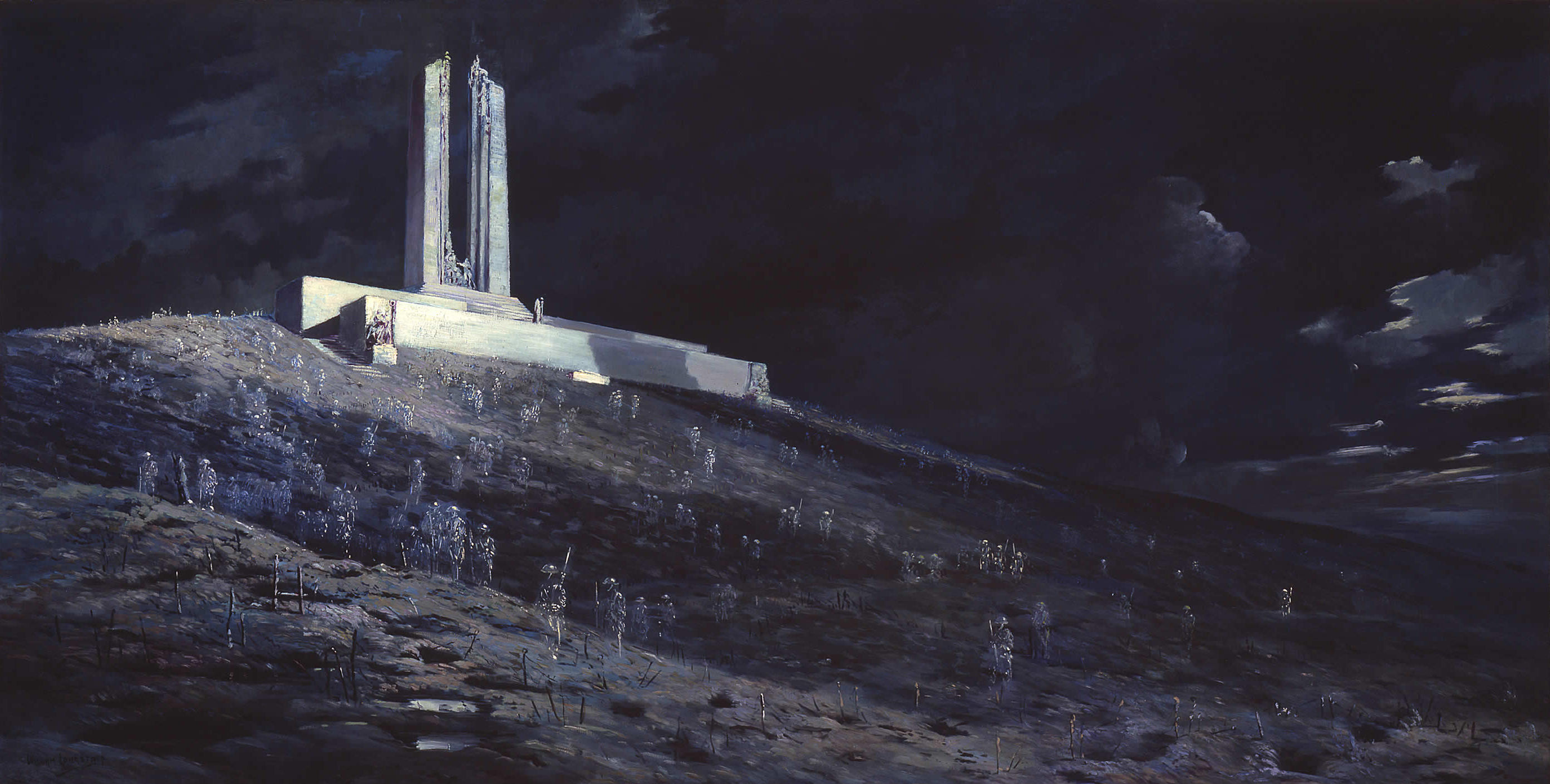
In fact the war encouraged the belief in ghostly manifestations with legends and images like the Angels of Mons , and the White Comrade . And after the war the Australian artist and former soldier, Will Longstaff, painted a series of extremely evocative images of soldierly ghosts haunting old battlefields and newly erected war memorials: the Cenotaph, Vimy Ridge, the Menin Gate, the coast of Belgium and Gallipoli. It all brought comfort to the thousands of people whose hopes for the future had been so radically altered by the death of their men.
This is why I think that Walter Birkett's inscription references his parents' belief in their son's continuing presence rather than in God's.
Birkett was born in Kingston Jamaica in the British West Indies in December 1892. He came to Canada with his parents and in 1914 was living in Cooksville, Toronto. He was a teamster and carried his experience as a wagon driver into the army where he served with the 2nd Division Ammunition Column of the Canadian Field Artillery. He died of wounds at a Field Ambulance station on 8 August 1916.
The source of the quotation is actually a poem by Claude Burton called An Unknown Grave.
4 January 2018


.jpg)


ONLY BELOVED SON OF
OF GEORGE AND LOUISE ALMAS
HAMILTON, ONT. CANADA
LIEUTENANT ERNEST NORVAL ALMAS
Ernest Almas enlisted in Toronto on 17 December 1915, served in Flanders with the 38th Battalion Eastern Ontario (Ottowa) Regiment and "Died of wounds (shrapnel wounds, face, right arm, shattered shoulder) at No. 11 CCS" on 31 October 1917.
ENOUGH
HE LIKE A SOLDIER FELL
LANCE CORPORAL BERT TRACEY
On December 4th "General Seely came into the lines and asked for volunteers to raid the barrier [across the Wulverghem-Messines road]. The raiding party was to get prisoners for identification purposes, if possible; find out the reasons for such a barrier; make reconnaissance and return within an hour. ... The raid was to take place behind a screen of an artillery bombardment but unfortunately this drew the enemy's fire in a counter-bombardment and put the opposing troops on the alert. ... Due to the bombardment there were several casualties. Captain Mackay, Privates B. Tracey and R. Sears were killed and four men wounded."
4th Canadian Mounted Rifles 1914-1919
Captain S.G.Benett MC, late Royal Engineers
Published 1926
Bert Tracey's parents lived in Stockport, Cheshire. He enlisted in Toronto on 27 November 1914. These are the only two firm facts I have been able to find out about his background. His mother chose his inscription. It comes from a broadside ballad, which, if it was written by William Vincent Wallace and Edward Fitzball, would have to have been written by 1873 when Fitzball died. The inscription is based on the final three lines. You can listen to the song here on a site called Music From the Works of James Joyce. The words vary on different sites but these are the ones printed on the broadsheet.
Oh let me like a soldier fall
Upon some open plain?
This breast expanding for a ball
To blot out every stain.
Brave manly hearts confer my doom,
That gentler ones may tell;
Howe'er unknown forgot my tomb
He, like a soldier fell.
He, like a soldier fell.
I only ask of that proud race,
That end its blaze in me -
To die the first and not disgrace
Its ancient chivalry.
Though o'er my grave no banner waves,
Nor trumpets swell;
Enough, they murmur at my tomb,
He, like a soldier fell,
He, like a soldier fell.
MY COUNTRY BEFORE EVEN YOU
MOTHER DEAR
(HIS PARTING WORDS
ON LEAVING HOME)
LIEUTENANT JOHN CLARENCE HANSON
John Clarence Hanson was a school teacher born in 1893 in St John, New Brunswick, Canada. He enlisted in the Canadian Infantry on 20 March 1916. He later transfered to the Royal Flying Corps, serving with the 55th Squadron, a daytime bombing squadron. He was "accidentally killed" on 14 July 1917.
It appears to me that he was an only child, which gives his inscription an added poignancy - how vividly his father has managed to convey the tensions of his last good-bye.
AT EVENING TIME
IT SHALL BE LIGHT
LIEUTENANT COLONEL HERBERT CECIL BULLER DSO
This inscription quotes Zechariah 14:7. When the day of the Lord comes, the last day, the day of judgement, "it shall be one day which shall be known to the Lord, not day nor night: but it shall come to pass, that at evening time it shall be light.
This may be the origin of the inscription but the source is probably the hymn called 'At Evening time it shall be light'. Five of the six verses end with this refrain and verse 2 offers the comforting promise that:
Thy morning may be overcast -
Clouds may obscure the brightest sky;
The gath'ring storm may burst at last -
But, O, take courage, God is nigh -
His promise puts all fears to flight
"At evening time it shall be light".
Henry Buller was one of the five sons of Admiral Sir Alexander Buller. A serving soldier before the outbreak of war, he was promoted to command Princess Patricia's Canadian Light Infantry on the death of his comanding officer in March 1915. In May that year he was badly wounded, losing an eye, but returned to his command and was killed on 2 June 1916 in the German attack on Canadian positions at Mount Sorrel. Three Canadian lieutenant-colonels and one major general were among the huge casualties suffered by the Canadians that day.
A SON OF THE PERTHSHIRE MOUNTAINS
LIES HERE
PRIVATE GEORGE LYALL MCLAUCHLAN MM
George McLauchlan emigrated to Canada in April 1910 at the age of 32. He enlisted in British Columbia in April 1915 and died of "shrapnel wounds, neck" in a base hospital in Boulogne on 16 April 1917. McLauchlan came from Struan, a small community in Perthshire. It was his brother, Alex, seven years older than him and an inspector on the Government railways in Ceylon, who chose his inscription. There's something rather moving about Alex in Ceylon remembering their Perthshire home on his brothers' headstone inscription in France.
WE HONOR YOUR NAME
UNCLE, AUNTIE, HARRY, DOROTHY
PRIVATE LESLIE HUDSON
Leslie Hudson, born in 1895, was the adopted son of William George Hardham and his first wife Lizzie Sarah Barrett. In 1905 the three of them emigrated to Canada, where Lizzie died in 1908. The following year William Hardham married Edith Amy Barrass and they had two children: Harry born in 1910 and Dorothy in 1912. It was William Hardham who chose Leslie Hudson's inscription and who would therefore presumably have been 'Uncle', 'Auntie' would have been Edith, and Harry and Dorothy their two children - none of them any blood relation to Leslie.
Leslie Hudson's origins are a bit of a mystery. He was born in Erpingham, Norfolk in 1895. In the 1901 census he's living as a five-year-old boarder with William and Lizzie Hardman, in 1905 he's listed with them on the passenger list of the SS Tunisian on its way to Quebec. I thought at one time that he could have been Lizzie Sarah's illigitimate son but as he was born after she and William were married that doesn't appear to be likely. His epitaph, however, anchor's him firmly within a family circle - his name honored.
YE SHALL DIE LIKE MEN
AND FALL LIKE
ONE OF THE PRINCES
PRIVATE CHARLES FREDERICK COX MITCHELL
The inscription comes from Psalm 82:
... all the foundations of the earth are out of course.
I have said, Ye are all gods; and all of you are children of the most High.
But ye shall die like men, and fall like one of the princes.
Private Mitchell came from Vancouver and served with the 7th Battalion Canadian Infantry, the British Columbia Regiment. He was killed in action at Ploegsteert "While taking part in operations south of Messines, he was hit in the head and instantly killed by an enemy rifle bullet". Canadian Expeditionary Force Burial Registers.
TELL MY MOTHER
I WILL MEET HER AT THE FOUNTAIN
PRIVATE WILLIAM GARFIELD RANKIN
An enigmatic inscription that was confirmed by eighteen-year-old Private Rankin's mother. At his enlistment, William Rankin gave his religion as Baptist and I believe his inscription is a reference to a very popular Baptist hymn by Anne Ross Cousin, 'The sands of time are sinking', number 454 in the Baptist Church Hymnal (1900). The hymn anticipates the long-awaited joys of dying and meeting Christ face to face.
The sands of time are sinking,
The dawn of heaven breaks,
The summer morn I've sighed for,
The fair sweet morn awakes:
Dark, dark hath been the midnight,
But day-spring is at hand,
And glory, glory dwelleth
In Emmanuel's land.
William Garfield's inscription references verse 3, which in itself references John 4:13, "whosoever drinketh of the water that I shall give him shall never thirst; but the water that I shall give him shall be in him a well of water springing up into everlasting life."
O Christ, He is the Fountain
The deep sweet Well of love!
The streams on earth I've tasted,
More deep I'll drink above:
There to an ocean fulness
His mercy doth expand,
And glory, glory dwelleth
In Emmanuel's land.
The regimental war diary for 24 April 1916 records: "At about 4.00 a.m. a Hostile aircraft drops 3 Bombs on Camp "E" occupied by R.C.R. One Bomb making a direct hit on one of the huts inflicting casualties to the extent of Killed 3 O.R. Wounded 31 O.R." William Garfield Rankin was one of the 3 soldiers killed. They were buried the same day.
"THUG THU BARRACHD
ANN AM BEUS"
PRIVATE HUGH MACINNES
Hugh MacInnes's inscription is a quotation from a Gaelic song, a lament, 'Cumha na-h-Oighe', 'Lament for a Maiden'. Despite my best endeavours I had been unable to find a translation for it until Stuart Sinclair saw my Twitter plea. He took it to a Gaelic speaker, Stewart Macleod, who sent a complete translation of the song. The phrase 'Thug thu barrachd ann am beus', from the second verse, means, 'you displayed superiority in manners'. Although the song is written about the death of a young woman, the grief it describes is just as applicable to those mourning the death of a young man. The inscription appears to have been chosen by Mrs Flora MacInnes, Hugh's mother.
Maid of my heart, maid of my love!
Cold today is your resting place,
Your leaves have withered, your bloom has faded,
And they have laid you in the earth.
I am so grief-stricken and wretched,
Missing you night and day.
They locked my joy in the grave,
And neither lamenting nor sorrow will release her.
You were gentle, you were kind;
Every element was in love with you.
It was your soft smooth brow,
That first enticed my love for you.
You displayed superiority in manners,
You were fairer than hundreds.
Your form was without fault or blemish;
Sad is my state, missing you.
You have vanished, star of virtues,
You left the sky too swiftly;
It was the cloud of death that tore you from me,
And ill starred and melancholy is my course.
You were as a guiding light to me,
Radiant star, jewel of my eyes,
I am now like a rudderless ship,
With no harbour in mind without you.
But there is a sky up in heaven
Over which passes neither mist nor cloud;
A bright sky of the greatest beauty
And you will be radiant there anew.
Shine down into my heart
And guide me to the land
Where it is my desire to be with you,
Forever, without want, without care.
Calum MacPharlain 1853-1931
Private MacInnes enlisted in Canada where he had joined the Canadian Bank of Commerce in January 1911. Born and educated in Oban, Argyll, where his father was a crofter and the ferryman for the Kerrara-Gallanach ferry, Hugh MacInnes enlisted in Manitoba in January 1916. He was killed in action on 30 October 1917 during the Battle of Passchendaele. He had already been wounded twice on that day but had voluntarily remained on duty.
HE PREFERRED A NOBLE LIFE
BEFORE A LONG
PRIVATE JAMES FINGLAND HYSLOP
Private Hyslop was born in 1887 in Muswell Hill, London. He enlisted in Calgary, Alberta on 11 June 1915. His inscription was chosen by his sister, Mrs JA Forbes. Whilst not a quote it owes its sentiment to Seneca the Younger, the Roman philosopher, who wrote: "Men do not care how nobly they live, but only how long, although it is within the reach of every man to live nobly, but within no man's power to live long.
HE LOVED HONOUR
MORE THAN HE LOVED LIFE
LANCE CORPORAL THOMAS EUSTACE
Thomas Eustace, born in Newfoundland in 1888, was a graduate of Bishop's University, Quebec, where he was studying for the ministry of the Church of England when he enlisted. According to the war diary, his squadron had just gone into the trenches at Hill 63 when he became the regiment's first casualty. The diary doesn't record how he died but mentions that German snipers had been very active. He was buried the next afternoon, "Simple burial service carried out. Corporal Hodge of the 4th CMR officiated." Corporal Hodge, a serving clergyman, was injured by a shell the following day and died of his wounds the day after that.
Thomas Eustace's inscription is not a direct quote but has echoes of Brutus's speech to Cassius when he declared, "For let the gods so speed me as I love the name of honour more than I fear death," [Julius Caeser, Act 1 Sc. 2] and also of the seventeenth-century poet, Richard Lovelace, whose 'To Lucasta, going to the Wars' ends: "I could not love thee, dear, so much, loved I nor honour more".
THOU ROCK OF AGES
I'M HIDING IN THEE
PRIVATE RUNDLE COUMBE
Private Coumbe's inscription references the Reverend Toplady's hymn, Rock of Ages, which begins and ends with the couplet:
"Rock of Age cleft for me,
Let me hide myself in thee".
In the hymn, the writer refers to God as the rock of ages, asking Him to shelter him from the guilt and power of sin:
"Be of sin the double cure,
Cleanse me from its guilt and power".
Mrs Coumbe, Private Coumbe's mother, who chose the inscription, appears to be telling God that she is hiding from the world in Him.
Rundle Coumbe was born at Underhill Farm in Cornwall in 1892. He enlisted in Canada on 8 February 1915. His parents still lived in Cornwall so I am assuming that he had emigrated.
WITH LOVE AND PRIDE
WE REMEMBER
THE CIRCUMSTANCES
OF HIS DEATH
SAPPER GEORGE STEPHENSON
Unfortunately it has not been possible to discover the circumstances of George's death, which the family say they remember with love and pride. The 15 June 1915 saw the Canadian Brigade suffer heavy casualties in an attack at Givenchy.
George was one of the three Stephenson brothers killed in the war (see previous epitaph). He had emigrated to Canada and enlisted in Quebec on 23 September 1914.
ONE OF SEVEN BROTHERS
WHO SERVED
THREE OF WHOM
REST IN FRANCE
SECOND LIEUTENANT ERIC LIONEL STEPHENSON
The Stephensons were a properous family living in Althorpe, Lincolnshire. The boys' father, Mr James Stephenson, was a local benefactor and JP. Eric's inscription tells the family story. Strangely, his is the only inscription that mentions the other brothers. The oldest, George, had emigrated to Canada and served with the Canadian Engineers. He was killed on 15 June 1915. The youngest, Lieutenant Urban Arnold Stephenson, Lincolnshire Regiment, was killed on 23 March 1918.
The War Graves Commission do not hold any family details for Urban, and he has no inscription, but he is definitely related to George and Eric because they are all three commemorated on the war memorial in Althorpe. The lack of family details could be because, as the the records show, Urban's body was originally only identified as that of an unknown British officer of the Lincolnshire Regiment. His body was exhumed, identified and reburied in Peronne Communal Cemetery Extension where, after the war, eleven cemeteries were concentrated into one. Perhaps the lack of information about Urban has something to do with the death of Mr James Stephenson in a car crash in 1925 .
UNIS DANS LA MORT
COMME ILS L'ETAIENT
DANS LA VIE
PRIVATE PAUL JEAN AND PRIVATE CHARLES GUY DESTRUBE
Brothers Paul Jean and Charles Guy Destrube were not only killed on the same day (see previous inscription) but they were buried in the same grave. French Canadians from Edmonton their inscription tranlates as 'United in death as they were in life'.
HIS MEN WROTE ON ROUGH CROSS
"IN MEMORY OF
A VERY BRAVE BRITISH OFFICER"
SECOND LIEUTENANT LAMONT LIVINGSTONE PATERSON
The 'rough cross' was Lieutenant Paterson's original grave marker, a wooden cross. His mother, touched by his men's inscription, had it repeated on her son's permanent headstone. Lamont Paterson was a Canadian born and bred. He served with an English regiment and to his men was "a very brave British officer".
ENLISTED AUG. 12 1914
MOOSOMIN. SASK. CAN.
LANCE CORPORAL HENRY CHILTON
Lance Corporal Chilton, a Canadian-born homestead farmer from Moosomin, Saskatchewan, Canada was a very early volunteer.