Good Story
UNG LOY-UNG FOY-UNG ROY
MAJOR MILES CHARLES CARISTON SETON
Well I certainly didn't expect this when I looked up this curious inscription. Mind you, it wouldn't be quite so curious if it wasn't set out like this, this is probably how it was meant to be: 'Ung loy - ung foy - ung roy'. But it would have been even clearer without the dashes. It's the Seton family motto and it's in Old French and means, 'One law, one faith, one king'.
However, that's not what I didn't expect. Major Seton died on 13 January 1919. I assumed it would be from wounds or influenza but it wasn't. Seton was murdered by a fellow officer, Lieutenant-Colonel Norman Cecil Rutherford, as The Times reported on 15 January:
"Late on Monday night Major Miles Charles Cariston Seton, CB, Australian Army Medical Corps, was shot dead in the drawing room of the house of his cousin, Sir Malcolm Cotter Cariston Seton, CB, in Clarendon Road, Holland Park, W. Lieutenant-Colonel Norman Cecil Rutherford, DSO, RAMC, (TF), was charged at the West London Police Court yesterday morning with causing his death."
The murder caused a sensation and events were closely followed in the press. Rutherford, who had shot Seton eight times, made no attempt to escape and waited patiently for the police to arrive at which point he was arrested. Two weeks later an inquest concluded that he should be sent for trial on a charge of murder.
Rutherford came to trial in April and pleaded 'not guilty'. The jury heard that Seton had become very familiar with Mrs Rutherford and her children, and that Mrs Rutherford wanted a divorce. Throughout the trial her reputation was constantly protected, the story being that Rutherford believed that Seton was turning his children against him. Rutherford was found not guilty but insane and was sentenced to be detained at His Majesty's pleasure in Broadmoor.
Undoubtedly Rutherford's war record, both his DSO and the fact that he had been buried alive by a shell, as well as a family history of insanity, told in his favour. He was released after ten years and spent he rest of his life abroad in Canada, Vienna, Persia and South Africa where he died in 1951.
Seton was buried in Brookwood Military Cemetery and his sister, Isobel, chose his inscription. He may not have died as a result of the war but anyone serving in the armed forces of King George V, who died between 4 August 1914 the 31 August 1921 from whatever cause - including murder - was deemed to be a casualty of the war and entitled to a war grave.
I MOURN FOR YOU IN SILENCE
BUT NOT WITH OUTWARD SHOW
LIEUTENANT WILLIAM CLARENCE MCGREGOR
This seems a very guarded inscription; it made me curious to know whether there was anything behind it and the more I looked into William Clarence McGregor the more dark thoughts I began to have about him.
His entire eight-eight-page service file has been digitised and for some time it made confusing reading.
The War Graves Commission record says that he was the son of Mrs Jessie McGregor and the late Dugald McGregor and that he served as Murray. According to the documents in his file, he enlisted on 17 September 1914 giving his name as William Clarence McGregor, his birthplace as Bellingen, New South Wales, his profession as motor driver, and his age as 21 and one month. In answer to the question had he ever been apprenticed he answered no. The next document in the file is his discharge paper. There is no information on it, no date of discharge and no information as to why he was discharged.
However, on 2 July 1915, the file contains the attestation form for Albert Murray. There is a note in red ink at the top of the form, 'Real name William Clarence McGregor'. 'Albert Murray' said he was born in Aukland, New Zealand, and that he was a motor mechanic who had been apprenticed for four years to his father in Aukland. In answer to the questions, 'Have you ever been discharged from HM Forces?', 'Have you ever served in HM Forces' and 'Have you ever been rejected as unfit?', his answer to every question was 'no'.
You can see why I was having dark thoughts about McGregor/Murray. Albert Murray received a commission in June 1916, embarked from Australia in January 1917 and served with the 49th Battalion Australian Infantry. However, he didn't get to France until the 17 November that year.
He seems to have been a bold soldier as testified by the manner in which he won his Military Cross on 17 August 1918:
"For conspicuous daring in dealing with a troublesome hostile machine-gun. Crawling over No Man's Land, he entered the enemy's trench & worked up it for about 150 yards, until he located the sentry mounted on the gun. He killed the sentry & captured the gun. After bombing a dug-out & killing an officer & four men, he made good his way back with two prisoners."
Note, citations usually read 'for conspicuous gallantry' not 'daring'. A month later whilst out on patrol he was hit by a machine-gun bullet and killed instantly.
At this point he was still known as Albert Murray. However, a year after his death his mother wrote to the military authorities to say that "as the mother of the above-named soldier, who was killed in action in France on the 16th September 1918, I desire to take the necessary steps to have his correct name recorded". This is the story she had to tell:
"My son enlisted to leave with the first lot of men to go and was very disappointed when he contracted rheumatic fever and instead of sailing with his camp comrades he had to go into hospital for 9 weeks and as a consequence received his discharge.
Later on when he considered that he had removed all trace of the [disease] he endeavoured to re-enlist but was advised that his former illness which had to be disclosed would come against him.
Not to be defeated in this worthy object he enlisted in a name other than his own and sailed as if Lieut Albert Murray in the troopship Ayrshire in 1916 ... "
Mrs McGregor obviously convinced the authorities, which is why his file has 'Correct name William Clarence McGregor' written over all his forms. She also got his correct name carved onto his headstone. However, it's interesting to note that the War Graves Commission told her that they would also include the name under which he served, reasoning:
"If the correct name only appeared in view of the fact that he served under the assumed name there would be danger of his identity being lost sight of."
So, my dark thoughts about McGregor were totally unfounded. His reasons for disguising his identity far from being nefarious were down to the fact that he was keen to join the action and feared that his medical history, if suspected, would prevent him doing so.
READY WHEN CALLED
PRIVATE ARCHIBALD RICHMOND MIDDLETON
Private Middleton enlisted in October 1915; he answered the 'call to arms'. But I don't think that this is the 'call' his father was referring to when he chose his son's inscription. The call Archibald Middleton answered was God's. Christians are constantly warned that they should be prepared to meet their God, in other words that they should always live godly lives because they never know when they will be called to meet their maker - "ye know neither the day nor the hour". Middleton, a Presbyterian, was, according to his father, ready when God called him.
Middleton served with the 31st Battalion Australian Infantry. He had embarked from Australia in March 1916 and was killed six weeks before the war ended. According to a witness:
"He was of 31st Battalion, A.2. 5ft 4, medium and 30. Came from New South Wales. Beyond Bellecourt near the railway line on September 29th 1918 at 10. a.m. we were resting in shelters during the attack when Middleton was wounded by a shell. He was carried out by two prisoners of war. He was conscious when I last saw him."
Another witness reported, "He died at a field D/S about two miles back from Bellicourt". The Officer Commanding 20th Casualty Clearing Station confirmed, "Admitted 20th Casualty Clearing Station 30.9.18. Died 1.10.18. Wounds: - shell wounds chest and left leg".
A WILLING SACRIFICE
FOR THE WORLD'S PEACE
SECOND LIEUTENANT WILLIAM KEITH SEABROOK
This inscription - "A willing sacrifice for the world's peace" - is a phenomenally magnanimous comment from the mother who had three sons killed on two consecutive days in September 1917: George Ross Seabrook and Theo Leslie Seabrook on 20 September and William Keith Seabrook on the 21st. But to whom does the word sacrifice refer? I think it has to be her son, William Keith Seabrook - and by implication her other sons - since they were the ones who volunteered to go and fight, who offered themselves willingly. There was no conscription in Australia so they were definitely volunteers.
An Australian Red Cross and Wounded Enquiry Bureau search was instituted within weeks of the brothers' deaths but it was never easy to find out exactly what happened to any one person in the heat of a battle, let alone three. Some reports say that all three brothers were killed by a single shell but others give more convincing accounts, like Private Cooper:
"T.L. Seabrook was killed by the same shell that wounded me, in fact I fell across him when I was hit. He was killed instantaneously. We were in a trench just this side of Polygon Wood, it was about 9 am."
Private Arnold gives slightly more gruesome details:
"Hit by shell head and stomach and legs. Died very soon after. He was badly hit. I saw him hit. Don't know whether he was buried. He was a friend of mine."
And Private Marshall gives a sequence to the deaths since it was whilst he was talking to George Seabrook that George:
"pointed out his brother Theo Leslie Seabrook's body lying on the ground. He had been killed by a shell. Informant states that another brother, Second Lieutenant William Keith Seabrook had been killed still earlier in the day, and that the Lieutenant had been his officer."
Neither George Ross nor Theo Leslie have graves and both are commemorated on the Menin Gate. William Keith, who had been wounded but not killed on the 20th, was taken to No. 10 Casualty Clearing Station in Lijssenthoek where he died the next day. All three brothers had been involved in the opening day of the Battle of Menin Road, the Australian Infantry Divisions' first action in the Third Ypres campaign.
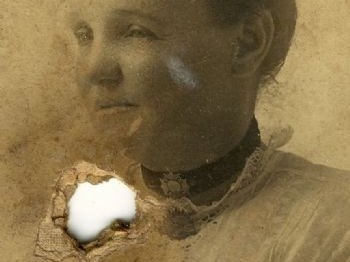
Look up images of the Seabrook brothers on the Internet and you will find one of all three of them in uniform, presumably on the eve of their departure from Australia since they all left Australia on board HMAT Ascanius on 25 October 1916. And there is another photograph too, this one was found on William Keith's body, it is a photograph of his gentle-looking mother which has a bullet hole through the bottom left-hand corner
IN MEMORY
OF THE DEARLY LOVED SON
OF J.H. PHILLIPS OF BRISBANE
PRIVATE ROBERT SIDNEY PHILLIPS
Soren Hawkes drew my attention to Private Phillips on her Twitter account, @sorenstudio. She published this document from Phillips' Australian Red Cross and Wounded Enquiry Bureau file:
Phillips R.S. 3098
Killed Sep. 25th 1917
Was in C. Coy., Lewis Machine Gunner. He was badly wounded in the legs and body during the hop over at Ypres. I saw him immediately after he was hit, his right leg was practically off. He later drew his revolver and blew his brains out. I did not see this happen. I don't know where he was buried.
Witness: - Sgt. W.S. Ward 1884, 49th Battn
Yet again I wonder how much information discovered by the Red Cross was passed on to the next-of-kin. Six months later another witness reported that he too had been told that Phillips had shot himself and the following month, April 1918 another witness gave a more graphic description:
I saw him after he was killed on September 25th at Passchendaele; he had been blown out of a shell hole and twisted like a cork screw. He crawled back into a shell hole and blew his head off with a rifle.
Rifle is probably more likely than revolver as only officers carried revolvers but whatever the weapon it appears that Phillips did kill himself. I wonder if his father knew. I rather hope not as Robert Phillips was a Roman Catholic, he said so on his attestation form, and to a Roman Catholic suicide is a mortal sin.
A GOOD LIFE
HATH BUT A FEW DAYS
BUT A GOOD NAME
ENDURETH FOR EVER
CAPTAIN WILLIAM HAROLD NICHOLLS
Captain Nicolls' inscription was chosen by his wife. It comes from Ecclesiasticus in the Book of the Apocrypha.
Have regard to thy name; for that shall continue with thee above a thousand great treasures of gold.
A good life hath but a few days: but a good name endureth for ever.
Ecclesiasticus 41:12-13
'Name' was a great preoccupation after the first world war. The names of the dead were recorded on memorials all over the Empire, great effort being exerted to ensure that no name was excluded. The statement "Their name liveth for evermore", the words from Ecclesiasticus 44:14, were carved onto Lutyen's Stone of Remembrance in all but the smallest war cemeteries, and was often the dedication on memorials in churches, villages, schools etc, all over the world. A similar sentiment was expressed on the the next-of-kin memorial scroll, "let those who come after see to it that his name be not forgotten", although here the responsibility for the names living for evermore lies with the generations who come afterwards. Name, or as in the case of this inscription, a good name, also has to do with renown, something that is above 'great treasures of gold' and which will endure for ever.
Billie Nicholls had emigrated to Australia and was working in the crockery department of Messrs Cribb and Foote, Ipswich, Queensland, when war broke out. He enlisted in the Australian Infantry and served throughout the Gallipoli campaign, earning a commission. The newspaper report of his death tells that he was so popular with his fellow soldiers that they all clubbed together to buy him a complete officer's kit.
Nicholls was born in Wales and his parents still lived there. In September 1916 he married Lily May Fuell in Holy Trinity, Llandbradach, South Wales. Returning to the front after a short holiday, he was killed on 26 January 1917. A shell dropped on the dugout where he had just gone for a rest and he was killed by concussion. This was the general conclusion of an Australian Red Cross Wounded and Missing Enquiry Bureau search, most of the witnesses assuring his wife that his body appeared untouched.
HE DIED FOR ITS COLOURS
AND SHED HIS HEART'S BLOOD FOR THE FLAG
PRIVATE LAURENCE RALPH STONE
Private Stone's inscription illustrates the impact of patriotic propaganda. Recruiting posters encouraged men to rally round the flag, whilst poetry from the South African War still cast its spell. Poems and Songs on the South African War (1901), featured an anonymous verse, The Union Jack, with the lines:
It's only a small piece of bunting,
It's only an old coloured rag,
Yet thousands have died for its honour,
And shed their best blood for the flag.
All this sentiment played into Private Stone's inscription but whereas for a soldier, 'the colours' usually mean the regimental flag, here it's the red, white and blue of the union flag around which, "Britons conquer, or die, but ne'er yield".
And how did Private Stone "shed his heart's blood"? A friend, reported:
"I saw him killed on the 30.12.17 at Warneton. He was caught by a shell and killed instantly. We were in the line at the time. I knew him very well, I went to school with him at Callie, W.A. His people are box manufacturers there. He was buried on New Year's morning at a little cemetery at Red Lodge near Warneton, I saw his grave, which was marked with a cross bearing his number, name and unit.
Pte. H Campbell 6423"
Report Australian Red Cross Society Wounded and Missing Enquiry Bureau files
HIS LAST WORDS TO FRIENDS
I WILL DO MY BEST
WHEN I GET THERE
GUNNER GEORGE FREDERICK PATTEN
Charles and Mary Patten had three sons. They all served in the war, only one returned. George, a railway fireman, was killed in Flanders on 28 August 1918. His brother Trooper Charles Douglas Patten, Australian Light Horse, died as a prisoner of war in Turkey on 9 February 1917.
Their sister, Mrs W.E.Webb, instituted a Red Cross Wounded and Missing Enquiry Bureau search for Charles. This revealed that he had been captured at Katia on 9 August 1916 and initially interned in Afion Kara Hissar. When he died six months later he was in Angora Paludean Cachexia. One of the witnesses informed the Red Cross "he was in & out of hospital every week at Angora, suffering from malaria - he was game to the last".
In answer to another query Trooper G.A. Roberts wrote: "We are not allowed to attend the burial of a fellow prisoner. When they die in hospital they are taken to a room in the hospital and washed and then conveyed on a stretcher to the hospital grave ward and buried by Turks (shrouds are unnecessary luxuries according to these people) there is no mark to show who is buried in certain places. We know they are English that is all."
After the war the bodies of all allied prisoners of war buried in Anatolia were exhumed and reinterred in Baghdad North Gate Cemetery. The graves are unidentified but the names of the dead are recorded at the cemetery. However, access to the cemetery is difficult at the present time and in acknowledgement of this the War Graves Commission have compiled a two-volume Roll of Honour of the casualties either buried or simply commemorated in Iraq, which can be inspected in the Commission's head office in Maidenhead.