Hymn
ENLISTED 8 AUGUST 1914
AND THEN IN HEAVEN
RECEIVE ME
MY SAVIOUR AND MY FRIEND
LANCE CORPORAL WILLIAM FLETCHER JONES
"Signaller's Fatal Wounds
Mr and Mrs J. Fletcher Jones, of 121 Mount Road, New Brighton, received official notification on Tuesday of the death from wounds of their eldest son, Lance-Corpl. William Fletcher Jones, which occurred in Flanders on November 9th. He had just turned 17 years of age when he joined the 4th West Lancashire Royal Field Artillery (Howitzer Brigade) in August 1914. He was drafted to Ypres in 1915 with the 2nd Canadian Division of which they formed part of the Artillery.
Sometime afterwards the 55th Division was formed with which they were embodied, and he was with the famous Division through the battles and hard fighting they experienced. After the battle of the Somme, he became attached to the Royal Engineers, having during the quiet periods made a special study of signalling, coming through the various examinations with the highest honours, and at the time of his death he was away on special duty in charge of the Brigade wireless.
Lance-Corpl. Jones was educated at Vaughan Road School, and for several years was a member of the 4th Wallasey (Emmanuel) Scouts, in which he took a most active and enthusiastic interest. Much sympathy has been extended to the parents in the loss of a gallant young life, just at the close of the fighting after 4 1/2 strenuous years."
William Fletcher Jones was born on 7 May 1897, the eldest child of John and Alice Jones of New Brighton, Cheshire. As his inscription records, Jones enlisted on 8 August 1914, four days after the outbreak of war. He died of wounds two days before the end. Jones was 17 and three months when he enlisted and 18 and four months when he disembarked in France on 29 September 1915. He was therefore underage. Soldiers were meant to be 19 before they could go to the front - unless they had their parents signed permission.
It's not possible to tell exactly when Jones was wounded but he is one of only six First World War soldiers buried in Chercq Churchyard. All six soldiers died on either the 8th or 9th November, casualties of the crossing of the River Escaut/Scheldt during that night when the 166th Brigade reported heavy enemy machine gun fire as they began to cross the river.
John Fletcher Jones signed for his son's inscription. The second part is a quotation from the last verse of the hymn, 'O Jesus I have promised to serve thee to the end':
Oh, let me see Thy footmarks,
And in them plant mine own;
My hope to follow duly
Is in Thy strength alone.
Oh, guide me, call me, draw me,
Uphold me to the end;
And then to rest receive me,
My Saviour and my Friend.
[Some of this information has been acquired from the excellent History of Wallasley website.]
MY BOY JACK
HE IS NOT HERE, BUT IS RISEN
PRIVATE JOHN WILLIAM KINGSLAND
John Kingsland was wounded on 28 October 1918 in the 1st/4th Seaforth Highlanders' attack on Mont Houy during the Battle of Valenciennes. He died nine days later in a Casualty Clearing Station in Cambrai.
Kingsland's father, John Padden Kingsland, a Congregational minister and an artist, chose his son's inscription. Whilst I can imagine that the family called John junior, Jack, I feel sure that the first line of the inscription is a reference to Rudyard Kipling's poem, 'My Boy Jack'. Many assumed that the poem, written in 1916, was a lament for his own son, John Kipling, but it is in fact a haunting generic lament for the thousands of dead sailors, 'Jacks', who died at the Battle of Jutland 31 May/1June 1916.
The poem may apply to sailors but the sentiment is appropriate to any grieving parent:
"Have you news of my boy Jack?"
Not this tide
"When d'you think he'll come back?"
Not with this wind blowing, and this tide.
[...]
"Oh dear, what comfort can I find?"
None this tide,
Nor any tide,
Except he did not shame his kind -
[...]
Then hold your head up all the more,
This tide,
And every tide;
Because he was the son you bore,
And gave to that wind blowing and that tide.
The second part of the inscription is a quotation from Luke 24:6. On the Sunday after the crucifixion the Mary, Jesus' mother, and Mary Magdalene, arrived at Christ's tomb to find that the body had gone. The distressed women found themselves addressed by two figures in shining garments who asked, "Why seek ye the living among the dead. He is not here but is risen". This evidence of the resurrection, of the fact that in Christ there is no death, brought great comfort to many mourning families.
NOW WITH TRIUMPHAL PALMS
THEY STAND
BEFORE THE THRONE ON HIGH
PRIVATE GORDON ROBINSON
Gordon Robinson's inscription comes from the third verse of the hymn: How Bright These Glorious Visions Shine. Written by Isaac Watts (1674-1748), the hymn is based on a passage from the Book of Revelation 7:13: 'And one of the elders answered, saying unto me, What are these which are arrayed in white robes? And whence came they?' The answer was: 'These are they which came out of great tribulation, and have washed their robes, and made them white in the blood of the Lamb.'
Verse three of Watts' hymn describes how:
Now with triumphal palms, they stand
Before the throne on high,
And serve the God they love, amidst
The glories of the sky.
Private Gordon Robinson served with the 1st/5th Battalion Gloucestershire Regiment, part of the 75th Brigade. The brigade had been in action throughout October 1918, the battalion diary reporting on the 12th that they had either been fighting or under enemy fire for the preceding seven days during which time they had advanced 13 miles, taken three villages, captured over 300 prisoners and many enemy guns. Their casualties had been 4 officers and 76 other ranks killed, and 24 officers and 469 other ranks wounded.
The battalion were rested for several days at Serain before going back into action for an attack on enemy positions south of Le Cateau on the 17/18 October. The attack met unexpectedly high resistance in the taking of the village of Bazuel. I think this is when Robinson would have been wounded. By the 3 November, the day he died, the battalion were 13 km away further east.
Robinson is buried in Le Cateau Military Cemetery where the majority of the graves belong to soldiers killed either in August 1914 or October/November 1918.
Mr George Henry Robinson signed for the inscription for Gordon, his middle son. At the time of the 1911 census the family were living at 42 Queen Street, Derby. When George Robinson gave his address to the War Graves Commission it was: 'Le Cateau', Belper Road, Derby. The Robinsons had named their new home after the cemetery where their son was buried. It was not an unusual custom. I wonder if the house still has that name today?
EARTH'S JOYS GROW DIM
ITS GLORIES PASS AWAY
SECOND LIEUTENANT JAMES DICK MM
When relations quoted from this hymn they usually quoted the first three words of the first verse: 'Abide with me', or the last line of the last verse: 'In life in death O Lord abide with me'. James Dick's parents have quoted from the second verse:
Swift to its close ebbs out life's little day;
Earth's joys grow dim, its glories pass away;
Change and decay in all around I see;
O Thou who changest not abide with me!
James Dick was a apprentice engineer in Gateshead-on-Tyne when he enlisted in the Durham Light Infantry soon after the outbreak of war. His medal card shows that he disembarked in France on 20 April 1915. He was a private. His military career shows his quality. Over the next two years he was awarded a Military Medal, promoted corporal, then acting sergeant and on 29 May 1917 he received a commission. Five months later, almost to the day, he died of wounds in one of the Casualty Clearing Stations at Proven.
He is buried in Mendinghem Military Cemetery. This was one of the humorous names the troops gave to this group of Belgian Casualty Clearing Stations, along with Bandaghem and Dozinghem.
FAITHFUL, TRUE AND BOLD
PRIVATE WILLIAM JOHN LARKIN
William Larkin's sister, Edith, chose his inscription. She was his only living relation their parents having both died by 1911. She chose a line from verse 3 of the hymn 'For all the saints'.
O may Thy soldiers, faithful, true and bold,
Fight as the saints who nobly fought of old
And win with them the victor's crown of gold,
Alleluia! Alleluia!
The siblings had not had an easy life. Father was a groomsman and domestic gardener who died in 1908. Their mother was deaf and had been since she was 25. Edith spent two years in the care of the Maidstone Poor Law Union between the ages of five and seven, and aged fourteen was living with her mother's sister. William doesn't appear in the 1901 census but by 1911 he was a grocer's assistant in Rottingdean.
William Larkin joined the 12th Battalion Sussex Regiment. The battalion were in France by March 1916 where they were heavily involved in the Somme campaign. On 8 October they relieved the 14th Battalion in the trenches at Auchonvillers. The war diary brackets the next three days with the comment:
"Our artillery & TMs (trench mortars) active in wire cutting & bombardment of enemy line. Enemy retaliated to some extent with TMs and 77 mm shells. Our trenches slightly damaged, but repaired each night. Enemy appear to have few heavy guns opposite us on this sector. 5 OR (Other Ranks) wounded, 3 OR killed."
YOUR MEMORY HALLOWED
IN THE LAND YOU LOVED
SOUTH AFRICA
SECOND LIEUTENANT ERROL SIDNEY PLOWES
Like yesterday's inscription, Errol Sidney Plowes' comes from the first verse of Sir John Arkwright's poem, which later became a hymn, O Valiant Hearts:
O valiant hearts who to your glory came
Through dust of conflict and through battle flame;
Proudly you lie, your knightly virtue proved,
Your memory hallowed in the land you loved.
Plowes' parents chose the last line, which is more usually quoted than the line above. However, unusually, they have identified 'the land he loved' - it was South Africa, the land where he was born and brought up and where his father, Sidney Arnold Plowes, worked for the Union Castle Shipping Line in Cape Town.
Born in Rondebosch on 22 February 1898, Plowes joined the 1st South African Infantry as a private in 1916 when he was just 18. On 8 April 1917, just after his 19th birthday, he received a commission into the Royal Field Artillery, serving with the 379th Battery, 169th Brigade. He was killed in action during the fighting for Hangard Wood, part of the German's Spring Offensive, a year and a day later when he was just 20.
YOU, YOUR KNIGHTLY
VIRTUE PROVED
SECOND LIEUTENANT WILFRED SPENCER BOWLES
Wilfred Bowles was killed in action on 10 July 1916 in the Welsh Division's attack on Mametz Wood. He was shot by a sniper. A theology student at King's College London, Bowles gave up his studies in June 1915 to join the Inns of Court OTC. Five months later he was commissioned into the 5th Battalion, Essex Regiment and three months after this he transferred to the Machine Gun Corps. He went to France on 4 June 1916 and was killed five weeks later.
William Spencer Bowles was the son of Tom and Alice Bowles of Les Rochettes, Pontac, St Clements, Jersey. His father was a house painter and his mother a school mistress who by 1911 was the head teacher of a church school on the island. This makes her one of the very few mothers in this project to have an independent career, least of all one with three children and a living husband.
Bowles' father signed for his inscription. It comes from the first verse of Sir John Arkwright's famous hymn, 'O Valiant Hearts', once a stalwart of Remembrance Day services before its sentiments went out of fashion:
O valiant hearts who to your glory came
Through dust of conflict and through battle flame;
Proudly you lie, your knightly virtue proved,
Your memory hallowed in the land you loved.
LEFT A WIFE &
TEN YOUNG CHILDREN
TO MOURN HIS LOSS
PEACE PERFECT PEACE
PRIVATE FREDERICK WILLIAM SAUNDERS
At the time of his death, Frederick Saunder's children were: Rose 14, Chrissie 13, Blanche 12, Florence 10, Daisy 9, Frederick 7, Cyril 6, Louisa 4, Ethel 3 and Agnes 2. A builder's labourer in Southborough near Tunbridge Wells in Kent, Saunders was in the army by September 1917.
Although a private in the 24th Battalion Manchester Regiment, Saunders joined the army as a sapper in the Royal Engineers and it's in a sapper's role that he worked for the Manchesters, digging and mending trenches and generally effecting other repairs. He served originally in Belgium before the battalion were withdrawn to Italy at the end of October 1917. Here they were based at Paderno where they spent the early months of 1918 on the Montello Hill near the River Piave constructing camouflaged areas for the artillery. It was here on 23 April, whilst he and his platoon were marching to work, that a shell burst among them. Saunders was severely wounded and died that day.
How did Mrs Saunders manage after the death of her husband? She married Lionel Skinner in the second quarter of 1919. Previously unmarried, he was 35, had lived with his parents in Southborough before the war and was a maker of cricket bat handles at Twort and Sons. The firm are known for their hand-made cricket balls but they must have made bats, or at least bat handles, too.
The last line of Saunder's inscription - Peace perfect peace - is one of the most popular of all inscriptions, and not just in war cemeteries. The words begin six out of the seven verses of a hymn written by Bishop E.H. Bickersteth, which questions how there can be peace, perfect peace in a world of sin, with our thronging duties, surging sorrows, loved ones far away, future unknown and the shadow of death hanging over us and those we love. The answer is to put our trust in Jesus,
It is enough: earth's struggles soon shall cease,
And Jesus calls us to heaven's perfect peace
Afterword:
Sevenoaks Chronicle and Kentish Advertiser
Friday 16 September 1927
The funeral of the late Mr Lionel Skinner of 23 Edward Street, who died at the General Hospital, Tunbridge Wells last week after a painful illness patiently born, took place on Saturday at Southborough Cemetery ....
[The majority of this information comes from the Imperial War Museum's Lives of the First World site.]
FOR THOSE IN PERIL ON THE SEA
RICHARD PAWSON
Richard Pawson was killed in a famous, or perhaps one should say, infamous, incident when a German U-boat fired on a group of six trawlers returning to their home port in Hull from a fishing trip in Icelandic waters. The trawlers were 55 miles south of the Faroe Islands when U-53 opened fire. Five of the trawlers had guns and after a three and a half hour engagement the trawlers eventually saw off the U-boat. The incident received much press publicity where it was viewed as a classic David and Goliath event since there was only one RN officer among the trawler crews, the rest of them were all civilian fishermen.
Richard Pawson was a 'spare hand' on the trawler SS Aisne. It was Aisne that achieved a direct hit on the U-boat just as the trawlers' ammunition was running out and the order 'prepare to ram' was about to be given. But Aisne herself had been badly hit: one crewman, Pawson, was killed and four others wounded.
Aisne returned to port and Pawson was buried in Hull Western Cemetery. His grave was not originally marked as a war grave but his name was included on the Mercantile Marine Memorial on Tower Hill. However, from the records, it looks as though his grave acquired a Commission headstone in 1998 and someone, the records do not record who, chose an inscription from the 'sailors' hymn:
Eternal Father strong to save
Who arm does bind the restless wave,
Who bids the mighty ocean deep
Its own appointed limits keep;
O hear us when we cry to Thee
For those in peril on the sea.
LEAD KINDLY LIGHT
AMID THE ENCIRCLING GLOOM
PRIVATE ERNEST CREASY HALL
The words of this hymn by John Henry Newman (1801-1890) have provided many inscriptions, usually from the first and last verses of this three-verse hymn:
Lead kindly light, amid the encicling gloom,
Lead Thou me on.
The night is dark and I am far from home,
Lead Thou me on;
Keep Thou my feet; I do not ask to see
The distant scene; one step enough for me.
...
So long Thy power hath blest me, sure it still
Will lead me on.
O'er moor and fen, o'er crag and torrent, till
The night is gone.
And with the morn those angel faces smile,
Which I have loved long since, and lost awhile!
The theme of stoically enduring this life, sustained by the hope of the eternal life to come, struck a note not only with the Victorians but with later generations too, as shown by the fact that it was one of the hymns regularly depicted in postcard series, like these Bamforth cards.
Ernest Creasy Hall was the younger son of Charles and Laura Jane Hall of Withernsea, East Yorkshire. Born in 1899, Ernest didn't come of military age until 1917 and wasn't old enough to serve abroad until 1918. He can't have been at the front for very long.
Hall served with the 2nd Battalion Kings Own Yorkshire Light Infantry and was killed in action on 13 March 1918 when the battalion were in the front line.
AND LET
OUR ORDERED LIVES CONFESS
THE BEAUTY OF THY PEACE
PRIVATE THOMAS HARRIS FOOT
Private Foot's wife, Alma, quotes from the still very popular hymn, 'Dear Lord and Father of mankind, forgive our foolish ways', for her husband's inscription. The hymn, adapted by W. Garrett Horder (1841-1922) from John Greenleaf Whittier's poem, 'The Brewing of Soma', attempts to encourage us to live simpler, more sober lives, seeking out silence and selflessness in order to be able to hear God's 'still, small voice of calm'. The inscription comes from thee penultimate verse:
Drop Thy still dews of quietness,
Till all our strivings cease;
Take from our souls the strain and stress,
And let our ordered lives confess
The beauty of Thy peace.
Thomas Harris Foot was born in Exeter in 1883, the son of John Spettigue Foot, a fruit merchant, and his wife, Annie. He married Alma Florence Matilda Little at St Paul's Kensington and Chelsea on 10 February 1916, giving his occupation as grocer and his address as Oare, Faversham, Kent.
Foot served originally in the Royal Engineers and then with the Army Ordnance Corps at the O.K.D. railhead. He's buried in Baillleul, which was a large hospital centre until it was overrun by the Germans just over two months after Foot's death. There is no indication as to the cause of his death.
I LIE HERE MOTHER
BUT THE VICTORY IS OURS
LANCE CORPORAL ALEXANDER MACK MM
Alexander Mack died of wounds in a Casualty Clearing Station six days before the end of the war. His mother chose his inscription. Is it a last message from her son, or are they words she has put into her son's mouth?
Lance Corporal Mack could well have known that victory was in sight. Although the Germans were still putting up fierce resistance, the Allies were daily pushing them further and further back towards Germany. Mack may not have known this but, Austria-Hungary had signed an armistice with the Italians on 3 November, a month after the Germans had approached President Wilson to see if they could negotiate a truce. Two days after Mack's death, General Hindenburg, head of the German army, opened peace negotiations with the Allies.
So Mack could well have known that military victory was in sight, but is this what the words mean? When Christians talk of victory they mean Christ's victory over death.
Death is swallowed up in victory. O death, where is thy sting? O grave, where is thy victory? The sting of death is sin; and the strength of sin is the law. But thanks be to God, which giveth us the victory through our Lord Jesus Christ.
1 Corinthians 15: 54-56
This famous passage from the bible was the inspiration for a hymn by the Scottish-born presbyterian minister William H Drummond (1772-1865) of which this is the first verse:
Thanks be to God, the Lord,
The victory is ours;
And hell is overcome
By Christ's triumphant pow'rs!
The monster sin in chains is bound,
And death has felt his mortal wound.
It's not impossible to think that Mrs Mary Mack was conflating Christ's victory over death with the British victory over the Germans, and that to her the 'monster' was Germany.
Alexander Mack was the son of James and Mary Mack. Born in Edinburgh, as were both his parents, the family moved to London soon after Alexander's birth. James Mack was a printer's machine minder, as were at least two of his sons, including Alexander. This was the person who was responsible for the overall look of the printed sheet, for the flow of the ink and the pressure of the rollers. Mack served with the 6th Battalion Northamptonshire Regiment and from the position of the Casualty Clearing Station where he died, was wounded in the fighting for the Sambre-Oise Canal.
WHAT PEACEFUL HOURS
WE ONCE ENJOYED
HOW SWEET THE MEMORY STILL
PRIVATE JOHN SHARP
John Sharp's inscription comes from verse three of the hymn, O For a Closer Walk With God, by the poet and hymn writer William Cowper (1731-1800):
What peaceful hours I once enjoyed!
How sweet their memory still!
But they have left an aching void
The world can never fill,
For John Sharp's family the words must have perfectly encapsulated their feelings - even though Cowper was not mourning the loss a loved one but the loss of God's love, which he felt he had forfeited through his own unworthiness.
Sharp came from Milesmark, a mining community near Dunfermline. His mother died in 1901 when he was five. His father, Frank Sharp, was a coal miner and it's possible to assume that John Sharp was too.
Sharp served with the 1st Battalion Cameron Highlanders, enlisting in 1916 when he became nineteen. He was a casualty of the opening day of the Battle of the Selle, 17 October 1918, in which the battalion took part as part of the 1st Division.
THE NIGHT IS DARK
AND I AM FAR FROM HOME
LEAD THOU ME ON
PRIVATE PERCY BEALEY
Nineteen-year-old Percy Bealey was killed in action in the taking of the village of Forceville on 8 October 1918. It must have been his father who chose his inscription. The name on the War Grave's form is Mrs Bealey, but Mrs Emma Bealey, his mother, died in 1912.
The inscription comes from the second line of John Henry Newman's famous hymn, Lead Kindly Light Amid the Encircling Gloom, which he wrote as a prayer. Newman longed for the consolation of Christian certitude in an age of doubt. The Bealey family, and the many other families who chose quotes from this hymn, longed for consolation in their grief and hoped to find it in God.
So long thy power hath blessed me, sure it still
Will lead me on;
O'er moor and fen, o'er crag and torrent, till
The night is gone;
And with the morn those angel faces smile
Which I have loved long since, and lost awhile.
I AM LISTENING LORD FOR THEE
WHAT HAST THOU TO SAY TO ME
SAPPER GEORGE JACKSON TREWHELLA
What does Mrs Ada Trewhella hope she is going to hear?
Master speak! They servant heareth,
Waiting for Thy gracious word.
Longing for Thy voice that cheereth;
Master, let it now be heard.
I am listening, Lord, for Thee;
What hast Thou to say to me?
She hopes to hear words that cheer, that bring her peace and that help her to accept God's will. Her husband, George Trewhella, is dead and she has been left with four daughters: Vera 12, Violet 11, Ada 7 and Lilian 3.
Master, speak! I do not doubt Thee,
Though so tearfully I plead;
Saviour, Shepherd! Oh! without Thee
Life would be blank indeed!
But I long for further light,
Deeper love, and clearer sight.
The words come from a hymn by Frances Ridley Havergal (1836-79).
George Trewhella worked for the Great Western Railway from 1902 until he was called up in May 1916. He was a plate layer who, according to his employer's reference, "gave satisfaction and proved himself a good workman".
Until January 1917 Trewhella was on home service but that month he went out to Salonika with the 267th Railway Coy. Royal Engineers. In August 1917, he spent a month in hospital with dysentery. Just over a year later he was admitted to hospital in Thessaloniki on 4 October suffering from influenza. He died the next day. The War Graves Commission's records say that he died of malaria but all his medical record cards say it was influenza.
Master, speak! I kneel before Thee,
Listening, longing, waiting still;
Oh, how long shall I implore Thee
Thy petition to fulfil!
Hast Thou not one word for me?
Must my prayer unanswered be?
GOD IS HIS OWN INTERPRETER
PRIVATE ALBERT ERNEST COPELAND
Private Copeland's father chose his inscription from a well-known hymn written by the poet William Cowper (1731-1800). Other relations chose to quote this hymn but most used the first line of the first verse - 'God move in a mysterious way' - whereas as Walter Copeland quoted from the last verse:
Blind unbelief is sure to err
And scan His work in vain;
God is His own interpreter,
And he will make it plain.
One way or another they are all saying the same as those relations who chose: 'God knows best', or 'We cannot Lord Thy purpose see but all is well that's done by Thee'.
Walter Copeland had perhaps more reasons than most to hope there was a purpose in God's actions. In June 1916 his eldest son Vivian Marshall Copeland died at the age of 21, three months later his wife, Mary Jane Copeland died at the age of 49. On the 22 March 1918 his youngest son, Harold, went missing in action and it wasn't until 16 July that Walter heard that he was a prisoner of war. Then just over two months after this his middle son, Albert Copeland died of pneumonia in Salonika aged 21.
Ye fearful saints, fresh courage take;
The clouds ye so much dread
Are big with mercy and shall break
In blessings on your head.
Judge not the Lord by feeble sense,
But trust him for His grace;
Behind a frowning providence
He hides a smiling face.
HE TOOK MY PLACE
FATHER
LIEUTENANT EDWARD FOX THAIRS
No other hope, no other plea;
He took my place, and died for me;
O precious Lamb of Calvary!
He took my place, and died for me.
This is the chorus of a hymn by Eliza Edmunds Hewitt (1851-1920) an American hymn writer. The 'he' who 'took my place' is Christ who died on the cross to save mankind.
I have to say that when I first saw this inscription I assumed that 'Father' was saying that it should have been him that died, not his son. It should have been him who went to war and got killed. The background fitted, father, Colonel George Thairs, the bursar of Ridley College, Ontario, had founded the embryo OTC, the Ridley Volunteer Cadet Corps, in his very first term there in 1889. And, when the Cadet Corps came into being in 1907, Thairs continued as the Contingent Commander, fostering in the pupils a martial spirit and a respect for drill.
His son, Edward Thairs, had been a pupil at the school. In 1916 he was working as a bank clerk when he joined the newly formed 176th Infantry Battalion, the Niagara Rangers, on 7 October 1916. The regiment was based in Thairs' home town, St Catharines, Ontario. The battalion left for Britain on 24 April 1917 where it became absorbed into the 12th Reserve Battalion, which provided reinforcements wherever they were needed. At the time of his death Thairs was serving with the 3rd Battalion Canadian Infantry, which took part in the capture of the town of Demuin on 8 August 1918, the day Thairs was killed.
Despite the fact that I can see that "He took my place" is a quote from a hymn, I don't discount the fact that Colonel George Thairs did actually feel that it should have been him that died rather than his son. After all, why wouldn't he?
SWEET FLOWERET
OF THE MARTYR'S BAND
SO EARLY PLUCKED
BY CRUEL HAND
GUNNER JOHN JOSEPH HAWKSWORTH
Gunner Hawksworth's inscription comes from the first two lines of a hymn written by the Revd John Dykes (1823-1877).
Sweet flowerets of the martyr band,
So early plucked by cruel hand;
Like rosebuds by a tempest torn,
As breaks the light of summer morn;
The hymn is based on a line from a poem by the Roman poet Aurelius Clemens Prudentius (c.348 - c.413). Clemens' poem writes graphically about the slaughter of the children by King Herod's 'cruel hand' on Holy Innocents' Day, 28 December, describing the children as, 'salvete, flores martyrum', 'torn by the storm on earth but now flowers in heaven'.
Hawksworth's mother chose his inscription. Martyr isn't a word that relations often used, sacrifice, yes, martyrdom, no - perhaps it's too Catholic a concept for a Protestant nation. John Joseph was her only child. Born in Edensor, Derbyshire where his father farmed, mother was living in Walcot, Shropshire when she chose her son's inscription, just 10 miles from Dawley where she had been born.
Hawksworth, a volunteer, served with 81st Battery, Royal Field Artillery. According to his medal roll, he arrived in France on 16 March 1915, which means that he was a volunteer. He died of wounds in a base hospital in Etaples on 19 September 1917.
MOVING UNRUFFLED
THROUGH EARTH'S WAR
THE ETERNAL CALM TO GAIN
MAJOR JOHN FREDERICK GRAHAM
John Frederick Graham was an Irishman, born in Rathdown, County Dublin, a mathematics medallist from Trinity College Dublin, who was the Accountant General in Madras, India. He was also a lieutenant colonel in the Madras Artillery Volunteers. On leave in England in September 1915, he offered himself to the War Office and was appointed a major in the Royal Field Artillery. He was killed in action, 'directing his artillery' on 1 July 1916, the opening day of the Battle of the Somme.
His inscription comes from a hymn by Horatius Bonar called The Inner Calm. The hymn asks in the first verse:
Calm me, my God, and keep me calm,
While these hot breezes blow;
Be like the night-dew's cooling balm
Upon earth's fevered brow.
The hymn goes on to enumerate the various situations in which the supplicant requires this 'calm': in solitude and in the busy street, in health, pain, poverty, wealth, when wronged, taunted or shamed. And the sort of 'calm' asked for is outlined in the final verse:
Calm as the rays of sun or star
Which storms assail in vain,
Moving unruffled through earth's war,
The eternal clam to gain.
Graham's inscription was chosen for him by his widow, Mrs FM Watt Smyth, who married Lieutenant-Colonel Gerald James Watt Smyth in January 1917. Their son, Major Brian James Watt Smyth, was killed in action in Burma in February 1945. His inscription reads: Blessed are the pure in heart.
PASSED BEYOND
ALL GRIEF AND PAIN
DEATH FOR THEE
IS TRUEST GAIN
PRIVATE WILLIAM WATCHAM
Safely, safely gathered in
Far from sorrow, far from sin,
Passed beyond all grief and pain,
Death for thee is truest gain:
For our loss we must not weep,
Nor our loved one long to keep
From the home of rest and peace,
Where all sin and sorrow cease.
Esther Watcham chose some lines from the second verse of this hymn by Mrs Henrietta Dobree (1831-1894) for her son's inscription.
There appears to be some confusion about Watcham. Firstly over the spelling of his name. Watcham is how the War Graves Commission spell it, and the census records; he appears as Watchman in Soldiers Died in the Great War, and as Watsham on the war memorial in his home town of Fingringhoe near Colchester in Essex. Then there's the fact that his record in SDGW states that he 'died' on 27 August 1917, not that he died of wounds or was killed in action, the implication being that he died of illness. However, the Colchester Chronicle reported on 14 September 1917 that Private William Watcham of the Manchester Regiment had been wounded, and then a month later, on 12 October, that he had died of wounds.
Nevertheless, however his name was spelt - and there is only one William Watcham, and no Watsham or Watchman, who served in the Manchester Regiment and died in the First World War - and whatever the cause of his death, this young man was dead, as his mother saw it:
Safely, safely gathered in,
No more sorrow no more sin;
God has saved from weary strife,
In its dawn, this young fresh life,
Which awaits us now above,
Resting in the Saviour's love.
Jesus, grant that we may meet
There, adoring at his feet.
IN MEMORY OF MY DEAR SON
SOME DAY
THE SILVER CORD WILL BREAK
PRIVATE JOSEPH FELTON
Private Fulton's inscription is taken from the first line of a hymn by the prolific, American hymn-writer, Fanny Cosby, 1820-1915:
Some day the silver cord will break,
And I no more as now shall sing,
But, O, the joy when I awake
Within the palace of the King.
And I shall see Him face to face,
And tell the story saved by grace.
Cosby in turn took the imagery from the Book of Eccelsiastes 12:6: "Or ever the silver cord be loosed, or the golden bowl be broken, or the pitcher be broken at the fountain, or the wheel broken at the cistern", all of which are metaphors for death. In the hymn, when the silver cord breaks we shall see God face to face, but somehow I feel that Mrs Felton believes that when the silver cord of her life breaks the 'He' she will see 'face to face' is her son.
The War Graves Commission has Private Joseph Felton, army number 11985, as aged 19 when he died. But the Joseph Felton 11985 who attested in West Bromwich on 19 September 1914 gave his age on that date as 19 and 88 days. He could have been lying but the 1901 census seems to confirm the fact that he would have been 19 in 1914 and 22 in 1917. Felton served with the 5th Battalion Dorsetshire Regiment and was killed in action on 5 October 1917 following the attack at Poelcapelle.
Some day, when fades the golden sun
Beneath the rosy-tinted West,
My blessed Lord will say, "Well done!"
And I shall enter into rest.
And I shall see Him face to face,
And tell the story saved by grace.
JESUS TOOK HIM FOR A SUNBEAM
PRIVATE GEORGE PARRY
George Parry's inscription comes from a popular Sunday School hymn, 'Jesus wants me for a sunbeam' of which this is the first verse and the chorus:
Jesus wants me for a sunbeam,
To shine for Him each day;
In every way try to please Him,
At home, at school, at play.
A sunbeam, a sunbeam,
Jesus wants me for a sunbeam;
A sunbeam, a sunbeam,
I'll be a sunbeam for Him.
Parry joined up in February 1917 when he was 18. He served with the 7th Battalion South Lancashire Regiment, joining them in France at the end of August 1917. Seven weeks later the sister-in-charge of the Casualty Clearing Station in Bailleul wrote to tell his parents that their son -
"was admitted severely wounded in the abdomen and although everything possible was done to relieve his condition he could not respond to his treatment and passed away on October 6, a few hours after admission".
His parents, sister and brother 'in France', and uncle and aunt all put notices announcing his death in the Liverpool Daily Post on both Wednesday 17th and Thursday 18th October. His parents' announcement concluded with a line from another hymn - 'Safe in the arms of Jesus'.
Safe in the arms of Jesus
Safe from corroding care,
Safe from the world's temptations;
Sin cannot harm me there.
Free from the blight of sorrow,
Free from my doubts and fears;
Only a few more trials,
Only a few more tears.
MARCHING TO THE PROMISED LAND
SECOND LIEUTENANT FREDERICK JOHN BARTLEY
This could be a coincidence but I don't think so. The Promised Land has a dual identity, it is both heaven and the physical land that God promised to Abraham, which was to stretch,: "from the river of Egypt unto the great river, the river Euphrates" [Genesis 15:18]. No one can quite decide whether 'the river of Egypt' referred to is the Nile or to the Wadi-el-Arish, but whichever it was Frederick Bartley was in the Promised Land when he was killed in the assault on Mansura Ridge in the First Battle of Gaza on 26 March 1917.
However, Bartley's inscription, 'Marching to the promised land', is a quote from the first verse of the hymn Through the Night of Doubt and Sorrow, not a statement of fact, even though factually
Through the night of doubt and sorrow
Onward goes the pilgrim band,
Singing songs of expectation,
Marching to the promised land.
And once he was dead, Bartley was of course, on his way to the promised land of heaven:
Where the one almighty Father
Reigns in love for evermore.
What I find curious is the fact that the first time I come across this inscription,it is on a grave in Palestine. I have not seen it in France or Flanders.
An auctioneer in East Anglia, Bartley was a member of the 1st/5th Battalion Essex Regiment, a Territorial battalion. Posted to Gallipoli in May 1915, the battalion was withdrawn to Egypt in December, spent 1916 defending the Suez Canal before moving to Palestine early in 1917.
HIS WEB OF TIME HE WOVE
PRIVATE GEORGE EDWARD EVANS
George Evan's inscription comes from a hymn, The Sands of Time are Sinking written in 1857 by Anna Ross Cousin, the wife of a minister in the Free Church of Scotland. She was inspired by the writings of Samuel Rutherford (1600-1661) on whose last words, "Glory, glory dwells in Immanuel's land", she based the refrain in her nineteen-verse hymn.
The inscription comes from verse 9:
With mercy and with judgement
My web of time He wove,
And aye the dews of sorrow
Were lustred with his love!
I'll bless the hand that guided,
I'll bless the heart that plann'd,
When thrones where glory dwelleth
In Immanuel's land.
What happens in your life is willed by God and although you may meet with sorrow, scorn, hatred and woe along your way at the end you can be sure that "Glory - glory dwelleth in Immanuel's land.
George Evans, who served in D Coy 1st/5th King's Own Royal Lancaster Regiment, died of wounds in a Casualty Clearing Station at Lijssenthoek on 8 January 1917.
WHERE LOYAL HEARTS AND TRUE
STAND EVER IN THE LIGHT
LIEUTENANT MONTAGUE GERALD HERBERT CHAPMAN
The report of Lieutenant Chapman's death in the Newcastle Journal on 1 September 1917 concludes with the words of his commanding officer: "He was doing a very brave deed at the time of his death, which was instantaneous. He was a very brave officer, and I cannot tell you [how] I feel his loss".
The 'brave deed' was the attempt to cross the Steenbeek in order to get a foothold on the east bank prior to the launch of the Battle of Langemarck. There had been several attempts to achieve this since the 8 August but they had all failed. This attempt succeeded in taking enough of the ground for the main attack to go ahead on the 16th, even though the German blockhouse, Au Bon Gite, lost to the Germans on the 31 July, held out until the 16th. The attack cost the 10th Battalion the Rifle Brigade, in which Chapman was serving, 215 casualties.
Chapman's father, Frederick Herbert Chapman, a wine merchant and brewer in Rye, Sussex, chose his inscription. It comes from the hymn 'O Paradise, O Paradise' where it is repeated at the end of every verse:
Where loyal hearts and true
Stand ever in the light
All rapture through and through
In God's most holy sight.
IN THE MORN
THOSE ANGEL FACES SMILE
LONG LOVED
BUT ONLY LOST AWHILE
SERJEANT FRED IFOULD, MM
Fred Ifould's inscription is a contraction from the last verse of John Henry Newman's very popular hymn 'Lead Kindly Light'. The verse itself reads:
So long thy power hath blest me, sure it still will lead me on,
O'er moor and fen, o'er crag and torrent, till the night is gone,
And with the morn those angel faces smile,
Which I have loved long since and lost awhile.
Ifould was a regular soldier. In the 1911 census he was serving with E Battery, Royal Field Artillery and living in Artillery Barracks, Chapeltown Road, Leeds. He and his brother, Harry, were both serving with the same battery and had consecutive army numbers indicating that they had joined up together. One of them, and I can't tell which, was a member of the gun crew that at 9.30 am on 22 August 1914 fired the first artillery round of the First World War on the Western Front. I have a suspicion that it was Harry Ifould because the crew list says Gunner Ifould and I think Fred Ifould was a bombardier by the outbreak of war.
Harry Ifould survived the war but Fred, now serving with D Battery 155th Brigade, was killed in action on the 23 October 1917, just before the opening day of the 2nd Battle of Passchendaele.
A BRAVE, BRIGHT SPIRIT
HIS LAST WORDS WERE
"CARRY ON"
SECOND LIEUTENANT RONALD HOWORTH STOTT
Stott - Killed in action on the 20th of September, 1917, Second-Lieutenant Ronald Howorth Stott, L.N. Lancashire Regiment, attached the Rifle Brigade, aged 21, the dearly loved only son of Mr. and Mrs C.H. Stott 112 Hare Street
"God grant the sacrifice be not in vain"
Rochade Observer 29 September 1917
For the announcement of their son's death Mr and Mrs Stott chose a line from John Oxenham's 'Epilogue 1914', but for his actual headstone inscription they quoted his own words: 'Carry On'.
According to a letter to his parents from Lt. Colonel Slogett, Stott was killed leading an attack on the opening day of the Battle of Menin Road, his body brought back and buried behind the lines in the presence of his company and brother officers.
It was only three weeks since Stott had been home on leave, celebrating his 21st birthday. Like all parents they must have feared the worst; the announcement of his death may have described him as their only son but he was in fact their only child. They describe him as a brave, bright spirit. The poet Gerald Massey (1828-1907) had described Nelson with these words, on the morning of the Battle of Trafalgar, as though he had foreseen his own death:
His proudly-wasted face, wave-worn,
Was loftily serene;
I saw the brave, bright spirit burn
There all too plainly seen;
As though the sword this time was drawn
Forever from the sheath;
And when its work to-day was done,
All would be dark in death.
NO BURDENS YONDER
ALL SORROW PAST
NO BURDENS YONDER
HOME AT LAST
SAPPER CECIL JOHN OSBORN
Sapper Osborn's inscription comes from a hymn written by Ada Habershon at the beginning of the twentieth century. The hymn itself is based on verse 4 of the Book of Revelations Chapter 21:
And God shall wipe away all tears from their eyes; and there shall be no more death, neither sorrow, nor crying; neither shall there be any more pain: for the former things are passed away.
The hymn itself welcomes the fact that at death everyone will lay down their burdens, there will be no testing, no toiling, no weariness, no disappointments, no distress, no partings, no pain, no sickness and no weeping. Osborn's inscription forms the chorus.
Osborn, a carpenter, enlisted on 14 February 1916. He arrived in France on 27 January 1917 and was killed on 19 October 1917. His mother, filling in the circular for the Roll of Honour of Australia, tells us what happened. He was "wounded in the right knee going from the line to his dugout with piece of shell and died the same day". The records of No. 3 Canadian Casualty Clearing Station describe it as a gunshot wound, but whichever it was it caused his death.
OUR BODIES MAY
FAR OFF REMOVE
WE STILL ARE ONE IN HEART
NELLIE
SECOND LIEUTENANT A.E. CRAWFORD HARRIS HARRIS
'Nellie', Mrs Ellen Harris, was Crawford Harris's wife and certainly the inscription sounds as though it was written by a wife declaring that she still loves her husband even though he is dead. I rather suspect that this is exactly what Nellie Harris meant it to sound like. The words rather appropriately come from a hymn for the sick and dying.
Blest be that sacred cov'nant love,
Uniting tho' we part;
Our bodies may far off remove,
We still are one in heart.
....
Nor joy nor grief, nor time nor place,
Nor life nor death can part
Those, who enjoying Jesus' grace,
In him are one in heart.
At the time of the 1911 census, Crawford and his wife had been married for six years. Crawford was a traveller for an iron merchant, they had no children and Nellie's mother lived with them. He died of wounds at one of the several 'Mendinghem' Casualty Clearing Stations.
I KNOW NOT WHAT AWAITS ME
GOD KINDLY VEILS MINE EYES
PRIVATE DAVID BROWN MADDISON
David Maddison died of wounds in a base hospital at Etaples. The War Graves Commission gives his date of death as between the 24th and the 25th July. I've seen this before when no one has known exactly when a man has died in battle but not when he's died in hospital. Did he die at midnight or was he found dead in his bed in the morning and no one could say when he had passed away? It's not possible to tell at this distance but I rather like the careful honesty of the records.
His inscription comes from a hymn from the Methodist Sunday School hymn book, which was based on a poem by the American poet Mary Gardiner Brainard 1837-1905. The poem was called 'Not Knowing'. The words were arranged for the hymn by Philip Bliss. The first verse is rather surprisingly positive:
I know not what awaits me,
God kindly veils mine eyes,
And o'er each step of my onward way
He makes new scenes to rise;
And every joy He sends me, comes
A sweet and glad surprise.
It's verse three that must carry the message the Maddison's wanted to convey:
Oh, blissful lack of wisdom,
'Tis blessed not to know;
He holds me with his own right hand,
And will not let me go,
And lulls my troubled soul to rest
In Him who loves me so.
MY DEAR SON FRED
OH! THE PAIN
WHAT JOY WHEN WE MEET
AT JESUS' FEET
PRIVATE FREDERICK SUMMERSGILL MITCHELL
For Private Mitchell's mother the pain was doubled when Frederick's twin brother died of wounds in September 1918. The brothers have consecutive service numbers - 3541 and 3542 - even though from the embarkation rolls it looks as though Frederick joined up on 21 July 1915 and his brother, Matthew Hawton Mitchell, on 1 December 1915. They left Australia together on 5 January 1916.
By the time Mrs Mitchell chose her sons' inscriptions she was a widow. Like many, many relations her consolation in her grief came from the belief that they will all meet again in the afterlife. Her reference to Jesus' feet comes from the chorus of the hymn God be with you till we meet again.
Till we meet, till we meet,
Till we meet at Jesus' feet,
God be with you till we meet again.

SAFE HOME AT LAST
PRIVATE CHARLES W. ALDRIDGE
So many hymns contain this line that it would be impossible to say with any certainty which one it came from. And does it matter since we all must know what it means: that death has freed us from the trials and tribulations of this mortal life and we are now safe 'home', for the Christian, in heaven.
Forced to choose, my front runner would be the Afternoon Hymn by Geoffrey Thring (1823-1894), mainly because it was the best known. Verse 2 reads:
Our life is but a fading dawn,
It's glorious noon how quickly past;
Lead us, O Christ, when all is gone,
Safe home at last.
When Earth's Labours Are O'er' is another contender. Although I think this is much less likely because it was not so widely known, I have quoted from it as it perfectly captures the wider meaning of the inscription. You can get this from the first two lines of the first verse and the last two lines of the final verse.
When earth's labours are o'er, and I rest on the shore
Of that land where no storms ever beat,
...
All my fears will be past; I'll be safe home at last,
Evermore with the Lord there to be.
In 1911 Charles Aldridge was a thirty-one-year-old married man with two children of three and nine months working as a domestic butler for the owners of Gay's House, Holyport, Berkshire. He served with the 2/4th Royal Berkshire Regiment and was killed in action in the attack on Pond Farm when the battalion war diary for the 22nd/23rd August recorded two officers wounded and missing, 32 other ranks killed, 25 wounded and missing, and 54 missing. Aldridge was among the missing, his body not discovered until September 1919 when it was identified by his identity disc and paybook. His wife, Margaret, now of the General Store, Windsor Road, Maidenhead, Berkshire, chose his inscription.
BRIEF LIFE
IS HERE OUR PORTION
BRIEF SORROW
SHORT LIVED CARE
RIFLEMAN WILLIAM HOYLE
These are the first two lines of a hymn written by Bernard of Cluny in the 12th Century and translated by the English hymn writer, J.M. Neale, in 1858.
Brief life is here our portion,
Brief sorrow, short-lived care;
The life that knows no ending,
The tearless life is there.
And where is 'there', where 'grief is turned to pleasure' and 'shadows shall decay? 'There' is the 'sweet and blessed country' where 'short toil' is turned to 'eternal rest' - in other words, heaven.
There, God our King and portion,
In fullness of his grace,
We then shall see for ever,
And worship face to face.
William Hoyle was killed on the opening day of the Battle of Polygon Wood (26 September - 3 October 1917) in which new tactics were employed and the weather for once favoured the attackers resulting in the British capturing and holding some strategically significant high ground. His mother signed for his inscription, William was the oldest of her nine children.
WAITING IN HOLY STILLNESS
WRAPT IN SLEEP
RIFLEMAN FRANK WILLIAM PROUDMAN
This inscription is yet more evidence of the comfort relatives derived from their belief in the resurrection of the dead. It comes from a hymn by Sabine Baring-Gould (1834-1924) of which these are the first two verses:
On the Resurrection morning
Soul and body meet again;
No more sorrow, no more weeping,
No more pain!
Here awhile they must be parted,
And the flesh its Sabbath keep,
Waiting in a holy stillness,
Wrapt in sleep.
But it's the penultimate verse that says it all:
On that happy Easter morning
All the graves their dead restore;
Father, sister, child and mother,
Meet once more.
Frank Proudman was killed on the first day of the Battle of Langemarck. Buried on the battlefield, two years later his body was exhumed as that of an unidentified British soldier. Later it was identified, according to the records, by his spoon.
Proudman was a married man and in July 1919 his wife, Wilhelmina Edith Proudman, received his war gratuity. However, when it came to the time to choose his inscription she was dead, consequently it was his mother chose the words. Wilhelmina died in December 1921, a fact that provides an interesting clue to the length of time it took the War Graves Commission to send out the requests for inscriptions.
THOU LORD, THEIR CAPTAIN
IN THE WELL FOUGHT FIGHT
HALLELUJAH
LIEUTENANT FREDERICK GUNDY SCOTT
There are so many lines from this hymn that can be and have been used as inscriptions. The hymn, 'For all the saints who from their labours rest', is both rousing and consoling in its promise that Christ is with us and that at the end of our lives we shall live with him in glory. With its martial imagery and language it is particularly consoling for the relations of those who have been killed in battle. Frederick Scott's inscription comes from verse two:
Thou wast their rock, their fortress and their might:
Thou, Lord, their captain in the well-fought fight;
Thou in the darkness drear their one true light.
Alleluia!
Scott was a student at Victoria College, Toronto when war broke out. He volunteered in the summer of 1915, was appointed to the 40th Battery Canadian Field Artillery and went overseas with them in February 1916. In July 1916 they were sent to the Western Front where they served first in the Ypres Salient and then on the Somme. In April 1917 the battery took part in the battle of Vimy Ridge. Scott was killed a few days later in the village of Vimy, hit by a shell when moving his guns to a new location.
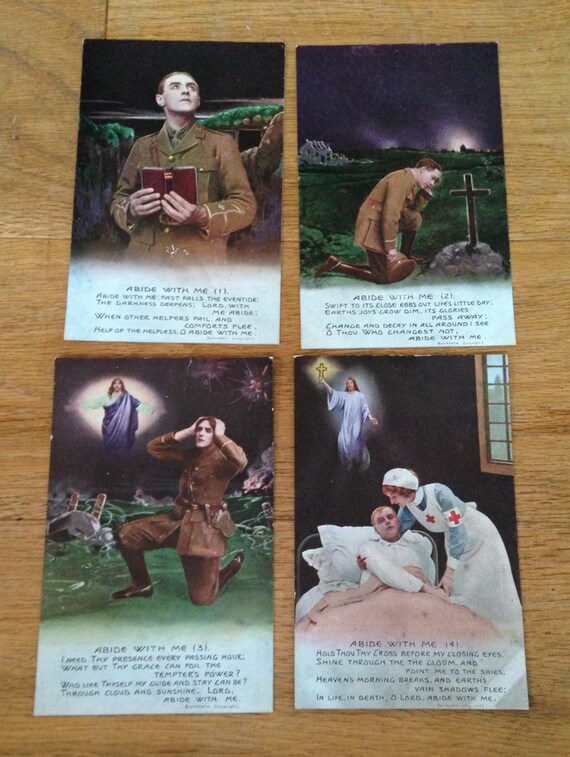
ABIDE WITH ME
ACTING ENGINE ROOM ARTIFICER 4TH CLASS GEORGE DOIG CHALMERS
'Abide with me' are the opening words of the first verse, and the last words of every verse, of a hymn known by the same name. Written by Henry Francis Lyte in 1847, a large part of the hymn's great popularity is attributable to the tune, Eventide, written by William Henry Monk in 1861. Sung at funerals, military services, royal weddings and sporting events, it is one of the best-known hymns of all time.
The words, based around two passages from the bible, bring comfort to both the dying and to the bereaved. This is the first verse:
Abide with me; fast falls the eventide;
The darkness deepens; Lord, with me abide;
When other helpers fail and comforts flee,
Help of the helpless, oh, abide with me.
It was apparently very popular during the First World War and it certainly featured in a set of Bamforth postcards showing a soldier praying in the trenches, kneeling by a battlefield grave, alone in No Man's Land and being held by a nurse whilst dying.
George Doig Chalmers was an engine fitter from the Govan shipyards on the River Clyde. He enlisted in the Royal Navy on 27 November 1915 and after a month's training on HMS Pembroke, the name of the naval training establishment at Chatham, he joined HMS Fortune on 27 December 1915. On the night of the 31 May/1 June 1916, during the Battle of Jutland, Fortune was hit in a firefight, caught fire and sank. There were eight survivors.
Over the next weeks a few bodies from the Battle of Jutland drifted ashore off the coasts of Norway, Sweden and Denmark. But only a very few, more than 6,000 British sailors died at Jutland, the bodies of fewer than 200 were recovered. Chalmers' body was one of those recovered and on 24 June he and another crew member, Arthur Stott, were buried in the town cemetery in Fredrikstad, Norway along with sixteen other British Jutland casualties, only seven of them identified - one from HMS Ardent, two from HMS Tipperary and two from HMS Queen Mary.
THE LOVE
THAT MAKES UNDAUNTED
THE FINAL SACRIFICE
PRIVATE WILLIAM PEATTIE
I have to say that I admire Mrs Janet Peattie, Private Peattie's mother, she has not only chosen a beautiful inscription that is strangely uncommon, but in filling in the biographical information for the War Graves Commission she has managed to provide brief but pertinent information. Thanks to her we know that her son was an apprentice cabinet maker, that he enlisted on 1 June 1915, was wounded on 8 July 1917 and that therefore it took him ten days to die at a Casualty Clearing Station in Proven. Mendinghem, along with Bandagem and Dozinghem, were the popular names the soldiers gave to these hospitals
The inscription comes from the last line of the first verse of Sir Cecil Spring Rice's poem 'I Vow to Thee My Country'. Rice wrote the original poem in 1908 and called it 'Urbs Dei', the City of God. In 1918 he added a new first verse, the one Janet Peattie has quoted from. This replaced the old first verse and very movingly reflects the terrible sacrifice Britain has asked the nation, and especially its young men, to make. Set to music by Gustav Holst in 1921, and published in the hymn book 'Songs of Praise' in 1926, the hymn is now a firm favourite and for many years was a stalwart of Remembrance Day services. This link gives all three verses but Rice always intended the current first verse to replace the second verse that is shown in this link.
I said at the beginning that William Peattie's inscription was strangely uncommon, considering the poem's sentiments, and that it refers specifically to the war dead, I might have expected to have seen it more often, but I haven't. So this is something else I admire Mrs Peattie for. This is verse one:
I vow to thee, my country, all earthly things above,
Entire and whole and perfect, the service of my love;
The love that asks no question, the love that stands the test,
That lays upon the altar the dearest and the best;
The love that never falters, the love that pays the price,
The love that makes undaunted the final sacrifice.
NOTHING IN MY HAND I BRING
SIMPLY TO THE CROSS I CLING
PRIVATE FRANK CULLEN
Yesterday's inscription quoted from the first line of the first verse of the hymn 'Rock of Ages', today's quotes the first two lines of the second verse:
Nothing in my hand I bring,
Simply to Thy cross I cling;
Naked, come to Thee for dress;
Helpless, look to Thee for grace;
Foul, I to the fountain fly;
Wash me, Saviour, or I die!
Twenty-one-year-old Frank Cullen was a butcher from Mallala a small community 58 kilometres north of Adelaide where the war memorial commemorates ten men "who died in defence of home and liberty". Cullen enlisted on 9 September 1916, embarked from Australia on 6 November 1916 and was killed in action on Christmas Day 1917.
ROCK OF AGES CLEFT FOR ME
PRIVATE JOSEPH PERCY COOPER
Of all the hymns quoted in inscriptions this is one of the most popular:
Rock of ages cleft for me,
Let me hide myself in Thee;
Let the water and the blood,
From Thy riven side which flowed,
Be of sin the double cure,
Cleanse me from its guilt and power.
It was a favourite nineteenth century hymn appearing in virtually every Protestant hymnal - of which there were fifty-two. And it was a favourite funeral hymn, Prince Albert, Queen Victoria's husband even asked for it to be played to him as he lay on his deathbed. Christ is the Rock of Ages, from whose side the water and blood flowed at his crucifixion, the event which guaranteed man's salvation.
Private Cooper was initially listed as missing. His parents instituted an Australian Red Cross Enquiry from which it was possible to piece together what happened to him:
"Informant states that the 26th A.I.F. were going into the line at Zonnebeke at about 8 pm on Oct/4th/17 when Cooper was struck by a shell and killed instantly a piece of shell went right through his lungs."
Private V.H. Lusk
"I saw him killed on the tape just as we left the duck boards to go over at Zonnebeke on the 4th October about 4.30 am. A whizz-bang killed him and Whipler and wounded several."
Private J.S. Locke
"I saw him killed at Ypres. He was caught by a shell fragment in the chest and killed instantly."
T.S. Burns
"I buried my comrade 400 yards from Zonnebeke Church as near as possible. ... The said soldier was a dear friend of mine and ... I would like his parents to know his comrades buried him decently."
Private G. Graham
TO OUR PRECIOUS SON
SO LOVED AND LONGED FOR
"UNTIL HE COME"
PRIVATE PENRYN STANLEY CHURCHILL
Penryn Churchill was his parents youngest son; there were almost ten years between him and his next brother, Herbert. A Chartered Accountant's Clerk working in London, he enlisted in November 1915 and after training embarked for France in October 1916.
On the morning of 15 March 1917, Colonel Ward of the 2nd Battalion Honourable Artillery Company, in which Churchill was serving, received orders to send out two patrols towards the village of Bucquoy. Ward was furious, those on the ground could all see that the Germans were present in great strength but Brigade H.Q. was insistent. Sent out at 2 pm that afternoon, the patrols met the expected devastating fire and lost heavily.
The Regimental History remarks that, "It is difficult to speak too highly of the gallantry and dash with which 'A' and 'B' Companies advanced, though it seemed to everyone that men were being thrown away on a very hopeless undertaking". But, although the Brigadier had protested strongly, and his protest had been backed by the Divisional Commander, Fifth Corps' reply had been that Army Headquarters insisted on the attacks being carried out "though those in authority could not have appreciated the practical difficulties of the situation". This appears to be a classic case of "those in authority" versus "those on the ground".
Churchill's inscription finishes with the words, "Until he come". This is not "Till he come" in which case it would have been a quote from 1 Corinthians 11:26 in which Christ tells his disciples that the bread of the Last Supper is to represent his body, and the wine his blood and that they are to eat and drink it in remembrance of him:
For as oft as ye eat this bread, and drink this cup, ye do shew the Lord's death till he come.
However, the words are "Until He come" and quote a hymn by George Rawson (1807-1889) based on the same biblical episode where they are the last words of five of the six verses. Christians are to eat and drink Christ's body and blood to sustain them through their lives until "the trump of God be heard", when the dead shall be raised up.
O blessed hope! with this elate
Let not our hearts be desolate,
But strong in faith, in patience wait
Until He come.
WE FEEBLY STRUGGLE
THEY IN GLORY SHINE
PRIVATE WALTER BERRY
This inscription comes from the fourth verse of the hymn, 'For all the saints, who from their labours rest'. Written by the Bishop of Wakefield, William Walsham Howe (1823-1897), the hymn has a particularly martial tone but the rousing words and the Ralph Vaughn Williams' tune to which it is usually sung gives it a memorably haunting quality.
The saints rest from their labours on earth where Christ was "their Captain in the well fought fight". May we be as soldiers - "faithful, true and bold", and "fight as the saints who nobly fought of old", and win as they did, "the victor's crown of gold".
O blest communion, fellowship divine!
We feebly struggle, they in glory shine;
Yet all are one in Thee, for all are Thine.
Alleluia, Alleluia!
And when the strife is fierce, the warfare long,
Steals on the ear the distant triumph song,
And hearts are brave again, and arms are strong
Alleluia, Alleluia!
The golden evening brightens in the west;
Soon, soon to faithful warriors comes their rest;
Sweet is the calm of paradise the blessed.
Alleluia, Alleluia!
It's a hymn of hope: the hope that when we have finished feebly struggling we shall live with Christ in Glory.
Walter Berry was an iron founder from Huddersfield in Yorkshire. He served with the 7th Battalion Yorks and Lancaster Regiment, a New Army battalion, that crossed to France in July 1915 and was engaged on the Western Front from then onwards.
NOW THE DAY IS OVER
PRIVATE JOSEPH BELL
Private Bell's mother chose his inscription. It's the first line of a popular evening hymn usually sung by children:
Now the day is over,
Night is drawing nigh,
Shadows of the evening
Steal across the sky.
Twenty-one-year old Joseph Bell was killed in action on 30 December 1916 and buried in Priez Farm Cemetery, Combles. As the war progressed several of the graves in this cemetery were destroyed and lost in the subsequent fighting. Bell's was one such grave. He now has a 'special memorial' in a memorial plot in Guards' Cemetery, Combles. The memorial plaque reads:
To the memory of these 29 British soldiers, killed in action in 1916, 1917 and 1918 and buried at the time in Priez Farm Cemetery, Combles, whose graves were destroyed in later battles. "Their glory shall not be blotted out."
The quotation in the final line comes from Ecclesiasticus 44:13 and was chosen by Rudyard Kipling for the special memorial headstones that commemorate soldiers whose graves were destroyed subsequent to their known burial.
THE DAY THOU GAVEST
LORD IS ENDED
PRIVATE HERBERT HORACE ATTEWELL
Private Attewell's wife Elizabeth chose his inscription; it comes from the first line of a very popular evening hymn, which is still one of the most popular of all hymns today:
The day Thou gavest, Lord, is ended,
The darkness falls at Thy behest;
To Thee our morning hymns ascended,
Thy praise shall hallow now our rest.
Attewell, a plasterer, was born in England, as was his wife. They married in England in 1904 but by the time their son Wilfred Cecil was born in 1913 they were living in Thunder Bay, Ontario. Attewell volunteered in Ontario in September 1915, served with the 52nd Battalion Canadian Infantry and died of wounds at a field ambulance dressing station on 9 July 1916.
PEACE SHALL FOLLOW BATTLE
NIGHT SHALL END IN DAY
LIEUTENANT HUMFREY RICHARD TALBOT
Lieutenant Talbot's inscription is a quotation from verse 3 of a hymn by John Mason Neale (1818-1866):
Christian! dost thou hear them,
How they speak thee fair?
"Always fast and vigil?
Always watch and prayer?"
Christian! answer boldly,
"While I breathe I pray."
Peace shall follow battle,
Night shall end in day.
Humfrey Richard Talbot was the third son of George Gustavus Chetwynd Talbot, Mayor of Hemel Hempstead. Educated at Wellington College and at Frieburg in Germany, he was gazetted into the King's Liverpool Regiment in 1909, transferred to the 3rd Dragoon Guards in February 1913 and embarked for France on 30 October 1914. He was killed by shellfire two weeks later on 13 November.
ABIDE WITH ME
HE FELL A CONQUEROR
LEADING THE ASSAULT
SUNDAY 16TH MAY 1915
LIEUTENANT COLONEL HARRY RODERICK BOTTOMLEY
Lieutenant Colonel Harry Bottomley, commanding the 2nd Battalion The Queen's West Surrey Regiment, died on 18 May of wounds he'd received two days earlier leading an assault on the German salient at Festubert. His inscription begins with the opening words of Henry Lyte's hymn, a prayer asking for God's supporting presence through all life's trails and especially when facing death. The first and last verses read:
Abide with me; fast falls the eventide;
The darkness deepens; Lord with me abide.
When other helpers fail and comforts flee,
Help of the helpless, O abide with me.
Hold Thou Thy cross before my closing eyes;
Shine through the gloom and point me to the skies.
Heaven's morning breaks, and earth's vain shadows flee;
In life, in death, O Lord, abide with me.
LOVED AND LOST AWHILE
LIEUTENANT MONTAGUE DOUGLAS SPANKIE
Lieutenant Spankie's mother has adapted a line from Cardinal Henry Newman's extremely popular hymn 'Lead Kindly Light' for her son's headstone inscription. The hymn is not an unusual source for inscriptions but it's usually the first line of the first verse that's chosen:
Lead, kindly light, amidst th'encircling gloom,
Lead Thou me on!
The night is dark, and I am far from home,
Lead Thou me on!
Keep Thou my feet; I do not ask to see
The distant scene; one step enough for me.
Mrs Spankie, a widow whose husband, Montague's father, had been an officer in the Indian army, has adapted a line from verse 3:
So long Thy power hath blest me, sure it still
Will lead me on.
O'er moor and fen, o'er crag and torrent, till
The night is gone.
And with the morn those angel faces smile,
Which I have loved long since, and lost awhile!
It is not clear how Lieutenant Spankie died but the previous two days, 12th and 13th May, the 29th Indian Brigade, which had only arrived in Gallipoli on 1 May, had taken part in an action that became known as Gurkha Bluff. Did Lieutenant Spankie die from injuries sustained in that action or was he killed by a sniper as the Brigade withdrew the next day?
BEHIND ALL SHADOWS
STANDETH GOD
LIEUTENANT COLONEL ROBERT GARTSIDE
Fifty-two-year-old Lieutenant-Colonel Robert Gartside was mortally wounded as he rose to lead an attack on the Turkish trenches during the Second Battle of Krithia. He is quoted as having just said, "Come on boys, I know it's deadly, but we must get on," when he was hit in the abdomen by machine gun bullets.
His inscription sounds as though it must be a quotation. It could be a reference to the hymn 'Once to Every Man and Nation'. The hymn's sentiment would have been seen to be appropriate:
Once to every man and nation
Comes the moment to decide,
In the strife of truth with falsehood,
for the good or evil side;
Some great cause, God's new Messiah,
Offering each the bloom or blight;
And the choice goes by for ever
'Twixt that darkness and that light.
With the last verse concluding:
Though the cause of evil prosper,
Yet 'tis truth alone is strong;
Though her portion be the scaffold,
And upon the throne be wrong,
Yet that scaffold sways the future,
And, behind the dim unknown,
Standeth God within the shadow,
Keeping watch above his own.
This looked to me as though it was the closest we were going to get to the source of the epitaph. However, I put the phrase into Google in inverted commas and came up with a photograph taken by E.R.Pretyman, 1870-1930, held in the Archives Office of Tasmania, which shows a large mausoleum with the words 'Light evermore, behind all shadows standeth God' written in huge letters across the pediment. Could this be the source of the inscription and if so is there any connection between Robert Gartside and this mausoleum, which unfortunately isn't identified?
AT EVENING TIME
IT SHALL BE LIGHT
LIEUTENANT COLONEL HERBERT CECIL BULLER DSO
This inscription quotes Zechariah 14:7. When the day of the Lord comes, the last day, the day of judgement, "it shall be one day which shall be known to the Lord, not day nor night: but it shall come to pass, that at evening time it shall be light.
This may be the origin of the inscription but the source is probably the hymn called 'At Evening time it shall be light'. Five of the six verses end with this refrain and verse 2 offers the comforting promise that:
Thy morning may be overcast -
Clouds may obscure the brightest sky;
The gath'ring storm may burst at last -
But, O, take courage, God is nigh -
His promise puts all fears to flight
"At evening time it shall be light".
Henry Buller was one of the five sons of Admiral Sir Alexander Buller. A serving soldier before the outbreak of war, he was promoted to command Princess Patricia's Canadian Light Infantry on the death of his comanding officer in March 1915. In May that year he was badly wounded, losing an eye, but returned to his command and was killed on 2 June 1916 in the German attack on Canadian positions at Mount Sorrel. Three Canadian lieutenant-colonels and one major general were among the huge casualties suffered by the Canadians that day.
'TWERE DISHONOUR TO YIELD
OR THE BATTLE TO SHUN
SERJEANT JAMES HENRY WELLS
Serjeant Wells' inscription comes from the penultimate verse of the martial-sounding hymn, 'We Are Soldiers of Christ': soldiers in the battle against "satan, the flesh and the world".
Now let each cheer his comrade, let hearts beat as one
While we follow where Christ leads the way;
'Twere dishonour to yield, or the battle to shun,
We will fight, we will watch, we will pray.
O GOD OUR HELP IN AGES PAST
PRIVATE GEORGE HERBERT HAYWARD
Private George Herbert Hayward, a pawnbroker's warehouseman in civilian life, died of wounds in a Casualty Clearing Station in Bailleul on 12 July 1917. In October 1915 he had married Anne Catherine Varley and it was she who chose his inscription. It is the the first line of a very popular hymn:
O God, our help in ages past,
Our hope for years to come,
Our shelter from the stormy blast,
And our eternal home.
THOU CALLED ME TO RESIGN
WHAT MOST I PRIZED
HE NE'ER WAS MINE
SECOND LIEUTENANT TERENCE WILLIAM HONYCHURCH
If Thou should'st call me to resign
What most I prize, - it ne'er was mine;
I only yield Thee what was Thine; -
"Thy will be done."
Can you see the difference between the verse from the hymn and the inscription? There's no 'if' about this epitaph and there's no 'it' about what was most prized. God did call Second Lieutenant Honychurch's widowed mother to relinquish what she most prized and 'he' was her son.
The final verse of the hymn, 'My God my Father, while I stray', reads:
Renew my will from day to day,
Blend it with Thine, and take away
All that now makes it hard to say,
"Thy will be done."
"HE KNOWS ABOUT IT ALL
HE KNOWS, HE KNOWS!"
PRO PATRIA
LIEUTENANT JOHN HENRY HANCOCK
This may not sound like a hymn but I think that it is, a misremembered quotation from the chorus of a revivalist hymn by Mrs Ophelia Adams:
He knows it all, He knows it all
My Father knows He knows it all
Thy bitter tears how fast they fall! -
He knows, My father knows it all.
John Hancock was killed by a high explosive shell on his way back to the rest camp at Reninghelst. Brought up in Ireland and educated at the protestant High School in Dublin, according to his parents he died for his country - pro patria.
I LAY IN DUST
LIFE'S GLORY DEAD
PRIVATE JOHN TELFER HIDDLESTON
John Hiddleston's inscription comes from the fourth line of the last verse of George Matheson's hymn, O Love That Will Not Let Me Go. This statement of total despair is followed by the final two lines of the hymn which speak of resurrection and eternal life. Neverthless, these were not the lines Hiddleston's father chose:
O Love that will not let me go:
O Cross that liftest up my head,
I dare not ask to fly from thee;
I lay in dust life's glory dead,
And from the ground there blossoms red
Life that shall endless be.
AT THE RIVER'S CRYSTAL BRINK
CHRIST SHALL JOIN
EACH BROKEN LINK
CORPORAL WILLIAM STARRETT
This is a very popular memorial inscription, particularly in Northern Ireland, which is where Corporal Starrett came from - Ballinahonemore, Armagh. The inscription is a modification of a hymn by the American hymnwriter Fanny Crosby. The hymn speaks of the 'sweet day' when 'we shall meet our lov'd ones gone':
At the river's crystal brink
Some sweet day, by and by;
We shall find each broken link
Some sweet day, by and by;
PEACE PERFECT PEACE
SERJEANT FRANK COLLINS
Whilst Christmas Day 1914 undoubtedly saw many truces at various points along the Western Front, in many other places it was business as usual. A total of 149 men died on 25 December 1914, seventy-eight of them in France and Belgium. Some men died in base hospitals and casualty clearing stations from previously acquired wounds but a fair few of them were killed in action on Christmas Day. And the fighting was savage enough for the bodies of thirty-two men to be unrecoverable - eighteen are commemorated on the Le Touret Memorial, eight on the Ploegsteert Memorial and six on the Menin Gate. Snipers remained active too, in fact Serjeant Frank Collins was killed by a sniper. He was returning from No Man's Land after exchanging cigarettes with the Germans when he was shot in the back. An unofficial truce was meant to have been in operation at the time but the man who went out to help him was shot and killed too.
Frank Collins' inscription, 'Peace perfect peace', is among the most popular of all headstone inscriptions. The words begin six out of the seven verses of a hymn written by Bishop E.H. Bickersteth, questioning how there can be peace, perfect peace in a world of sin, with our thronging duties, surging sorrows, loved ones far away, future unknown and the shadow of death hanging over us and those we love. The answer is to put our trust in Jesus,
It is enough: earth's struggles soon shall cease,
And Jesus calls us to heaven's perfect peace
TELL MY MOTHER
I WILL MEET HER AT THE FOUNTAIN
PRIVATE WILLIAM GARFIELD RANKIN
An enigmatic inscription that was confirmed by eighteen-year-old Private Rankin's mother. At his enlistment, William Rankin gave his religion as Baptist and I believe his inscription is a reference to a very popular Baptist hymn by Anne Ross Cousin, 'The sands of time are sinking', number 454 in the Baptist Church Hymnal (1900). The hymn anticipates the long-awaited joys of dying and meeting Christ face to face.
The sands of time are sinking,
The dawn of heaven breaks,
The summer morn I've sighed for,
The fair sweet morn awakes:
Dark, dark hath been the midnight,
But day-spring is at hand,
And glory, glory dwelleth
In Emmanuel's land.
William Garfield's inscription references verse 3, which in itself references John 4:13, "whosoever drinketh of the water that I shall give him shall never thirst; but the water that I shall give him shall be in him a well of water springing up into everlasting life."
O Christ, He is the Fountain
The deep sweet Well of love!
The streams on earth I've tasted,
More deep I'll drink above:
There to an ocean fulness
His mercy doth expand,
And glory, glory dwelleth
In Emmanuel's land.
The regimental war diary for 24 April 1916 records: "At about 4.00 a.m. a Hostile aircraft drops 3 Bombs on Camp "E" occupied by R.C.R. One Bomb making a direct hit on one of the huts inflicting casualties to the extent of Killed 3 O.R. Wounded 31 O.R." William Garfield Rankin was one of the 3 soldiers killed. They were buried the same day.
OUR RON
AGED 18½ YEARS
HE FOUGHT THE GOOD FIGHT
PRIVATE RONALD CARPENTER BAND
"Our Ron", one can still sense his parent's heartbreak, their son, just eighteen and a half years old, dead. Official government policy was that you had to be 18 to sign up and 19 to serve abroad, unless you had your parent's written permission - or the written permission of one parent, although you could of course have simply lied about your age. The fact that Mr and Mrs Band give their son's exact age, and that they complete the inscripton with a reference to the hymn 'Fight the Good Fight', all incline me to think that they had given their permission.
THOU ROCK OF AGES
I'M HIDING IN THEE
PRIVATE RUNDLE COUMBE
Private Coumbe's inscription references the Reverend Toplady's hymn, Rock of Ages, which begins and ends with the couplet:
"Rock of Age cleft for me,
Let me hide myself in thee".
In the hymn, the writer refers to God as the rock of ages, asking Him to shelter him from the guilt and power of sin:
"Be of sin the double cure,
Cleanse me from its guilt and power".
Mrs Coumbe, Private Coumbe's mother, who chose the inscription, appears to be telling God that she is hiding from the world in Him.
Rundle Coumbe was born at Underhill Farm in Cornwall in 1892. He enlisted in Canada on 8 February 1915. His parents still lived in Cornwall so I am assuming that he had emigrated.
IN LOVING MEMORY
THESE ARE THEY -
LIEUTENANT GEORGE GORDON STEVEN
An enigmatic inscription which is explained when you realise that the quotation, "These are they", comes from the hymn, 'How Bright These Glorious Visions Shine'. The hymn is based on Revelation 7:14 "These are they which came out of great tribulation and they have washed their robes and made them white in the blood of the lamb". The full text of the hymn reveals how it could have brought comfort to the bereaved. Verse five reads:
Hunger and thirst are felt no more
Nor suns with scorching ray;
God is their Sun, whose cheering beams
Diffuse eternal day.
And verse seven:
Midst pastures green He'll lead His flock
Where living streams appear;
And God the Lord from every eye
Shall wipe off every tear.
LEAD THOU ME ON
PRIVATE R CAMPBELL
Private Campbell's wife had remarried by the time she confirmed this inscription for his headstone. It's a quote from the hymn, 'Lead Kindly Light', written by John Henry Newman in 1833:
Lead kindly light, amid the encicling gloom,
Lead Thou me on.
The night is dark and I am far from home,
Lead Thou me on;
Keep Thou my feet; I do not ask to see
The distant scene; one step enough for me.
AND FROM THE GROUND
THERE BLOSSOMS RED
LIFE THAT SHALL ENDLESS BE
LIEUTENANT JOHN NOBLE
John Noble, a graduate of Glasgow University, was a school teacher at Henderson Street School, Glasgow. His inscription comes from the last verse of the hymn, O Love that will not let me go:
O Cross that liftest up my head,
I dare not ask to fly from thee;
I lay in dust life's glory dead,
And from the ground there blossoms red
Life that shall endless be.