Next Of Kin Memorial Scroll
Read the article: Next Of Kin Memorial Scroll
DUTY CALLED HIM
HE WAS THERE
TO DO HIS BIT
AND TAKE HIS SHARE
CORPORAL GEORGE JAMES HARWOOD
On 27 October 1918 the 12th Battalion Durham Light Infantry, part of the 23rd Division, attacked across the heavily defended Piave River during the Battle of Vittorio Veneto in Northern Italy.
George Harwood was killed the next day, the 28th. He is buried in Giavera British Cemetery. Yesterday's casualty who died on 27 October 1918 is buried in Tezze British Cemetery. Giavera cemetery is for those who died on the west bank of the river, Tezze for those who died on the east bank. Many many soldiers died in the river itself, swept away by the fast flowing stream or killed by machine gun fire.
Harwood was a married man with two sons aged 4 and 2 at the time of his death. His wife, Ellaline chose his inscription. It comes from a piece of verse regularly seen in newspaper In Memoriam columns:
Duty called him he was there
To do his bit and take his share;
His heart was good, his spirit brave
His resting place a soldier's grave.
To do your bit was a colloquial way of saying that you were making a contribution to the war, playing your part in it.
In April 1919 Ellaline Harwood married William Robins; she was Mrs Robins when she chose her former husband's inscription. A week after Harwood's death the Austrians surrendered and the war in Italy was over.
BY THE PATH OF DUTY
R.I.P.
PRIVATE ROBERT SAMUEL WADE
Sometime during the years 1919 and 1920, the bereaved next-of-kin received a bronze plaque carrying the name of their deceased relation, together with a commemorative scroll. Underneath the royal crest, the scroll recorded the deceased's rank, name and regiment with the following much discussed wording:
"He whom this scroll commemorates was numbered among those who, at the call of King and Country, left all that was dear to them, endured hardness, faced danger, and finally passed out of the sight of men by the path of duty and self sacrifice, giving up their own lives that others might live in freedom. Let those who come after see to it that his name be not forgotten."
Robert Wade's father, James, quoted the phrase, 'by the path of duty' for his son's inscription.
The Wades were a military family. James Wade had served in the South African War, been wounded and taken prisoner at Zilikat's Nek and then, having retired, re-enlisted in the reserve on 6 September 1914. His brother, Samuel, was also a soldier. He had remained in the army and had risen through the ranks, receiving a commission in November 1914. He was killed in action on 8 December 1914. James' eldest son, William, also a regular soldier, died of wounds received in action on 25 October 1914. Robert Wade, James's third son, was killed at Polygon Wood and buried at Bridge House Cemetery where all but one of the 45 burials died on either 25 or 26 September 1917.
LET THOSE WHO COME AFTER
SEE TO IT THAT HIS NAME
BE NOT FORGOTTEN
CAPTAIN WILLIAM CALHOUN
Private Calhoun's inscription comes from the last lines of the memorial scroll sent to the next-of-kin of every man killed in the war. Written on high quality paper in calligraphic script, the scroll outlines the qualities of the dead man and of the sacrifice he had made.
"He whom this scroll commemorates was numbered among those who, at the call of King and Country, left all that was dear to them, endured hardness, faced danger, and finally passed out of the sight of men by the path of duty and self-sacrifice, giving up their own lives that others might live in freedom.
Let those who come after see to it that his name be not forgotten."
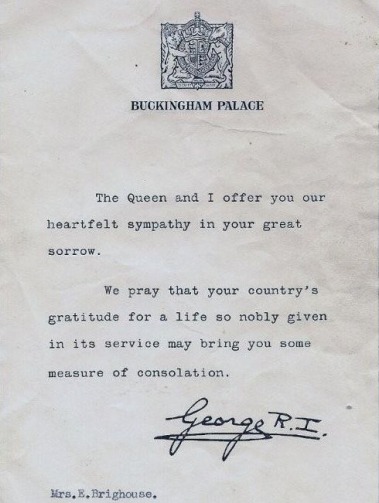
The final decision on the wording was made by Dr Montague Rhodes James, the author M.R. James, Provost first of King's College, Cambridge and then of Eton. The scroll acknowledges the fortitude and endurance of the men and asks the future to ensure that their names are not forgotten . There is no expression of gratitude, this had come in the letter of condolence from King George V that followed receipt of the news of the casualty's death:
"The Queen and I offer you our heartfelt sympathy in your great sorrow.
We pray that your country's gratitude for a life so nobly given in its service may bring you some measure of consolation.
George R.I."
And with a note from the King accompanying the memorial plaque all next-of-kin received once the war was over.
"I join with my grateful people in sending you this memorial of a brave life given for others in the Great War.
George R.I."


LET THOSE WHO COME AFTER
SEE TO IT THAT HIS NAME
BE NOT FORGOTTEN
SERJEANT DANIEL SMITH
Not only did the relatives of the dead receive a memorial plaque and a letter from the King but also a memorial scroll. The wording on the scroll had been very difficult to compose: Rudyard Kipling, Montague Rhodes James and King George V all made their suggestions. Charles Keary finally modified the last lines, changing them from, "The remembrance of them shall long be honoured in the land which they loved and died to save," to, "Let those who come after see to it that his name be not forgotten". Judging by their popularity as an inscription, the words obviously struck the right cord. The whole scroll reads:
He whom this scroll commemorates was numbered among those who, at the call of King and Country, left all that was dear to them, endured hardness, faced danger, and finally passed out of the sight of men by the path of duty and self-sacrifice, giving up their own lives that others might live in freedom
Let those who come after see to it that his name be not forgotten.
There is an excellent article on the plaque, letter and scroll at www.greatwar.co.uk