Sacrifice
A HUMAN SACRIFICE
ON THE ALTAR OF DUTY
PRIVATE EDWIN MARTIN
On the 28 March 1918 the 40th Battalion Australian Infantry were rushed up to the front to try and close the gap that was developing between the British 3rd and 5th Armies under pressure from the German offensive. The Germans were held for a short while but eventually the Australians were forced to withdraw, having suffered huge casualties, among them Private Edwin Martin.
Martin was first treated for a fractured femur, and for gun shot wounds in his thigh and side at a Field Ambulance on the 28th. He was passed the same day to a Casualty Clearing Station. Four days later he was admitted to a hospital in Etaples. Here his left leg was amputated but he died that same day, 1 April 1918.
Martin's brother, Howard Martin, chose his inscription - who was sacrificing who? Christ sacrificed himself on the cross to save mankind. I would suggest Edwin Martin sacrificed himself.
There was no conscription in Australia, every Australian soldier was a volunteer. It was a deeply controversial issue but despite there being two referendums on the issue, the public never voted for it. Martin enlisted on 14 November 1916, just two weeks after the first referendum had voted 1,087,557 in favour and 1,160,033 against; a majority of 72,476 against conscription. Martin sacrificed himself for what he saw as his duty.
HE GAVE HIS LIFE
THAT WE SHOULD LIVE
PRIVATE ALBERT WELLINGTON JARMAN
Albert Wellington Jarman was born in Leicester and died in Leicester thirty years later. In the intervening years he had gone to Canada to live and work, returned to Europe to fight, and come back to Leicester to die. He is buried in the Commonwealth War Graves Commission's section of Leicester's Walford Road Cemetery, which is less than a mile from his father's home in Havelock Road.
Albert's parents were William and Priscilla Jarman. William Jarman was a shoe maker - as was much of the population of Leicester. Priscilla died and in 1896 William remarried. Eleven-year-old Albert was still living at home with his father and step-mother in 1901, but by 1911 he had gone to Canada. He settled in Londesborough, a small community in Ontario, from where he enlisted in February 1916, describing himself as a farmer.
Jarman joined the 161st Huron Battalion, part of the Western Ontario Regiment. On the night of the 9 October 1916 the 777 Huron County men of the 161st Battalion dined, drank and danced at the Bedford Hotel and the Oddfellows Hall in Goderich before marching to the station the next day and embarking for Europe - 551 of them would not return.
Jarman died on 1 April 1919, almost five months after the end of the war. His death is described in the cemetery register as 'following wounds'. Unfortunately that is all I have been able to discover about his death. There is no indication as to where or when he was wounded, nor the nature of the wounds. However, for general purposes the war was deemed to have ended on 31 August 1921. This meant that those who died of wounds incurred during their military service before that date are counted as having died during the First World War.
I don't imagine that Jarman died at home. Leicester was the location of the 5th Northern General Hospital, which had more than 2,600 beds and occupied several buildings in Leicester and North Evington. It admitted more than 95,000 casualties during its existence, of which 514 had died. Some of these will be among the 344 casualties buried in the Walford Road Cemetery; perhaps one of them was Alfred Jarman.
Alfred's father chose his inscription - 'He gave his life that we should live'. This is very close to the opening line of a poem by someone who was probably the most popular poet of the First World War, and is probably someone you have never heard of - John Oxenham, the pseudonym for William Arthur Dunkerley (1852-1941).
They died that we might live,
Hail and Farewell!
- All honour give
To those who nobly striving nobly fell,
That we might live!
The poem is a strange combination of the Roman poet Catullus's lovely tribute to his brother's grave, Ave Atque Vale, and the Christian concept of sacrifice. Christ's sacrifice for mankind was equated in many people's minds with the sacrifice the hundreds of thousands of young men made who died for the safety and security of the British Empire. According to the narrative, they 'gave' their lives so that people might be able to live - to live free from the threat of German militarism.
This inscription will feature as part of the Global War Graves Leicester project, which aims "to explore and bring to light how the 298 First World War casualties came to be buried in the cemetery, how their identities were negotiated in death; and how even the British burials alongside them also had connections throughout and beyond the UK. The purpose of this research will be to challenge and expand our understandings of the relationship between local and global in terms of Leicester and the First World War".
GOD GRANT THE SACRIFICE
BE NOT IN VAIN
SECOND LIEUTENANT THOMAS GEORGE MAY
This is another quotation from one of John Oxenham's poems. It comes from Epilogue 1914 published in All's Well Some Helpful Verse for these Dark Days of War. Oxenham blames the Kaiser for the war:
Thy slaughterings, - thy treacheries, - thy thefts, -
Thy broken pacts, - thy honour in the mire, -
Thy poor humanity cast off to sate thy pride; -
'Twere better thou hadst never lived, - or died
After several verses of accusation Oxenham asks, in capital letters, 'AND AFTER .......... WHAT?'
God grant the sacrifice be not in vain!
Those valiant souls who set themselves with pride
To hold Thy ways ... and fought ... and died, -
They rest with Thee.
So Mrs May, who chose her son's inscription, is taking comfort from Oxenham's assurance, that, 'no drop of hero's blood e'er runs to waste' because God, in His acknowledgeably obscure ways, will use it to ensure 'nobler doings', 'loftier hope' and 'all-embracing and enduring peace'.
Thomas May originally served as a private with the Ceylon Planters Rifle Corps, a volunteer reserve regiment based in Kandy, Sri Lanka, then Ceylon, which was made up of European tea and rubber planters. As, apart from his birth in Chertsey in 1891, there is no mention of either him or his parents in any of the census records, I am assuming that he grew up in Ceylon. He served with the Planters, guarding the Suez Canal, from 7 November 1914 until they were then sent to Gallipoli the following summer. In July 1916 he was commissioned into the Machine Gun Corps and was serving with the 143rd Company when he was killed in action on the 6 August 1917.
A WILLING SACRIFICE
FOR THE WORLD'S PEACE
SECOND LIEUTENANT WILLIAM KEITH SEABROOK
This inscription - "A willing sacrifice for the world's peace" - is a phenomenally magnanimous comment from the mother who had three sons killed on two consecutive days in September 1917: George Ross Seabrook and Theo Leslie Seabrook on 20 September and William Keith Seabrook on the 21st. But to whom does the word sacrifice refer? I think it has to be her son, William Keith Seabrook - and by implication her other sons - since they were the ones who volunteered to go and fight, who offered themselves willingly. There was no conscription in Australia so they were definitely volunteers.
An Australian Red Cross and Wounded Enquiry Bureau search was instituted within weeks of the brothers' deaths but it was never easy to find out exactly what happened to any one person in the heat of a battle, let alone three. Some reports say that all three brothers were killed by a single shell but others give more convincing accounts, like Private Cooper:
"T.L. Seabrook was killed by the same shell that wounded me, in fact I fell across him when I was hit. He was killed instantaneously. We were in a trench just this side of Polygon Wood, it was about 9 am."
Private Arnold gives slightly more gruesome details:
"Hit by shell head and stomach and legs. Died very soon after. He was badly hit. I saw him hit. Don't know whether he was buried. He was a friend of mine."
And Private Marshall gives a sequence to the deaths since it was whilst he was talking to George Seabrook that George:
"pointed out his brother Theo Leslie Seabrook's body lying on the ground. He had been killed by a shell. Informant states that another brother, Second Lieutenant William Keith Seabrook had been killed still earlier in the day, and that the Lieutenant had been his officer."
Neither George Ross nor Theo Leslie have graves and both are commemorated on the Menin Gate. William Keith, who had been wounded but not killed on the 20th, was taken to No. 10 Casualty Clearing Station in Lijssenthoek where he died the next day. All three brothers had been involved in the opening day of the Battle of Menin Road, the Australian Infantry Divisions' first action in the Third Ypres campaign.
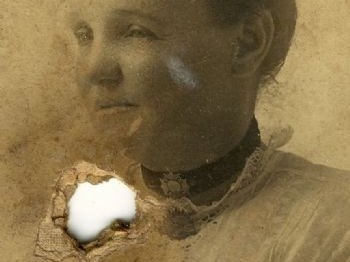
Look up images of the Seabrook brothers on the Internet and you will find one of all three of them in uniform, presumably on the eve of their departure from Australia since they all left Australia on board HMAT Ascanius on 25 October 1916. And there is another photograph too, this one was found on William Keith's body, it is a photograph of his gentle-looking mother which has a bullet hole through the bottom left-hand corner
A MOTHER'S SACRIFICE
FRANCIS JOHN COOMBES
Jack Coombes, a painter from Newtown, Sydney, New South Wales, was born in England in Luton, Bedfordshire. He emigrated to Australia with his parents in 1898 when he was 6. I can't tell whether his father was still alive at the time of his death, nor whether he had any brothers or sisters. It was his mother who was described as his next of kin, she also filled in the circular for the Roll of Honour of Australia and instituted a search via the Australian Red Cross Wounded and Missing Enquiry Bureau. While two witnesses say that he was sniped "through the forehead, death being instantaneous", another man, who looks as though his name was Company Sergeant Major H.S.A. Creehy, has another tale to tell; you can decide whose is the most likely.
"Informant states that on 31/9/18 the Battalion was holding the line in a trench at Villers Bretonneux. About mid-day when they were resting in a trench Coombes was hit by a shell and died about two minutes afterwards. Informant was with him when he died. He was conscious and asked informant to remember him to his mother. Informant saw him fall, being only about 4 yards away from him at the time and had been speaking to him just before. Informant added that Coombes was a fine fellow and was well liked by his men. If Coombes' mother cares to write to him he will go and see her if she lives in Sydney."
I have a feeling that the informant (Creehy?) was a very kind man and that he possibly knew there was a close relationship between mother and son. If so he hoped her son's 'last words' would bring her comfort.
HE MADE THE GREAT SACRIFICE
MY ONLY SON
LANCE CORPORAL S.J. CLEGG
The Great Sacrifice by James Clark, painted in 1914, shows a dead British soldier lying out on the battlefield at the foot of a ghostly image of Christ on the cross. The message is obvious - the soldier's sacrifice and Christ's are as one. The painting was sold to raise money for a war relief charity and Queen Mary bought it for her husband's aunt, Princess Beatrice, whose son, Prince Maurice, had been killed on 27 October. The painting hangs as a memorial to him in St Mildred's Church Whippingham on the Isle of Wight.
Numerous prints were made from the painting, and several of them can still be found in churches where they were hung in memory of the dead. The painting was also the inspiration for many memorial stained glass windows.
Mrs ME Franklin, Lance Corporal Clegg's mother, chose the inscription. I have not been able to discover either his Christian names or his age.
Paul Breen has written an article about the painting on the Imperial War Museum War Memorials Archive Blog.

LOVE MEANS SACRIFICE
Unidentified
In 1914, John Scott was a barrister at the Inner Temple who had served as a regular officer with the Royal Artillery in the South African War. He retired in 1908. but joined the Queen's Own Oxfordshire Hussars with the rank of Captain. When the war broke out he went to France with the regiment in September 1914. In January 1916 he was gazetted Lieutenant-Colonel in the Somerset Light Infantry and was killed leading them in an attack during the Battle of the Scarp on 23 April 1917.
His adjutant, who was wounded beside him, later wrote to Scott's wife to tell her what had happened.
"We took part in a big attack last Monday, the 23rd; we started at 4.45 am, and our Battalion was in support of the 4th Middlesex. At the start the attack went off fairly well, although the Germans had quite a lot of artillery opposite us, and the barrage was accurate. We were held up by machine-guns before reaching the road running between Roeux and Gavrelle, and we were in shell holes all the morning till about 1 pm, by which time the strong point which had held us up was cleared of all the Germans in it. We then advanced about 300 yards and were preparing to push on to what is called Greenland Hill. We then used our glasses standing up in a shell hole, and the Colonel was killed instantaneously by a sniper."
Memorials of Rugbeians Who Fell in the Great War
Volume IV
John Scott's inscription was chosen by his wife. 'Love is sacrifice'. John Scott sacrificed his life for the love of his country. Madeline Scott may have felt that she had sacrificed her husband. It's certainly what many next-of-kin felt, as Harry Lauder wrote after visiting his son's grave.
" And my own grief was altered by the vision of the grief that had come to so many others. Those crosses, stretching away as far as my eye could reach, attested to the fact that it was not I alone who had suffered and lost and laid a sacrifice upon the altar of my country."
A Minstrel in France
Harry Lauder 1918
HE HUMBLED HIMSELF
BECOMING OBEDIENT UNTO DEATH
PRIVATE THOMAS PERCEVAL BLAKEMAN
This inscription quotes Philippians 2:8.
And being found in fashion as a man, he humbled himself, and became obedient unto death, even the death of the cross.
The concept might have been doctrinally completely unsound but this did not stop families equating the sacrifice their menfolk had made with that of Jesus Christ. Christ had died to save mankind on the cross, these men had died to save mankind on the battlefield. Sir John Arkwright's poem, O Valiant Hearts, encouraged the view:
All you had hoped for, all you had you gave,
To save mankind - yourselves you scorned to save.
... Christ our redeemer passed the self same way.
SACRIFICED
PRIVATE SIDNEY JOHN CANNELL
This is a difficult inscription to gauge. At first sight it looks like a bitter criticism of Private Cannell's pointless death, but perhaps that is to be reading it with our twenty-first-century preconceptions. Sidney Cannell was wounded on 1 November in the desperate fighting around Ypres as the Germans pushed again and again to break the British lines. His wife chose his inscription. I wonder if she was simply acknowledging that something she held very dear had had to be given up for the greater good, which is the meaning of sacrifice, rather than that her husband was the victim of a callous military command.