Spoken By Dead Man
Read the article: Spoken By Dead Man
HIS LAST MESSAGE
"I WOULD NOT HAVE MISSED IT
FOR ANYTHING"
PRIVATE HENRY JAMES HEWETT
James Hewett had been a member of the Berkshire Yeomanry since he'd served with it in the Second South African War 1899-1902. In civilian life he was a sugar boiler in a confectionery factory but he remained a member of the Yeomanry, which became a Territorial force in 1908. At the outbreak of the First World War he opted for imperial service and was posted to Egypt with the 2nd Mounted Division in April 1915. Four months later the regiment was sent to Gallipoli where it served dismounted until the evacuation in January 1916. In March 1916 the regiment became part of the 6th Mounted Division, and in April 1918 it merged into the 17th Squadron Mounted Machine Gun Corps.
Hewett served with the Division in Egypt and Palestine until his death, taking part in all three battles of Gaza and in the capture of Lebanon in October 1918. For those who served in this part of the world, it was a totally different war from the Western Front - for the most part it was a war of movement, hot, dangerous, dusty and exhausting, but presumably for someone like Hewett exciting too. As he told his family, "I would not have missed it for anything".
The information on his medal card says that Hewett 'died', as opposed to 'died of wounds' or 'killed in action'. Like so many soldiers who served in that part of the world he could have died of dysentery or heat exhaustion or from the flu pandemic that was sweeping the world at the time.
Born in St John's Wood in 1891, Henry James Hewett was the son of Charles Hewett, who died in 1890, and his wife, Mathilda. Before his father's death the family lived at Uxmore Farm, Ipsden, which was then in Berkshire. Perhaps this is where Hewett acquired his skills in horsemanship.
HIS LAST MESSAGE
"I DIED DOING MY DUTY"
PRIVATE NORMAN JOHN WARREN HOFFMEYER
What is duty? For some people today it has become synonymous with the word chore, but that is not how men like Private Hoffmeyer saw it. To them 'duty' was something you owed, in this case to your country, something you felt to be morally right despite the fact that it might involve self-sacrifice. There was no conscription in Australia so those who volunteered did so for any number of reasons, which in Norman Hoffmeyer's case amounted to a sense that it was his duty to do so.
Hoffmeyer, a farmer from Bendigo in Victoria, enlisted in September 1916, admitting that he had previously been rejected on the grounds of 'bad feet'. He served at the front from March 1917 except for two weeks in June 1917 when he was wounded, and two weeks in Britain in March 1918 when he was on leave.
On the 31 August 1918 at 4.20 am, the 38th Battalion took over the front line near the Canal du Nord prior to an attack. The war diary reported that at 3.15 pm the 37th Battalion moved through to continue the attack and the 38th went into reserve. 'Moved through' gives a hint as to how the fighting in August had changed from the trench warfare of the past four years, so do the diary's references to 'semi-open' and 'rapidly moving' warfare.
There is no indication as to how Hoffmeyer met his death. His family did not request information from the Australian Red Cross perhaps because, as his inscription suggests, someone was with him when he died who passed on the information. This suggestion is supported by a chance discovery in 2007. Two cousins, sorting out a shed in the family property on the outskirts of Bendigo, came across a collection of First World War photographs that had been taken by their fathers, Jack and Bert Grinton. The brothers served with the 38th Battalion and among the images in the collection is one of Hoffmeyer's grave, marked with a wooden cross. Evidence perhaps that Hoffmeyer was among friends when he died.
BETTER A WOODEN CROSS
THAN BE ONE
WHO COULD HAVE GONE
AND DID NOT
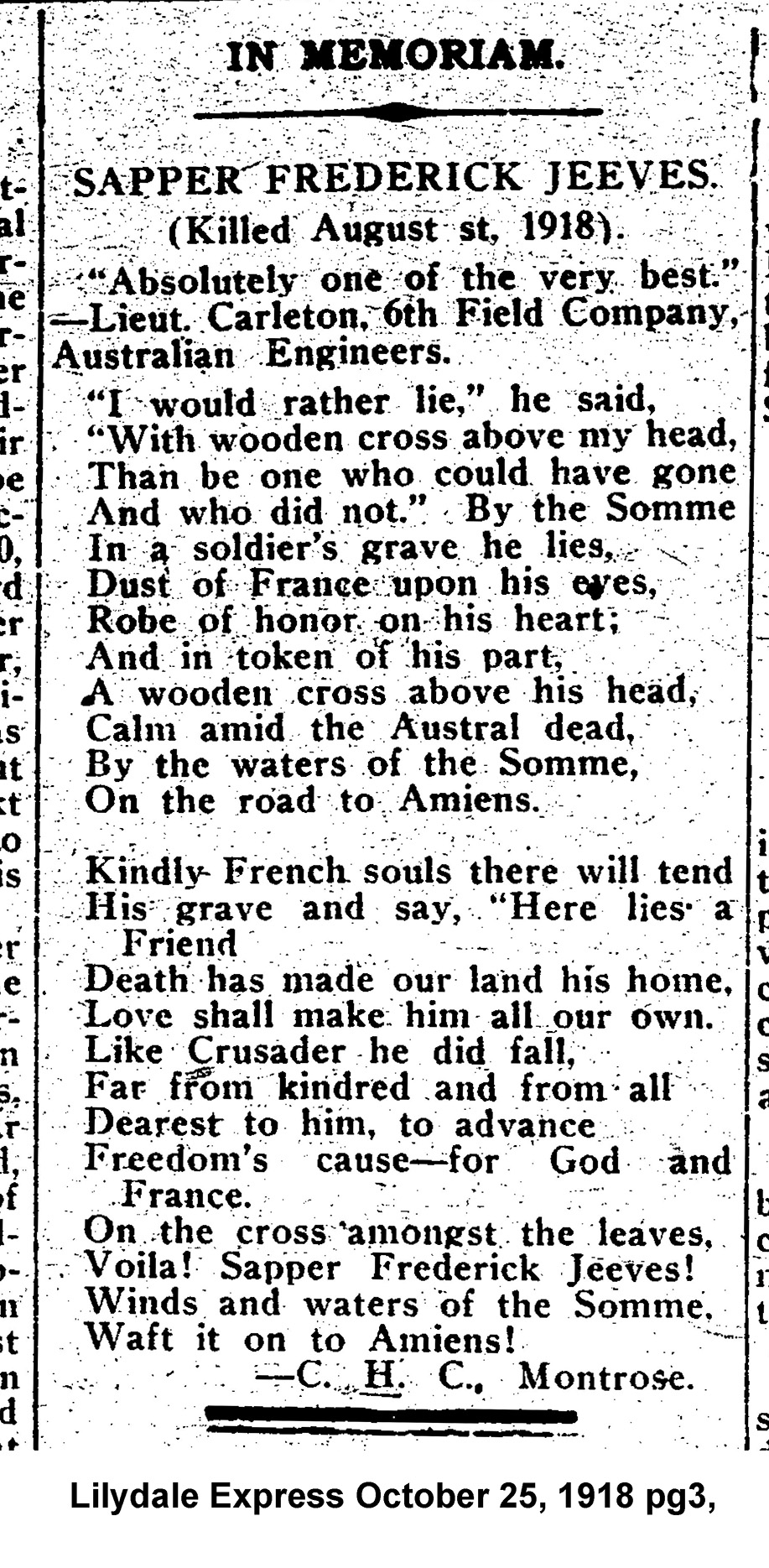
SAPPER FREDERICK WILLIAM JEEVES
Sapper Jeeves' wife chose his inscription. She took the words from a letter he had written from the front, which she quoted when she filled in the circular for the Roll of Honour of Australia:
"I would rather lie with a little wooden cross above my head, than be one of those who could have gone and did not."
The words inspired his brother-in-law, Clarence Herbert Cazaly, to write 'In Memoriam Sapper Frederick Jeeves'. The poem, published in the Lilydale Express on 25 October 1918, begins with the same sentiment:
"I would rather lie," he said,
"With wooden cross above my head,
Than be one who could have gone
And who did not." By the Somme
In a soldier's grave he lies,
Dust of France upon his eyes,
Robe of honour on his heart;
And in token of his part,
A wooden cross above his head,
Calm amid the Austral dead,
By the waters of the Somme,
On the road to Amiens.
Jeeves, a motor mechanic and garage proprietor from Croydon, Lilydale, Victoria, joined up on 1 February 1916 and embarked for Europe on 28 July that year. His inscription has to be seen against the background of Australian resistance to the introduction of conscription. He served with the 6th Field Company Australian Engineers and was killed on 1 August 1918, as reported in the War Diary:
No.4 Section, while building S.P. Shelters for 22nd Battalion in railway cutting at O.28.c.3.8. came in for a heavy "area shoot", Sapper F.W.Jeeves being killed and Sapper H.Q. Boutchard wounded.
Jeeve's platoon commander, Lieutenant Carleton, described him as, "Absolutely one of the very best".
I HAVE ONLY DONE MY DUTY
AS A MAN IS BOUND TO DO
"GIBBIE"
PRIVATE JOHN GILBERT GILL
"Gibbie", Private John Gilbert Gill, served with the 4th London Divisional Field Ambulance and was killed in action on 8 August 1917. His father signed for his inscription, quoting his son's own words; words that will have summarised what motivated hundreds and thousands of other young men - their duty.
Gill had been a clerk in a felt factory before the war. He volunteered in March 1915, which meant that he volunteered to do his duty rather than that he was conscripted to do it. Some RAMC men were conscientious objectors who accepted non-combatant work in the RAMC but this would seem to be unlikely in Gill's case. And even if this was the case, service with the RAMC did not keep you out of danger.
FATHER AND MOTHER
WEEP NOT FOR ME
NOR WISH ME BACK AGAIN
DRIVER JAMES BUSHBY
The State Library of Western Australia has a collection of photographs entitled the Bushby Collection of Rosedale Farm, Cuballing, Western Australia. This is Driver James Bushby's family. James Bushby Senior arrived in Australia in 1885. His wife, Honour, came the following year with with their two children: Annie and her younger brother James Junior. In November 2015 the Cuby News, which covers the communities of Cuballing, Popanyinning and Yornaning, published an article by Stephen Bowes on the family and the sons who went to war.
Jim enlisted on 24 June 1915 at the height of the Gallipoli campaign, embarking from Australia on 18 November. The transport arrived in Suez in December by which time the Gallipoli Campaign was winding down. Bushby joined the 54th Battery Australian Infantry and went with them to France, arriving in June 1916. By the summer of 1917 the Battery were in Flanders. Bushby was killed on 12 August. His death is not mentioned by name in the war diary but it does record two soldiers killed that day.
Two other brothers also served, Fred was badly wounded in the chest in September 1917. After being hospitalised in England, he eventually returned to the front but in September 1918 went absent without leave. He was arrested five days after the war ended and sentenced to seven years penal servitude. This was suspended in April 1919 after he had spent some months working for the AIF Graves Detachment. The other brother, Alf, was also wounded and had a leg amputated.
Mrs Bushby chose her son's inscription, presumably quoting her son's sentiments if not his actual words: Father and mother weep not for me nor wish me back again.
IT IS MEN
OF MY AGE AND SINGLE
WHO ARE EXPECTED
TO DO THEIR DUTY
PRIVATE WILLIAM HENRY RICKARD
William Rickard's father chose his inscription: the words have to have been his son's. Rickard volunteered at Blackboy Camp, Western Australia in April 1916; he was 24. He served with the 24th Battalion Australian Infantry, originally raised in Blackboy in April 1915. Rickard went out with the 16th reinforcements.
By 1916 Australian recruitment was beginning to dry up, so much so that in October 1916 the Government tried but failed to introduce conscription - it lost the referendum 49%-51%. Rickard had not volunteered initially but you can see how his mind was working by April 1916.
He arrived in France on 22 December 1916 and was wounded in the thigh three months later. Hospitalised in England, he rejoined his battalion in August 1917. The battalion took part in the attack on Broodseinde Ridge on 4 October 1917 where Rickard was again wounded. He died the same day at No. 10 Casualty Clearing Station, Lijssenthoek of 'shrapnel wounds on the head'.
Rickard, an engine driver from Fremantle, Western Australia, was his parents only son.
IF I DO NOT COME BACK
I AM NOT AFRAID TO DIE
LIEUTENANT ELLIOT ADAMS CHAPIN
Oh my goodness - read this!
On June 27, while bombing Thionville, he was engaged in combat by a German plane at a height of thirteen thousand feet; an incendiary bullet pierced his petrol tank, and his machine fell in flames. His friend, Lieutenant Walker, of the same squadron (the 99th), who was only fifty feet away from Lieutenant Chapin when he fell, wrote:-
"When he saw death staring him in the face, I saw him turn round to his observer, reach out his hand, and shake hands with him. He died a hero's death, unafraid, and was a son for any parents to be proud of. ..."
[Quoted from Phillips Academy Andover in the Great War]
"When he saw death staring him in the face, I saw him turn round to his observer, reach out his hand, and shake hands with him." RAF pilots and their observers did not carry parachutes until September 1918. It was known that if a plane was hit the wood and doped canvas would burn like a torch. It was a horrible way to die and some pilots apparently carried guns in order to shoot themselves rather than burn to death. In the face of certain death, Chapin turned round and shook his observer's hand ... it doesn't bear thinking about. But as his inscription says, 'I am not afraid to die'.
Elliot Adams Chapin was an American citizen, born in Massachussetts to American-born parents. Whilst still at Harvard, he enlisted in the British Royal Flying Corps in September 1917. After training in Canada and Texas, he sailed for England early in 1918. In France he joined 99 Squadron flying DH 9 bombers and was shot down returning from a bombing mission on the railway at Thionville.
MY LIFE I GAVE
FOR MY COUNTRY'S GOOD
& THEY TOOK IT FROM ME
WHERE I STOOD
PRIVATE HARRY WILFRED PAYNE
This inscription, which appears in Trefor Jones' On Fame's Eternal Hunting Ground, has a ring of Kipling's famous epitaph:
I could not look on death, which being known,
Men led me to him, blindfold and alone.
Harry Payne was a volunteer - My life I gave for my country's good - but who were the "they" who took his life from him "where I stood?" Was he bound to a post and executed? As it happens, the Australian Red Cross Wounded and Missing Enquiry Bureau has the answer. Payne's family wrote to enquire about the circumstances of his death and the Bureau learnt from a witness, Private A Wolland, that:
"There was a lull in our fighting at the time and Payne was looking over the parapet pointing out something in the German lines to a comrade. While his head was exposed he was struck by a rifle bullet from a German sniper. He was wearing a steel helmet but the bullet went right through ... he was removed to a dressing station in the rear of our lines, but died on the way there."
Few families knew the exact circumstances of their relation's death but the Payne's did and reflected it in their son's inscription.
IF I FALL
I SHALL HAVE DONE
SOMETHING WITH MY LIFE
WORTH DOING
PRIVATE GEORGE LAWRENCE HOLMDEN
George Holmden's father used his son's own words for his epitaph. Twenty-year-old George, a piano stringer from Grenfell, Quebec, volunteered on 16 September 1914. Both his parents had been born in Britain, emigrating to Canada in September 1877. Many of the earliest Canadian volunteers were young men who had been born in Britain; George Holmden, who was also an early volunteer, was born in Montreal.
"I MUST GO!
I AM ASHAMED TO BE SEEN
WITHOUT A SOLDIER'S UNIFORM"
PRIVATE ALFRED KINGSNORTH MALLYON
This is a difficult inscription. It was chosen by Private Mallyon's father and as the words are in quotation marks they presumably belong to Private Mallyon himself. I used to think that he must have been admitting to having been constrained by public opinion into enlisting. However, I now don't think this can be the case. If it was, why did his father say on the form for the Roll of Honour of Australia that his son had been deeply impressed by the tombs of "England's noble sons" in St Paul's Cathedral and Westminster Abbey. Alfred had gone on to tell his father that, when you remember what they stood for, coupled with the high traditions of our country "one needs no further inspiration to fight for them, and if need be lay down one's life for them". Maybe the two sentiments - headstone inscription and Roll of Honour quote - are not incompatible, but if so the former is easily misunderstood without the latter.
WE WILL GO FORWARD
AT WHATEVER COST,
QUIETLY, UNTIRINGLY
UNALARMED
CAPTAIN CHARLES HUNTER BROWNING
Captain Browning, a professional soldier, was educated at Eton where he had been not only a King's Scholar and Captain of School but also a fine cricketer whom Wisden described as "a stubborn batsman and an excellent wicketkeeper with a quiet style".
His inscription displays the same quiet style and sounds as though it comes from something that Browning wrote or said himself - a letter, a diary entry or perhaps, and most likely, his instructions to his men on 26 August as the British II Corps were ordered to take a stand at Le Cateau in order to delay the oncoming German 1st Army.
The British were heavily outnumbered and exhausted after their defeat at Mons on the 23rd, since when they had been retreating with scarcely any rest. Browning, was a professional soldier. He joined the army in 1898 and served throughout the South African War. His words sound as though they come from someone who knows the odds: "We will go forward at whatever cost, quietly, untiringly, unalarmed".
Browning was killed when his battery came under direct fire from German artillery. Although British casualties were very heavy, and they were forced to withdraw by mid-afternoon, the delay at Le Cateau is considered to have made a significant difference to the ultimate outcome of the war.